2026 Distinguished Industry Scholar Lecture Series: Prof. Dennis S. Nielsen, Member of the Danish Academy of Technical Sciences, Explores New Strategies for Gut Microbiome Manipulation
On the morning of 29 October 2026, the latest session of the Distinguished Industry Scholar Lecture Series of the School of Biology and Biological Engineering was held as scheduled in Meeting Room B6-207. At the invitation of Prof. Deng Ling, Prof. Dennis S. Nielsen, member of the Danish Academy of Technical Sciences and professor at the University of Copenhagen, visited the School and delivered a lecture entitled “The role of bacteriophages in the gut - and their potential use for gut microbiome manipulation”. The lecture was chaired by Prof. Deng Ling, with faculty and students of the School taking an active part.
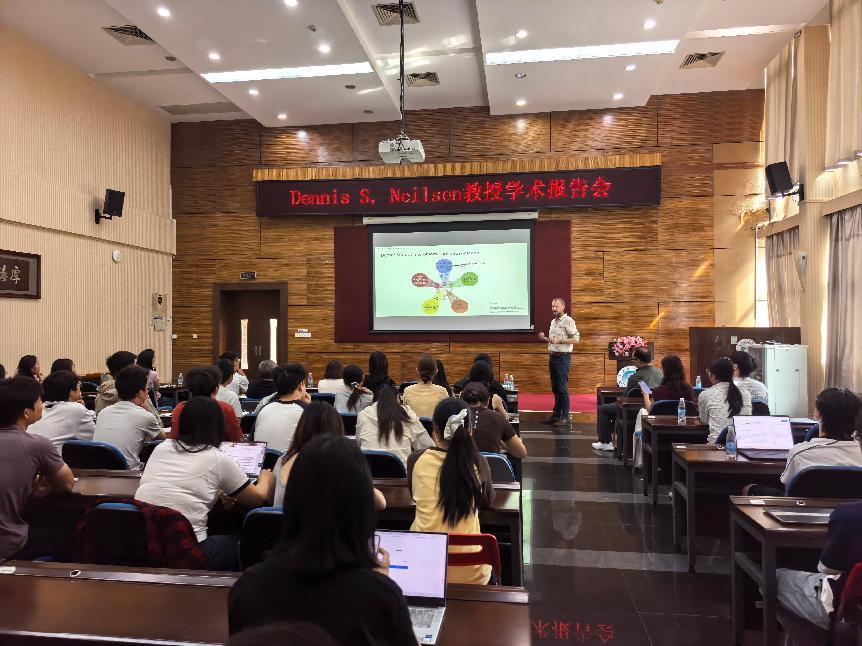
Prof. Dennis S. Nielsen of the University of Copenhagen delivering the lecture
Prof. Nielsen began by examining the relationship between gut microbiome dysbiosis and the onset of disease. He noted that dysbiosis of the gut microbiota has been found to precede metabolic diseases such as type 2 diabetes, immune diseases such as asthma, and other gut-related disorders. This makes interventions aimed at modulating the gut microbiome particularly attractive. He explained that bacteriophages (commonly called phages) are viruses that attack bacteria in a host-specific manner, and that a growing body of research shows that phages, together with other components of the gut virome, play a key role in shaping the composition of the gut microbiome and thereby influence host health or the trajectory of disease.
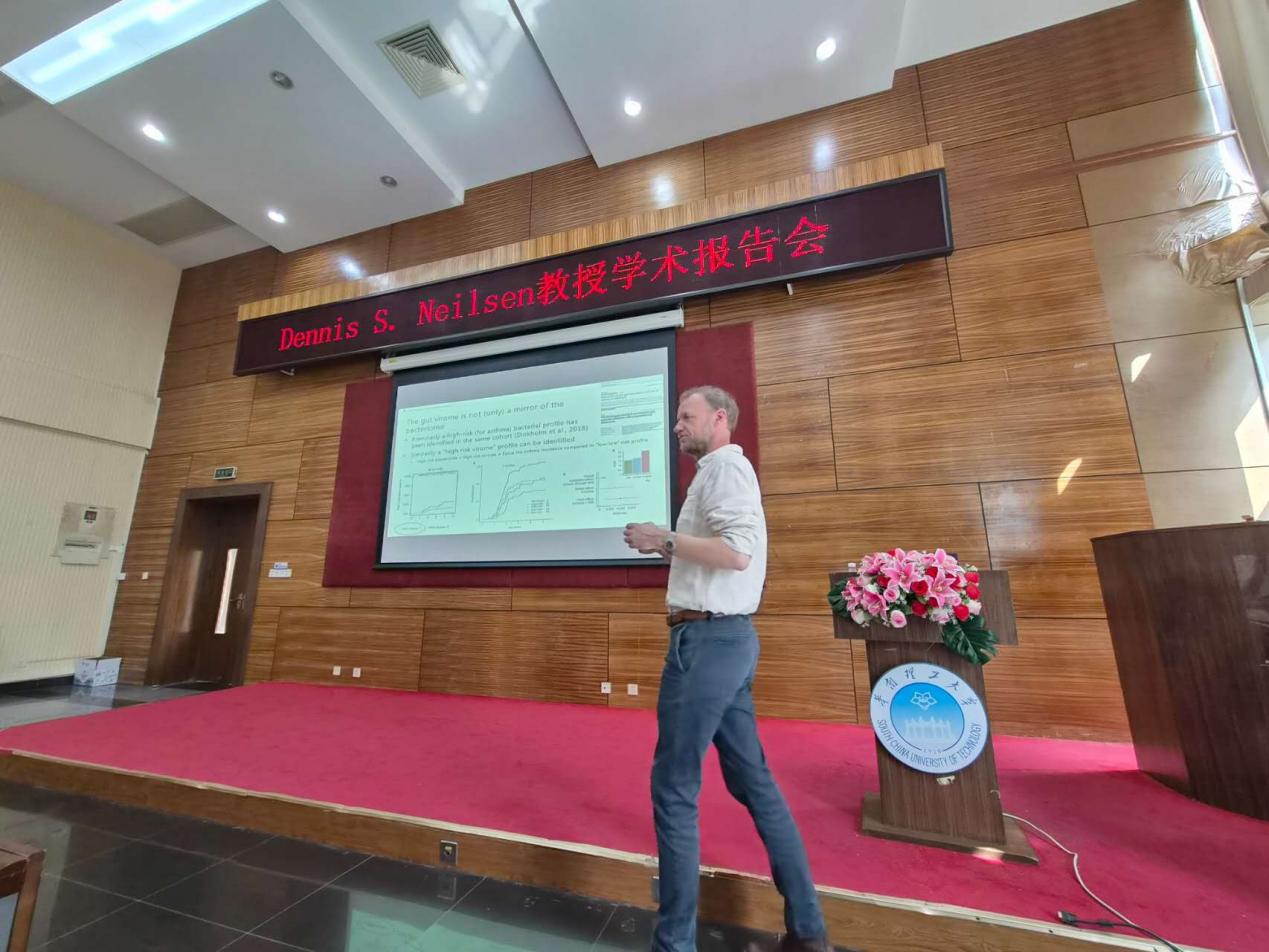
Prof. Nielsen sharing his research findings
Focusing on the role of phages in gut health, Prof. Nielsen systematically reviewed recent advances in the use of phage consortia and even undefined fecal viromes (sterile-filtered feces) to alleviate diseases associated with gut dysbiosis, and gave examples showing their potential to intervene in conditions such as Clostridioides difficile infection, metabolic syndrome and necrotizing enterocolitis. The lecture covered both the frontiers of basic research and key issues in the therapeutic use of phages and the translational application of fecal viromes, offering faculty and students a new perspective on strategies for manipulating the gut microbiome.
After the lecture, Prof. Nielsen exchanged views with the faculty and students present on issues such as the specificity and safety of phage therapy, the design of phage cocktails, the standardization of fecal viromes and the prospects for clinical translation. The atmosphere was lively; students commented that the lecture had deepened their understanding of the research value and application prospects of phages in gut health and disease intervention, and that they had found it highly rewarding.
This lecture was organized by Prof. Deng Ling, who also extended the invitation. The School of Biology and Biological Engineering will continue to invite distinguished scholars from industry and academia to share their latest research findings and research methods, providing a solid platform for faculty and students to engage with cutting-edge academic research.
Appendix: Profile of Prof. Dennis S. Nielsen
Prof. Nielsen is a member of the Danish Academy of Technical Sciences and a professor in the Department of Food Science at the University of Copenhagen. His research has long focused on food microbiology, the gut microbiome and its interactions with host health. His work covers the mechanisms through which various dietary components, prebiotics, probiotics, postbiotics and phages regulate the gut microecology; he combines in vitro models, animal experiments and human intervention studies to systematically explore the associations and mechanisms linking the microbiome to host health. Prof. Nielsen is currently an editor of FEMS Microbiology Reviews and an associate editor of Gut Microbiology. He serves on the committee for the Technical and Production Sciences of the Independent Research Fund Denmark, and has been invited repeatedly to serve as a reviewer of research grants for the United Kingdom, the United States, New Zealand, Belgium, the Netherlands, Sweden, Portugal, Qatar and other countries and regions. As principal investigator, his research has been funded by the Independent Research Fund Denmark, Innovation Fund Denmark, the pharmaceutical company Lundbeck, the Villum Foundation, the Novo Nordisk Foundation, the European Union and a number of companies, with cumulative research funding of approximately DKK 169 million (EUR 22.6 million). In addition, he is actively involved in science communication and public outreach. Through university outreach, science and cultural events, food-themed exchange platforms and other channels, he has given numerous public lectures, continuously promoting the dissemination of scientific knowledge on food microbiology and gut health. To date, Prof. Nielsen has published more than 320 papers in internationally renowned academic journals such as Nature Medicine, Gut, Nature Microbiology, Nature Communications, The ISME Journal, Microbiome and Gut Microbes, with more than 22,000 total citations on Google Scholar and an h-index of 75, and he enjoys broad international academic influence in the fields of food microbiology and the gut microbiome.