Associate Professor Didar Baimanov’s Team Publishes Methodological Article in Nature Protocols: A Strategy for Dynamic Soft Protein Corona Analysis and Receptor Discovery
Recently, Associate Professor Didar Baimanov from the South China University of Technology, in collaboration with teams from Peking University, the Institute of High Energy Physics of CAS, and the Suzhou Institute of Nano-Tech and Nano-Bionics of CAS, published a methodological article in Nature Protocols entitled “Receptor discovery for nanomaterial soft and hard coronas via a biosensor-based Fishing strategy”. This study establishes a broadly applicable and highly standardized experimental system for in situ analysis of nanomaterial protein coronas and receptor discovery, providing a systematic solution for understanding how nanomaterials are biologically recognized in complex physiological environments. Associate Professor Didar Baimanov from South China University of Technology and Researcher Jing Wang from Peking University contributed equally as first authors. Researcher Liming Wang from the Institute of High Energy Physics CAS, and Academician Chunying Chen from the Suzhou Institute of Nano-Tech and Nano-Bionics CAS, served as corresponding authors.
Modern nanomedicine faces a key translational challenge: once nanomaterials enter blood or interstitial fluid, they are rapidly covered by a layer of proteins and other biomolecules, known as the “protein corona”. This endogenous “biological coating” gives nanomaterials a new biological identity and directly affects their biodistribution, clearance, cellular uptake, immune response, and targeting performance. For example, PEGylation is designed to prolong circulation time, but repeated administration may induce anti-PEG antibodies and lead to accelerated blood clearance. Active targeting ligands, such as antibodies or peptides, may also lose recognition efficiency when shielded by the protein corona. Therefore, clarifying how the protein corona regulates receptor recognition is a key issue for the clinical translation of nanomedicines.
The major technical difficulty is that the protein corona has a dynamic layered structure, consisting of a relatively stable hard corona and a weakly bound, highly exchangeable soft corona. Conventional methods such as ultracentrifugation and size-exclusion chromatography may introduce shear force, mechanical compression, or buffer changes, which can disrupt the soft corona and cause the loss of critical information. To address this challenge, the team developed a biosensor-based “Fishing” strategy using biolayer interferometry. This label-free strategy enables real-time monitoring of protein corona evolution under near-physiological conditions. By precisely adjusting the strength of microenvironmental elution, the method enables in situ stepwise separation and identification of soft and hard coronas, preserving the dynamic information of this transient bio-nano interface. This strategy was first reported in Nat. Commun. 13, 5389 (2022).
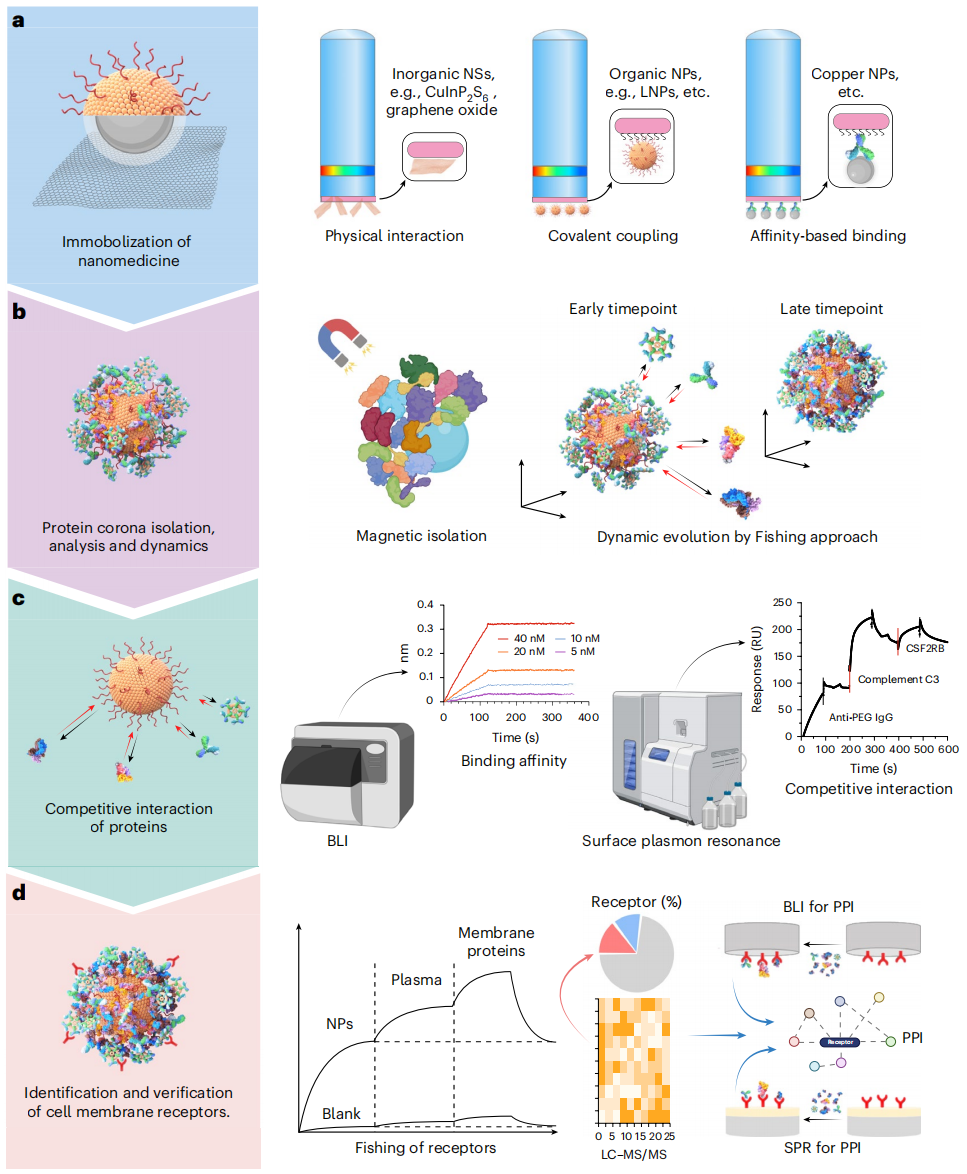
Figure 1. Overview of the method for nanomaterial protein corona analysis and cell membrane receptor discovery.
The newly published Nature Protocols article further develops this strategy into a systematic methodological framework. By integrating biolayer interferometry, surface plasmon resonance, and high-resolution quantitative proteomics, the protocol standardizes three interface-anchoring strategies for different nanomaterials: 1. physical adsorption, which preserves the original physicochemical properties of nanomaterials; 2. covalent coupling, which improves stability under complex fluid conditions; and 3. bioaffinity-based immobilization, which enables specific and oriented surface attachment. The protocol is organized into six standardized procedures: sensor functionalization, real-time protein corona monitoring, soft/hard corona separation, high-resolution mass spectrometry identification, kinetic parameter fitting, and candidate receptor validation. Together, these procedures enable a closed-loop analysis from nanomaterial surface corona composition to biological recognition function.
A key feature of this platform is its bidirectional mapping capability. On the one hand, the nanomaterial protein corona can be used as “bait” to fish unknown cell membrane receptors involved in corona-mediated recognition. On the other hand, known receptors can be immobilized to trace the key protein components recognized from complex plasma. Using this strategy, the team previously identified CSF2RB as a myeloid cell receptor involved in the recognition and uptake of lipid nanoparticle-plasma protein complexes, revealing a molecular pathway by which nanomedicines may be rapidly cleared by immune cells. This work was published in J. Am. Chem. Soc. 147 (9), 7604–7616 (2025).
This standardized strategy is not limited to identifying which proteins are present in the corona. More importantly, it helps reveal how the protein corona communicates with cells. The platform provides a useful methodological tool for nano–bio interface research and may support the rational design of nanomedicines with improved targeting ability, immune compatibility, and in vivo performance.
This work was supported by the National Key Research and Development Program of China, the National Natural Science Foundation of China, the Strategic Priority Research Program of the Chinese Academy of Sciences, the Beijing Natural Science Foundation, the New Cornerstone Science Foundation, and institutional research platforms of the Chinese Academy of Sciences.
Baimanov, D., Wang, J., Chen, C., Wang, L. Receptor discovery for nanomaterial soft and hard coronas via a biosensor-based Fishing strategy. Nature Protocols (2026).