Professors Jianling Xie, Ling Wang, and Hongli Du Published a Collaborative Research Article in PNAS: Targeting Protein Disulfide Isomerases for Prostate Cancer Therapy
Recently, a joint research team led by Professors Jianling Xie, Ling Wang, and Hongli Du from the School of Biology and Biological Engineering, South China University of Technology (SCUT), published a research paper entitled “Protein disulphide isomerases regulate androgen receptor stability and promote prostate cancer cell growth and survival” in the internationally renowned journal Proceedings of the National Academy of Sciences (PNAS). Their study discovered that prostate cancer can be treated by targeting the formation of protein disulfide bonds in proteins from prostate cancer cells. Professor Jianling Xie is both the first and corresponding author of the paper. The School of Biology and Biological Engineering, SCUT, is the primary corresponding institution.
Online article link: https://www.pnas.org/doi/10.1073/pnas.2509222122
Background
Prostate cancer is one of the most common malignancies in China and worldwide in men. Growth and metastasis of prostate cancer is driven by abnormal activity of the androgen receptor (AR). As such, AR-targeted therapies are used to treat metastatic prostate cancer. Unfortunately, these therapies are not curative and their failure results in the onset of an aggressive and lethal disease state, termed castration-resistant prostate cancer (CRPC).
Key Findings
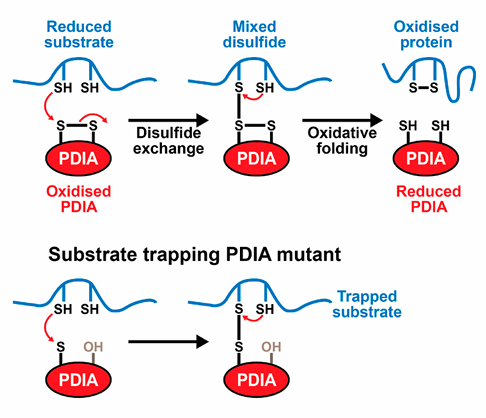
The joint research team from SCUT identified two AR-regulated redox enzymes, protein disulfide isomerases 1 and 5 (PDIA1 and PDIA5), expressed in prostate tumors. Knocking down or inhibiting either enzyme forms a positive feedback loop that affects disulfide bond formation in AR proteins, leading to AR degradation and induction of reactive oxygen species within cancer cells, and effectively suppresses cell growth and promotes death to the prostate cancer cells (Figure 1).
A
 B
B

Figure 1:
A. Schematic diagram showing PDIA-catalyzed protein disulfide bond formation.
B. Illustration of a newly discovered positive feedback regulatory loop between PDIA1/5 and AR.
Research Significance
Globally, frontier research on prostate cancer biology primarily focus on exploring epigenetic and transcriptional changes in the cancer cells during disease progression. However, it remains unclear how protein folding is reprogrammed in prostate cancer cells and how this process affects the global proteomic landscape of tumors. The current study establishes that the PDIAs act as key “folding regulators” that promote oncogenesis, outlining a new research direction in prostate cancer research. Currently, the joint research group is aiming to accelerate the development of new PDIA inhibitors, to provide renovative therapeutic strategies not only for prostate cancer but also for other diseases.
Authors and Fundings
A total of 30 researchers from 18 institutions in both China and Australia participated in this study. Student and postdoctoral contributors from SCUT include:
From Prof. Jianling Xie’s group: Wenken Liang, Zijian Kuang, Meiling He, Sishu Yu, Peiwen Zhou, and Xiang Ao
From Prof. Ling Wang’s group: Liye Chen
From Prof. Hongli Du’s group: Kaijie Chen and Dr. Jinfeng Wei
This work was supported by South China University of Technology’s Double First Class initiative fund, the Program for Guangdong Introducing Innovative and Entrepreneurial Teams (2019ZT08Y318), the Natural Science Foundation of Guangdong Province (2023B1515020042), the Flinders Foundation in Australia, among other relevant research grants.