

INFORMATION CENTER

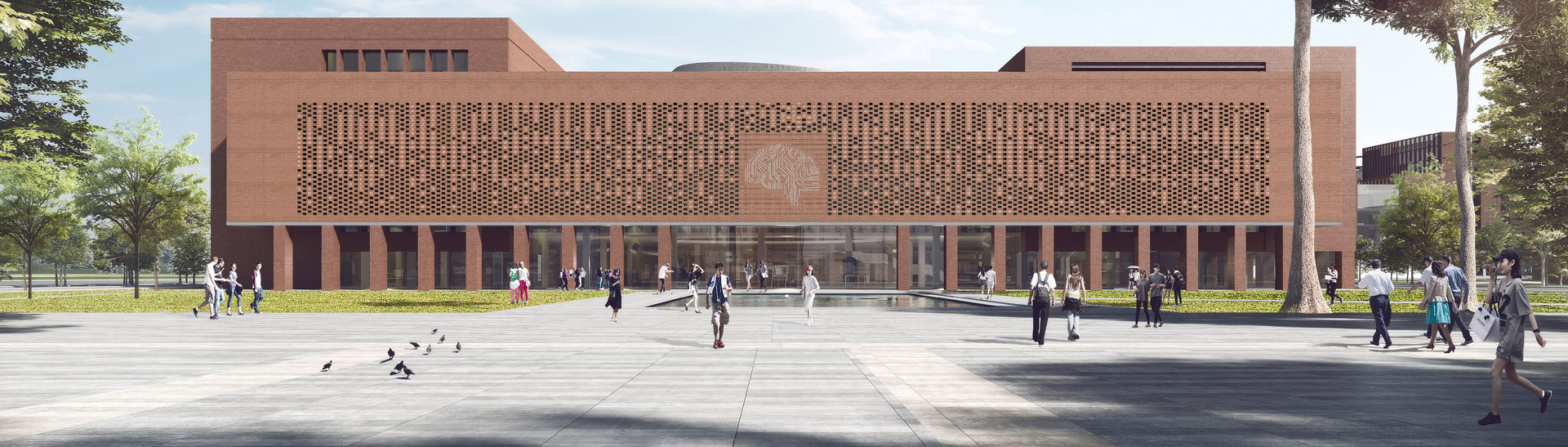
From October 20 to 24, 2026, the 2026 Guangdong–Hong Kong–MacaoGreater Bay Area Embodied Intelligence Robot Competition, themed “Embodied Intelligence Sets Sail, Chasing Dreams in the Greater Bay Area,” was held at the Lingnan National Defense Education Base in Xingning, Meizhou, Guangdong Province. Under the guidance of Academician Chen Xiaoqi, Dean of the Shien-Ming Wu School of Intelligent Engineering, a team composed of Cai Songyin, adoctoral student in the 2025 cohort, and Xu Zikun and Liu Tianzheng,undergraduates in the 2025 cohort majoring in Robotics Engineering, competed inthe Embodied Intelligence Robot Jungle Off-Road Challenge. After fierce competition, the team stood out from 124 teams in this category and won the Gold Award.
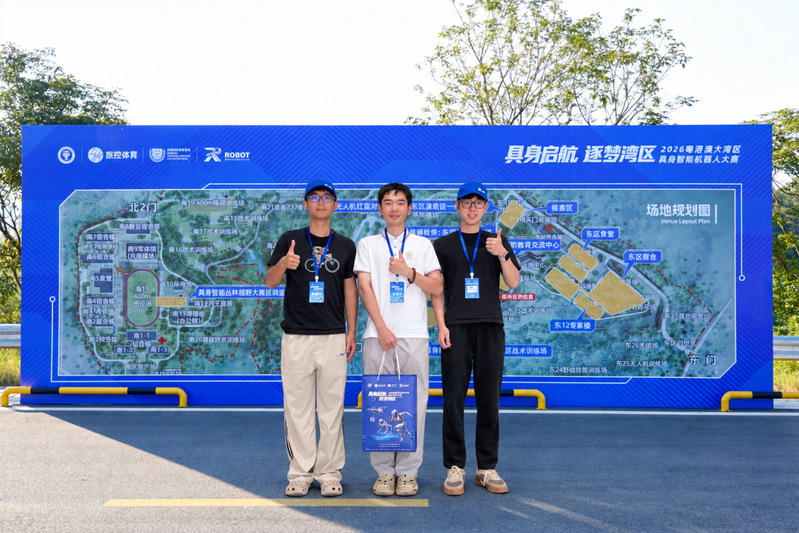
Group Photo of the Competition Team
As a key category of the competition, the Embodied Intelligence Robot Jungle Off-Road Challenge attracted 124 teams. The competition was staged in a real mountainous and jungle environment, with two courses, one for humanoid robots and the other for quadruped robot dogs. Teams were required to complete the competition tasks on each of the two courses, and the assessment focused on their overall capabilities in areas such as locomotion over complexterrain, precise remote operation, task execution, and teamwork.
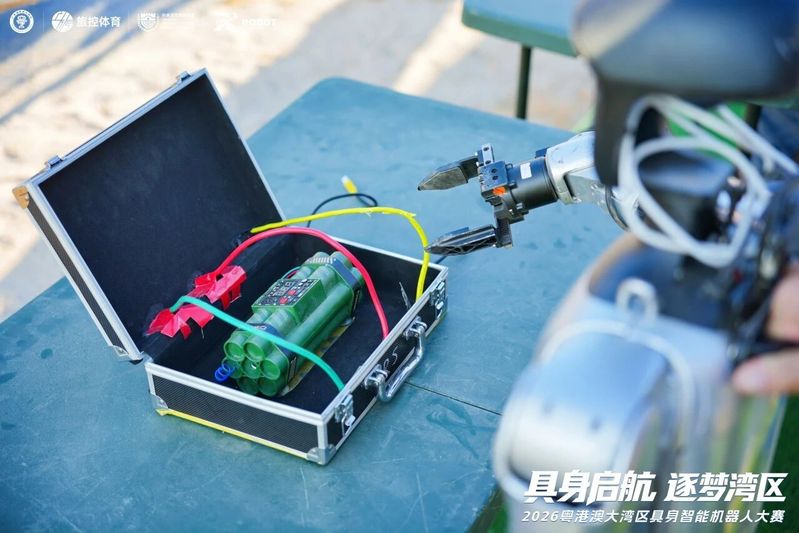
Humanoid Robot Competition Site
In the humanoid robot course, the team used VR teleoperation tocontrol the robot remotely, completing tasks such as slalom navigation and mobile positioning, and then controlled the robot to perform simulatedwire-cutting and bomb-disposal operations. This course not only tests therobot’s locomotion stability and the dexterous manipulation capability of itsrobotic arm, but also places high demands on the operators’ spatial awareness, precision in remote operation, and human-robot collaboration. In the quadruped robot dog course, the competition featured off-road challenges such as slopeclimbing, slalom around stakes, crossing stacked wooden blocks, climbing gravelstairs, and jumping through hoops. The robot dog was required to maintain stable locomotion on complex terrain and across successive obstacles, with the assessment focusing on its obstacle-crossing ability, movement coordination,and environmental adaptability.
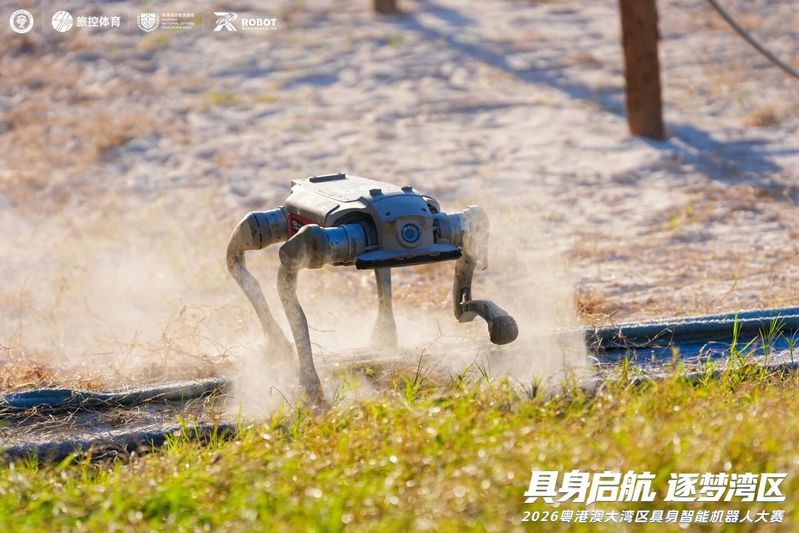
Scene of the Team’s Quadruped Robot Dog Competition
Facing multiple challenges across the two courses, team members designed technical solutions and carried out on-site testing and debugging for humanoid robot teleoperation and quadruped robot motion control in unstructured environments. They adapted their systems to multi-task scenarios. Overcomingone challenge after another, the team won the Gold Award and demonstrated itspractical competence in applying embodied intelligent robot technologies.
Under the guidance of the Department of Industry and Information Technology of Guangdong Province and the Human Resources and Social Security Department of Guangdong Province, the competition was hosted by the Guangdong Robotics Association and Guangdong Provincial Tourism Holdings Sports Industry Co., Ltd., and organized by the Lingnan National Defense Education Base. Itdrew numerous teams from universities, research institutes, and technology enterprises. Focusing on the technical application of embodied intelligent robots in real and complex environments, the competition integrated robotmotion control, environmental adaptation, and human-robot interaction with practical tasks. It aimed to promote technological innovation, talent development, and industrial application of embodied intelligence.
The competition fully demonstrated the solid professional foundation, strong practical engineering capabilities, and teamwork spirit ofstudents from the Shien-Ming Wu School of Intelligent Engineering. Goingforward, the School will continue to support students’ participation in high-level scientific and technological innovation competitions, promoting learning and research through competition to steadily enhance students’scientific and technological innovation capacity and practical engineering skills.
