
INFORMATION CENTER

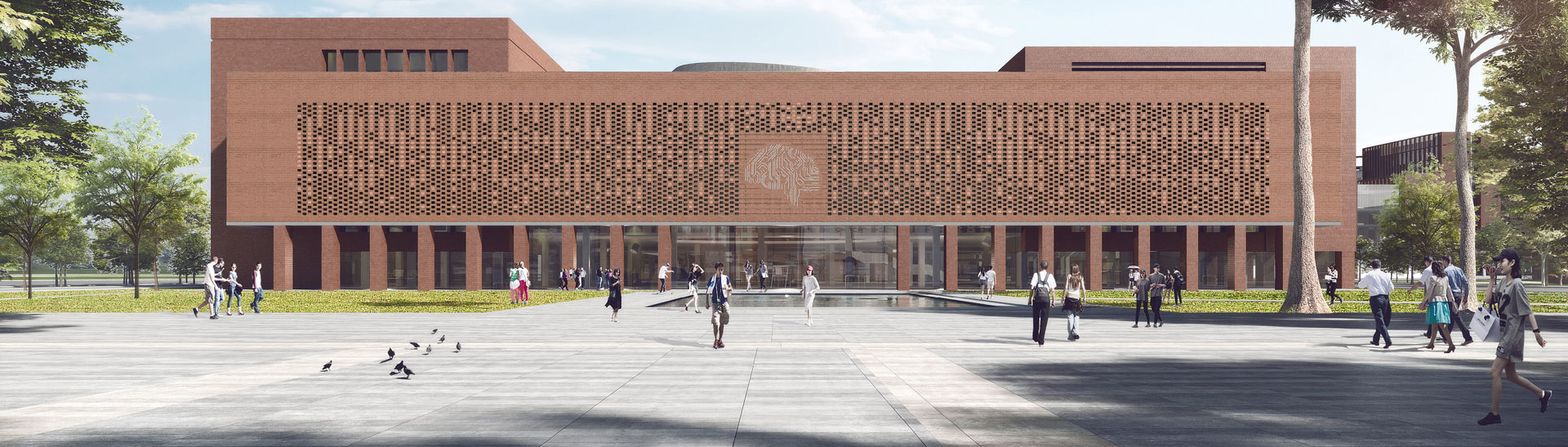
From April 22 to 25, the final round of the third National College Student Career Planning Competition, co-hosted by the Ministry of Education and the Tianjin Municipal Government, took place in Tianjin. After intense competition at the university, provincial, and national levels, Lu Peining, a sophomore in Intelligent Manufacturing Engineering at the Shien-Ming Wu School of Intelligent Engineering, stood out. With a clear career goal, solid academic foundation, impressive practical achievements, and a calm on-stage presence, he won the Gold Award in the Employment Track for undergraduate students. This marks the first national gold medal the school has ever received in this competition.
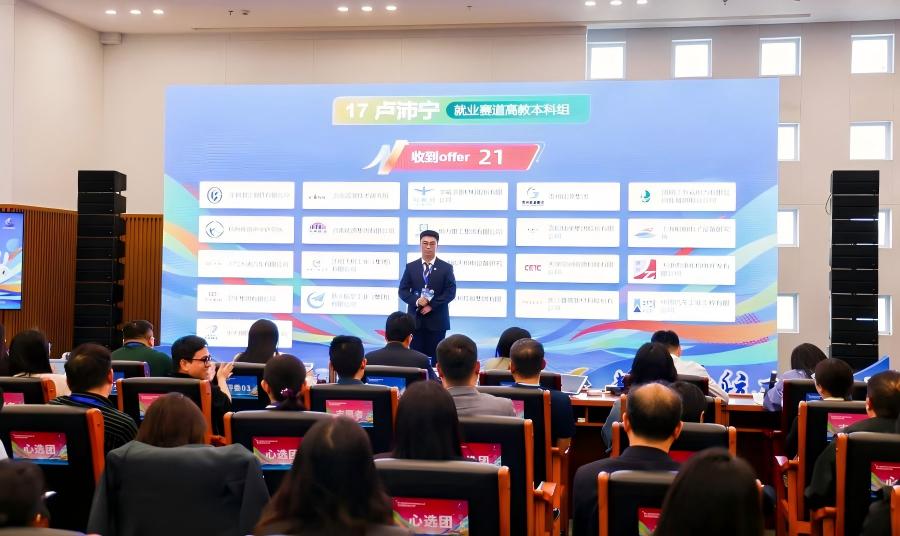
Lu Peining’s Presentation
During the competition, Lu Peining delivered a talk titled “Precision Vision, Smart Manufacturing Future,” focusing on his career goal of becoming a “Vision Control R&D Engineer.” He began with a personal story: his father’s work on a plasma generator was limited by a tiny 0.12mm error, which first taught him the meaning of “precision.” He then connected this to trends in smart manufacturing, autonomous driving, LiDAR, and machine vision, highlighting the critical value of vision control technology in high-end manufacturing.
On career insights, he noted that the vision control industry now faces not just precision challenges in the lab, but systemic issues for real-world deployment. Stable sensing, cost reduction, and reliable scaling are becoming key drivers of competitiveness. He summed up the core competencies for a future vision control R&D engineer in four words: absolute precision to hold the bottom line, responsibility to enable system integration, challenge to drive innovation, and action to achieve engineering implementation.
Lu Peining systematically showed his fit for the target role by drawing on his studies, research, internships, and student leadership. Academically, he has deeply engaged with smart manufacturing courses, building knowledge around process understanding, system algorithms, and engineering execution. In research, he joined a lab in his freshman year, working on vision recognition, precision positioning, and system control—enhancing his hands-on skills through projects like logistics vehicles and active-passive vision fusion.
For industry experience, he interned at Hesai Technology’s advanced quality department, where he debugged LiDAR vision inspection modules, reviewed new product quality, and helped build an AI pre-audit agent. He spent time on production lines and audit sites, involved in cross-department coordination and quality scoring, gaining a full view of LiDAR from testing to quality control. He also competed in an internal AI contest alongside master’s and Ph.D. students, achieving excellent results and continuing to work on integrating the AI audit agent—demonstrating strong learning and engineering execution skills.
Beyond technical abilities, Lu Peining has long been active in student organizations and social practice. As a student council chair member at Mingcheng College, he organized major events and led his team and class to honors such as “May Fourth Red Flag Youth League Branch” and “Advanced Class Collective.” His research, internship, and leadership experience together shaped him into someone who understands technology, works well in teams, takes responsibility, and focuses on real-world results.
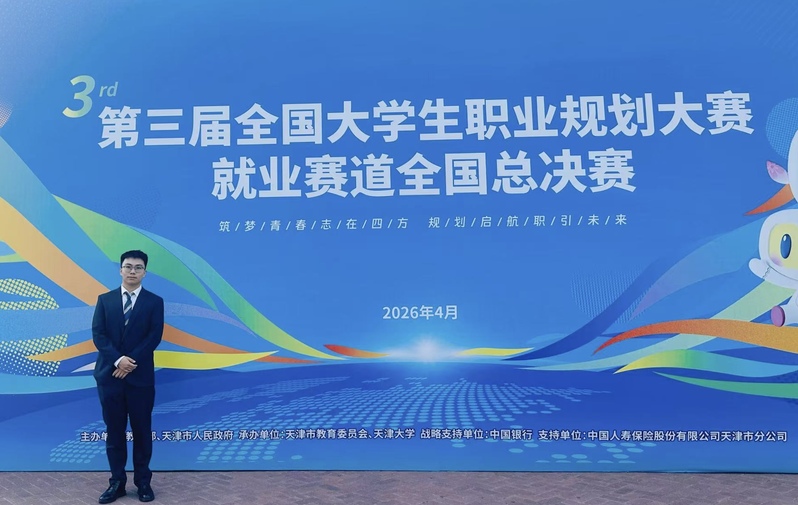
Lu Peining at the Competition
Starting from “precision” and heading toward “smart manufacturing,” Lu Peining said the gold award is both recognition and a new starting point. In the future, he will continue focusing on high-precision vision perception, multi-sensor fusion, and engineering deployment—integrating his personal growth into the national push for smart manufacturing upgrades—and strive to become a young engineer who solves real problems and serves industrial development.
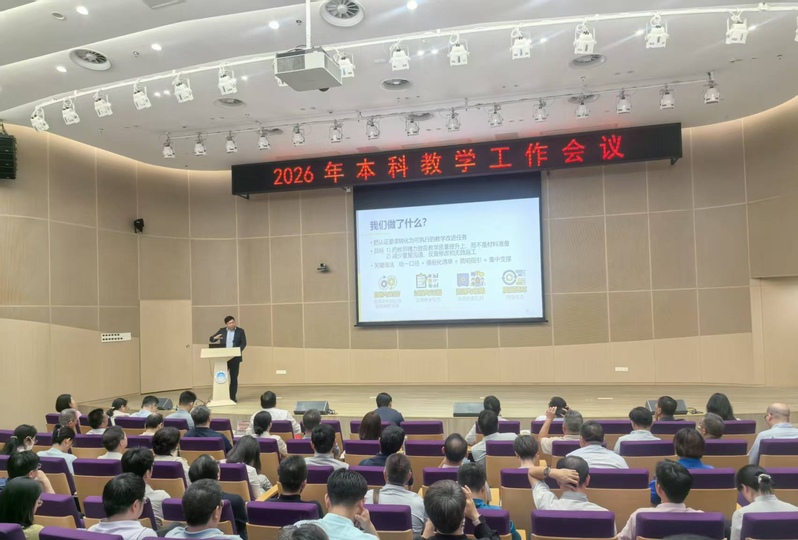
Professor Chen’s Report
The outstanding performance of students reflects the school’s educational success. At the recent 2026 university-wide undergraduate teaching conference, Associate Dean Chen Baiji shared the school’s experience in teaching reform and development under the title “From Self-Statement to External Validation: International Professional Accreditation as a Shared Driver for Quality Improvement and Internationalization.” He comprehensively reported on how the school uses international accreditation as a core lever to enhance undergraduate teaching quality and global engagement. He highlighted the school’s adoption of IET accreditation as a key benchmark for teaching quality, blending Chinese and Western educational strengths, and strengthening students’ engineering application skills, teamwork, and innovation—fully demonstrating the distinctive achievements of the school’s undergraduate programs.
Looking ahead, the school will further strengthen its first-class undergraduate education foundation, deepen teaching and learning reforms, continuously improve the course-project-competition linkage mechanism, and enhance the guiding role of international professional accreditation. By cultivating cross-disciplinary fields and optimizing talent development models, the school aims to raise the quality of education, helping students reach higher peaks in research and career paths. It strives to nurture top-tier talent with both a strong sense of national commitment and professional excellence, contributing to the high-quality development of China’s robotics and intelligent manufacturing industry.(Text/Photos: Shien-Ming Wu School of Intelligent Engineering)
