

INFORMATION CENTER

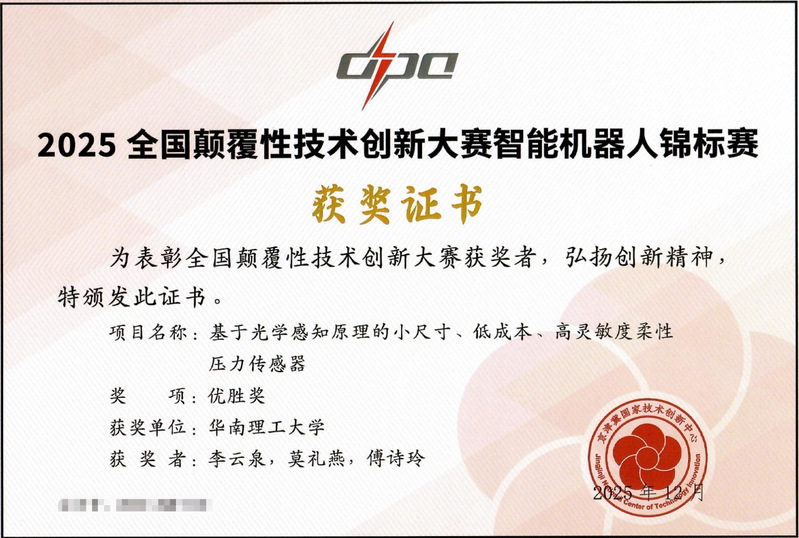
Recently, the 2025 National Disruptive Innovation Competition's Intelligent Robotics Tournament came to a successful conclusion. A team led by Associate Professor Li Yunquan from the School, including doctoral students Mo Liyan and Fu Shiling, stood out among over 200 competing projects with their entry, Small-Scale, Low-Cost, High-Sensitivity Flexible Pressure Sensor Based on Optical Sensing Principles. The team advanced to the national top 12 and received the Excellence Award, making them one of only three university teams to be honored among the winners.
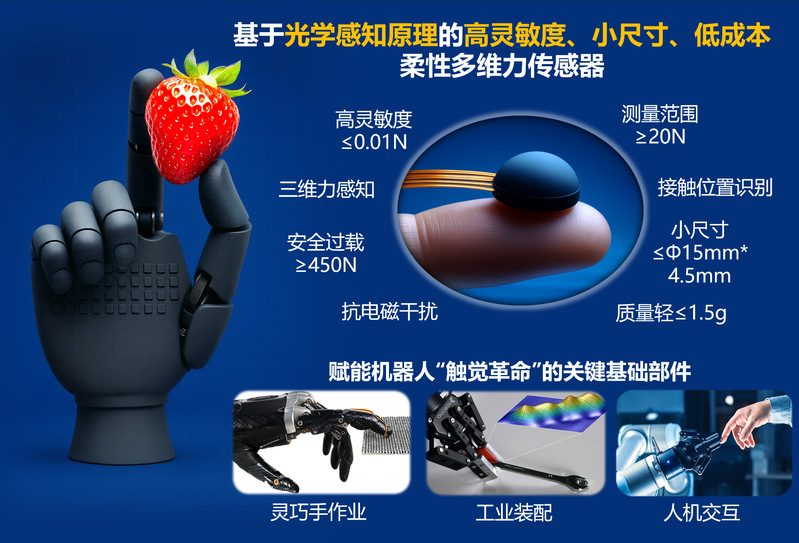
Associate Professor Li Yunquan's team focuses on the tactile sensing needs of humanoid robotic dexterous hands, proposing a new flexible pressure sensor solution based on optical sensing mechanisms. This achievement showcases innovation in sensing principles while achieving a balance between small size, low cost, and high sensitivity in engineering implementation. It offers a novel technical pathway for tactile sensing in precision robotic operations and holds significant potential for engineering and application promotion.
The inaugural Intelligent Robotics Tournament of the National Disruptive Innovation Competition was hosted by the Beijing-Tianjin-Hebei National Technology Innovation Center and co-organized by the Shenzhen Disruptive Innovation Technology Center. The competition adhered to the principle of valuing innovation regardless of background or origin, selecting projects centered on cutting-edge original technologies in the intelligent robotics industry. A total of 253 projects from universities and enterprises across the country participated, covering key aspects of the industry chain, from perception and decision-making to control and execution. After two rounds of evaluation—preliminary and final—the expert panel assessed the projects based on criteria such as technological disruptiveness, demand urgency, and production feasibility, ultimately selecting 12 award-winning projects.
Competing against top-tier enterprises and research teams nationwide, the School's team stood out, reflecting the institution's long-standing commitment to advancing core technologies in industrial embodied intelligent robotics. It also underscores the effectiveness of a research and education model driven by practical engineering challenges and supported by high-level scientific innovation. Moving forward, the School will continue to align with national strategic needs and cutting-edge industrial technologies, further optimizing graduate training mechanisms and refining the research education model characterized by mentor guidance, team collaboration, and project practice. Efforts will also focus on encouraging graduate students to participate in major projects and innovation competitions, strengthening the integration of industry, academia, and research. By collaborating with key enterprises to establish joint laboratories, enhancing interdisciplinary course offerings and academic exchanges, and improving students' capabilities in system design, integrated development, and engineering application, the School aims to cultivate high-level engineering talents with innovation, practical skills, and a global perspective. (Text/Photos: Shien-Ming Wu School of Intelligent Engineering)
