

INFORMATION CENTER

Dean Chen Xiaoqi recently delivered a lecture at the Guangdong Private Universities Science Association Alliance.
On November 11th, the 2025 Academician Forum of the Guangdong Private Universities Science Association Alliance was held at Guangzhou Nanyang Polytechnic College. The event was guided by the Guangdong Association for Science and Technology and co-organized by several institutions. Featured speaker Chen Xiaoqi, an Academician of the Royal Society of New Zealand and the New Zealand Academy of Engineering, as well as Dean of the Shien-Ming Wu School of Intelligent Engineering at South China University of Technology, delivered akeynote lecture titled The Development and Future of Embodied Intelligent Robots.
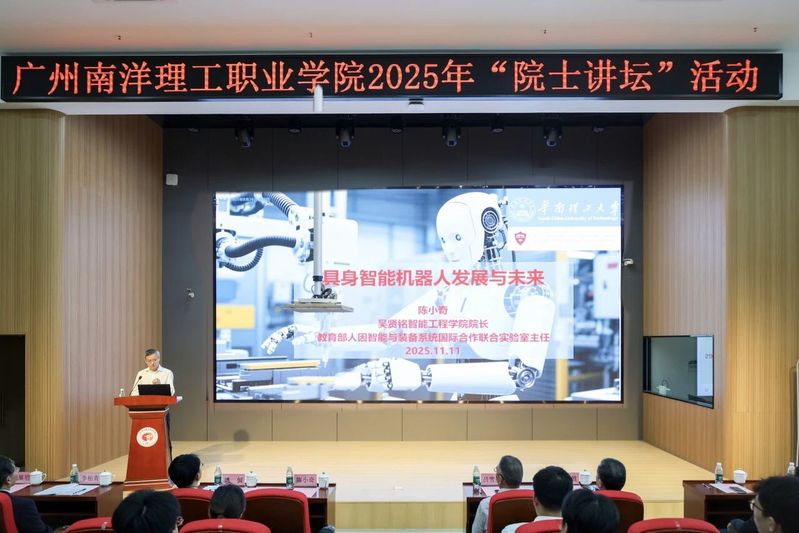
Drawing from his over four-decade academic career, Academician Chen vividly outlined the evolution and future trends of embodied intelligent robots. He highlighted that intelligent manufacturing and robotics technology have become central tonational and global strategic competition, serving as a key measure of acountry's comprehensive strength. To seize this strategic opportunity,Guangdong Province has introduced a series of supportive policies and led the establishment of industrial alliances, aiming to accelerate the agglomeration and advancement of the regional AI and robotics sector.
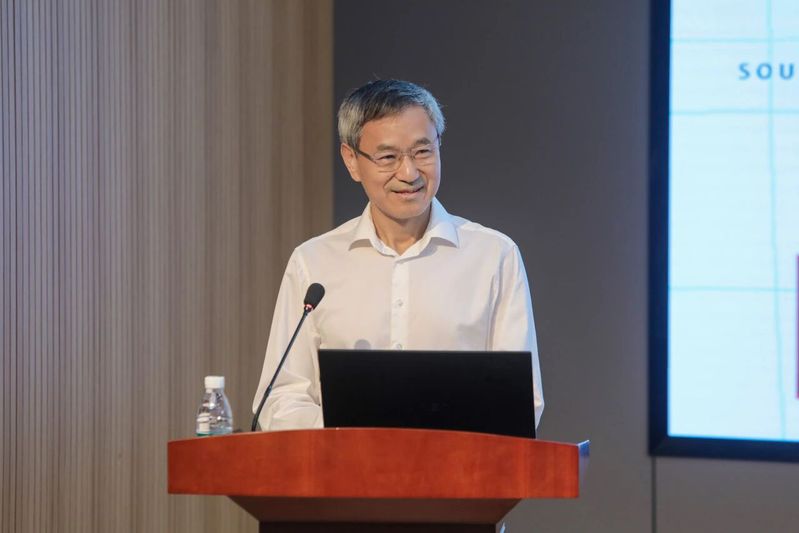
Looking at application prospects, Chen believes industrial and service-oriented embodied intelligent robots will see broad potential across various fields including smart manufacturing, education, elderly care, and community services.He specifically noted that China currently leads the world in both the application density and overall scale of industrial robots, with the entire industry experiencing rapid growth.
Regarding innovations, Chen shared his team's breakthroughs in areas like multi-modal perception welding robots, equipment for aero-engine blade remanufacturing, and dexterous humanoid hands. He emphasized that future research should focus onovercoming key technical bottlenecks in environmental perception, intelligent decision-making, and precise manipulation for humanoid robots. The ultimategoal is to achieve deep integration and large-scale application of intelligent manufacturing across all scenarios, injecting strong momentum into developingnew quality productive forces.
Dean Chen Xiaoqi Elaborates onEmbodied Intelligent Robot Development
In a recent interview with the Guangzhou Daily Science Weekly, Academician Chenfurther elaborated on the development direction of embodied intelligent robotsin smart manufacturing and outlined his school's research focus in related fields. He pointed out that digital and automation technologies in the PearlRiver Delta's smart factories are already quite mature. To propel smart manufacturing to a higher level, the introduction of cutting-edge technologies like AI large models, digital twins, and embodied intelligence is necessary.Chen stressed that embodied intelligent robots for industrial manufacturing should focus on specialization. Given current computing power constraints, pursuing overly general large models is not ideal. Instead, efforts should concentrate on specific industry scenarios to develop targeted,lightweight small models.
Regarding the school's research layout in smart manufacturing, efforts are centered on three main directions: Firstly, exploring the use of AI large models to enhancethe digital and intelligent levels of production line scheduling and real-time monitoring. Secondly, strengthening digital twin technology for smart factoriesto achieve real-time data collection and closed-loop control for complex production lines. Thirdly, integrating AI and embodied intelligence technologies in complex processes like hybrid additive-subtractive manufacturing to continuously improve the intelligence of manufacturing.
Moving forward, the school will actively respond to the national strategic deploymentin the 15th Five-Year Plan to accelerate high-level self-reliance and strengthin science and technology. Centering on Industrial Embodied Intelligent Robots, it will conduct frontier basic research on five common key technologies and develop six types of industrial embodied intelligent robot systems. It aims to promote technological innovation and practical application of these robots in various industrial scenarios—including intelligent manufacturing, healthcare, agriculture and forestry, and the low-altitudeeconomy—striving to build the Guangdong-Hong Kong-Macao Greater Bay Area into atalent hub and technological innovation highland for Industrial Embodied Intelligent Robots.(Text and Images:Guangzhou Nanyang Polytechnic College, Guangzhou Daily, Shien-MingWu School of Intelligent Engineering.)
