

INFORMATION CENTER

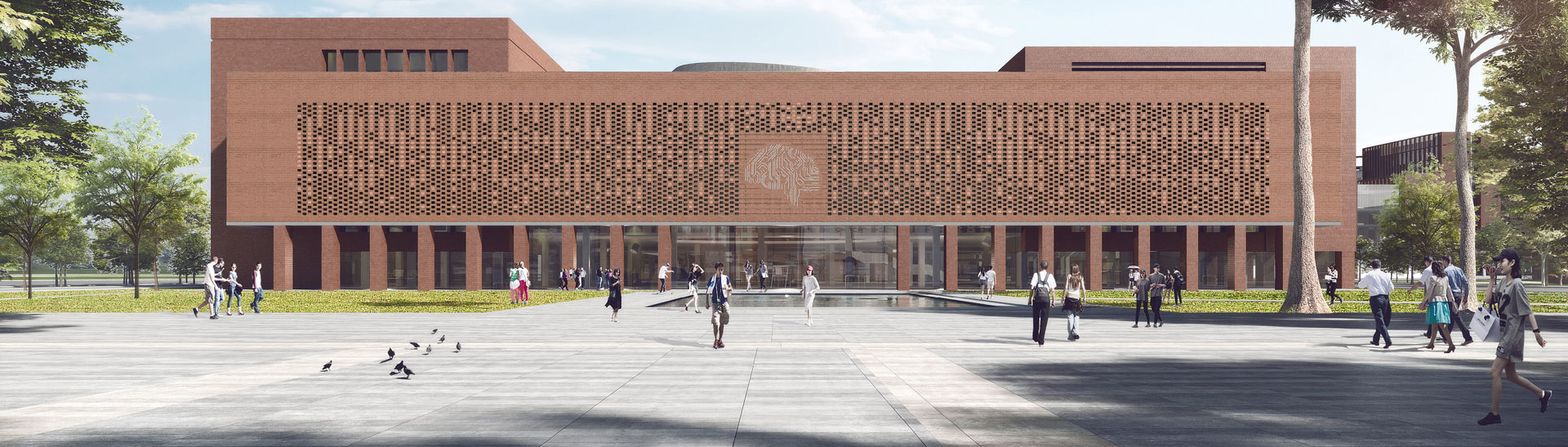
Recently, the 10th Soft Robotics Conference—Symposium on Fundamental Theories and Key Technologies& Innovative Design Competition was successfully held at the Qingdao Innovation and Development Base of Harbin Engineering University. Organized by Harbin Engineering University, the event saw active participation from faculty and students of the School, who delivered remarkable performances in threethemed presentations and the innovation design contest. Their achievements fully demonstrated the School’s research strength and innovative capacity in the field of soft robotics.
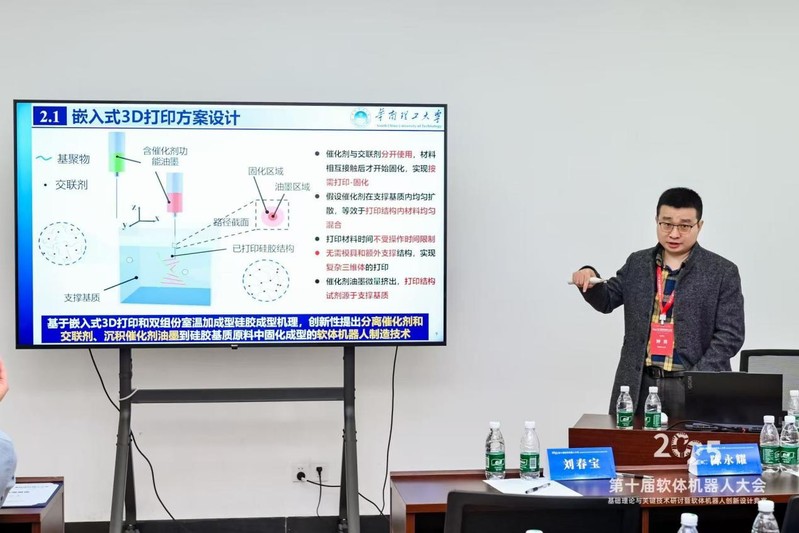
In a presentation titled Research on Integrated Driving and Sensing Technologies for Bio-inspired Soft Robots, Professor Zhong Yong addressed integration challenges arising from traditional discrete manufacturing. Heproposed a novel printing-curing integrated manufacturing method based on embedded 3D printing and catalyst diffusion. This technique overcomes limitations in materials and structures, enabling the in-situ integration of multifunctional materials and the monolithic molding of complex structures,thus offering an innovative pathway for the efficient fabrication of intelligent soft robots.
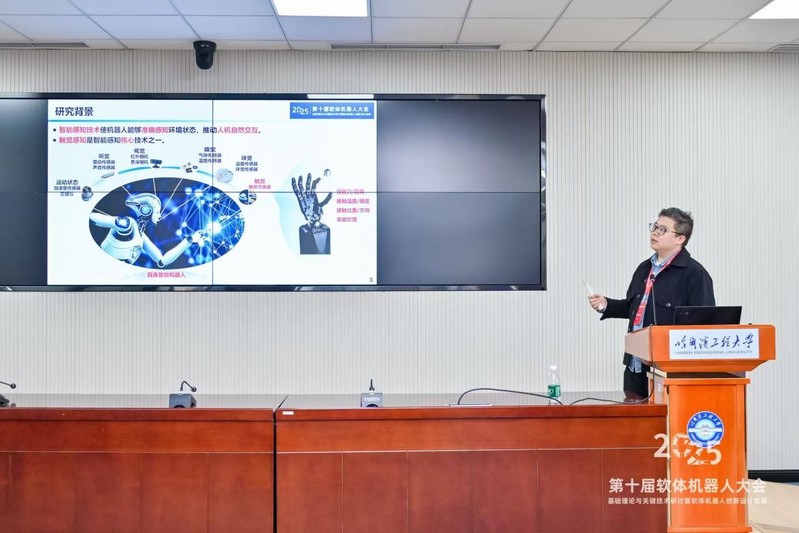
Associate Professor Li Yunquan introduced a new optical tactile sensor design in hisreport, Design and Validation of a Flexible Three-Dimensional Force Sensor Based on Optical Occlusion Structures. By leveraging structural changes that cause light occlusion, the sensor achieves accurate 3D forcede tection with high sensitivity and low cost. Combined with a machine learning-based decoupling model, it demonstrates strong application potentialin robotic flexible grasping and interaction tasks.
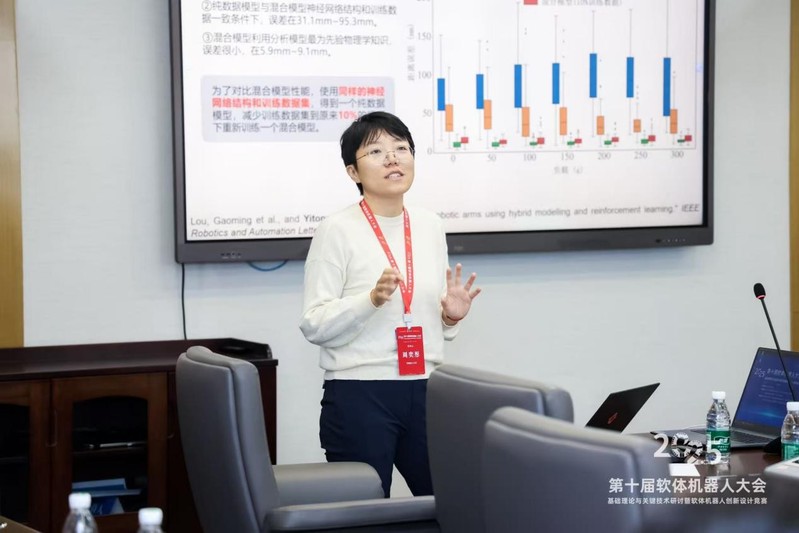
In her presentation on Physics-DataHybrid Modeling and Reinforcement Learning Control for Soft Robots,Associate Professor Zhou Yitong systematically analyzed the limitations of traditional modeling approaches and proposed a new hybrid method that integrates physical models with data-driven techniques. Focusing on asix-degree-of-freedom soft robotic arm, she further introduced a reinforce mentlearning control strategy based on an inverse kinematics model, effectively improving modeling accuracy and control efficiency.
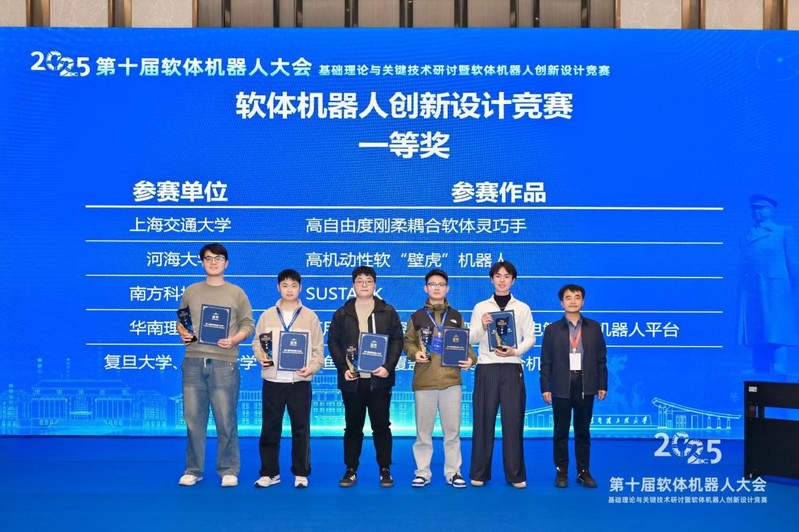
The Soft Robotics Innovative Design Competition was a key part of the conference,featuring 75 finalist teams from universities and research institutions acrossthe country. Three student teams from the School stood out with their creativeideas and solid technical skills, achieving outstanding results in the intense competition. Among them, a joint master’s and doctoral team consisting of Wang Xiaoguang and Xian Shuai won first prize in the robot competition for theirproject, A Bio-inspired Electric Ray Soft Robot Platform for Underwater Detection and Grasping. During the poster session, Xian Shuai’s team also received a second prize for their work on Catalyst Diffusion-EnabledEmbedded 3D Printing: One-Step Fabrication of Integrated Flexible Sensors and Soft Robots, while projects by Xu Boyi and Mo Liyan were both awarded Excellence Prizes.
Since its inception in 2015 by Zhejiang University, the Soft Robotics Conference has been held ten times. Dedicated to building a platform for technical and intellectual exchange among faculty and students, it has become a majoracademic event in China’s soft robotics research community. This year’sconference attracted experts, scholars, and students from leading universities and research institutions both in China and abroad to discuss cutting-edgetopics and innovative designs in soft robotics.
Through this conference, faculty and students of the School have fully showcased their innovative research outcomes and solid technical expertise in soft robotics.Moving forward, the School will take this event as a starting point, aligning with the university’s goal of accelerating its rise into the global top 100 and the School’s own disciplinary development objectives. It will focus onadvancing robotics+ discipline construction, continuously optimizing its distinctive 156+X interdisciplinary cluster, and strengthening technological innovation and practical application acrossmultiple industrial sectors—including smart manufacturing, healthcare,transportation, agriculture, forestry, and the low-altitudeeconomy—contributing to the university’s Double First-Classinitiative and promoting high-level technological self-reliance. (Image/Organizing Committee of the 10th Soft Robotics Conference / Text/ Shien-Ming WuSchool of Intelligent Engineering)
