
INFORMATION CENTER

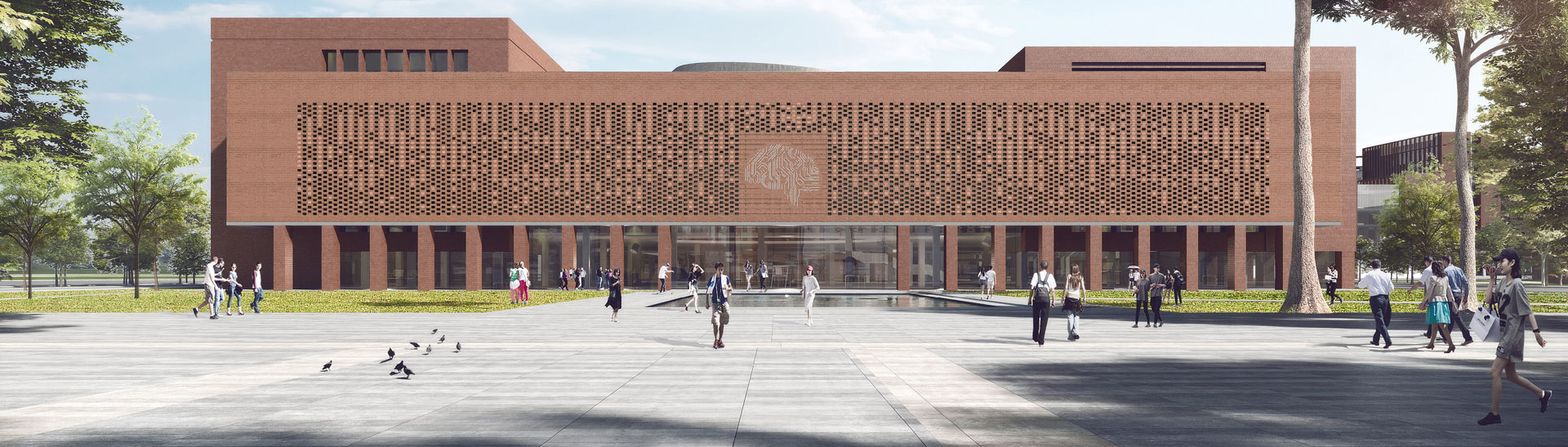
The 13th IET International Conferenceon Power System Control, Operation, and Management (APSCOM 2025) was recently held successfully in Hong Kong, China. As a flagship event of the Institution of Engineering and Technology (IET) in the power and energy sector, this year'sconference brought together leading global experts and scholars to explore pathways for developing high-performance, resilient power grids of the future.
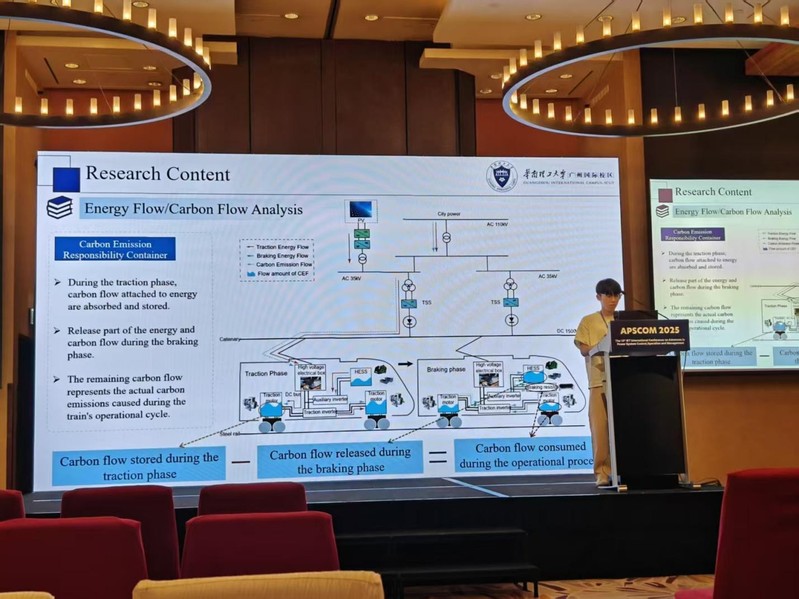
APSCOM 2025Conference Session: Presentation on Energy Flow / Carbon Flow Analysis Research
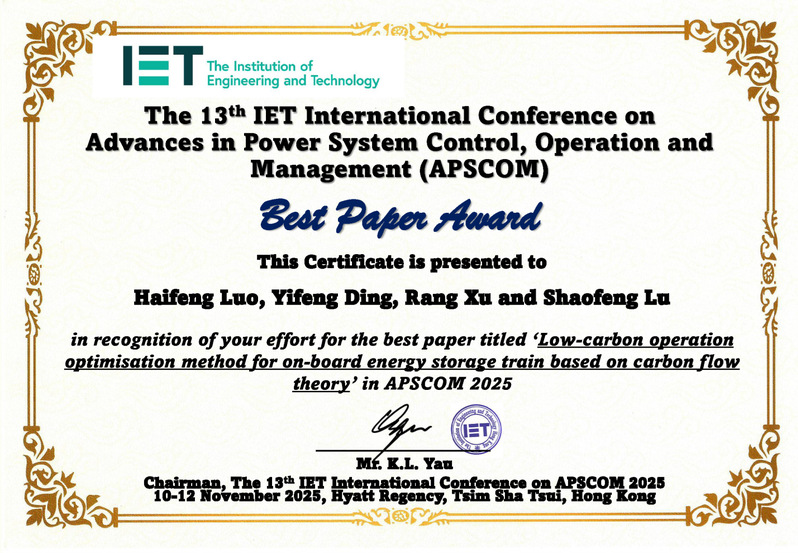
APSCOM 2025 Best Paper Award Certificate
At the conference, a research teamled by Professor Lu Shaofeng from the Shien-Ming Wu School of Intelligent Engineering stood out, with their latest research winning the conference's BestPaper Award. This recognition highlights the international academic community'shigh regard for the school's innovative research intersecting smart transportation and green energy.
Addressing a Common Misconception: Debunkingthe Traditional View That “Energy Saving = Emission Reduction”
Driven by China's Dual Carbon strategic goals, the green transformation of urban rail transit isurgently needed. While subway trains produce zero direct emissions, their substantial electricity consumption leads to significant indirect carbon emissions. For a long time, industry research on train control has primarily focused on Minimizing Energy Consumption (Min E). However, as powergrids become increasingly complex with integrated sources like photovoltaics,wind power, and energy storage, the carbon emission intensity of electricity varies greatly depending on the time and source.
Professor Lu's team identified a keyscientific issue: in a multi-energy coupled context, lower energy consumption does not automatically mean lower carbon emissions. Merely focusing on totaltrain energy use is insufficient. It is necessary to distinguish the specificcarbon contributions from different power sources and links, quantitatively tracing the carbon emission flow behind the energy flow to specifically reduce the carbon emissions per unit of electricity consumed.
Innovative Breakthrough: Novel Application ofCarbon Flow Theory in Rail Transit
Addressing this challenge, theaward-winning paper, Low-carbon operation optimisation method foron-board energy storage train based on carbon flow theory, proposed aninnovative solution. It applies the Carbon Emission Flow (CEF)theory from power systems to the control and optimization of trains withon-board energy storage.
The team developed a novel two-step optimization framework. Within this framework, the on-board hybrid energystorage system (e.g., supercapacitors and batteries) is not just an energycarrier but also a carbon responsibility container. By dynamically calculating and tracking the carbon emission factors associated with energy flow among the grid, the train, and storage devices, the research successfully shifted the control objective from traditional passive energy saving to proactive Carbon Emission Minimization (Min C).
Using actual operational data from Guangzhou Metro Line 7 for case analysis, the team first calculated anenergy-optimal speed profile under existing schedules and safety constraints.Then, they constructed two optimization objectives: the traditional Min Estrategy minimizing total traction energy consumption, and the proposed Min Cstrategy minimizing total carbon emissions by prioritizing power sources withlower carbon intensity, even if total energy use was slightly higher.
The carbon flow optimization strategy intelligently adjusts the timing of energy storage charging and dischargingbased on real-time carbon intensity rankings of available power sources(traction substation, battery, supercapacitor). These rankings change duringdifferent segments of the journey as regenerative braking energy is recovered.
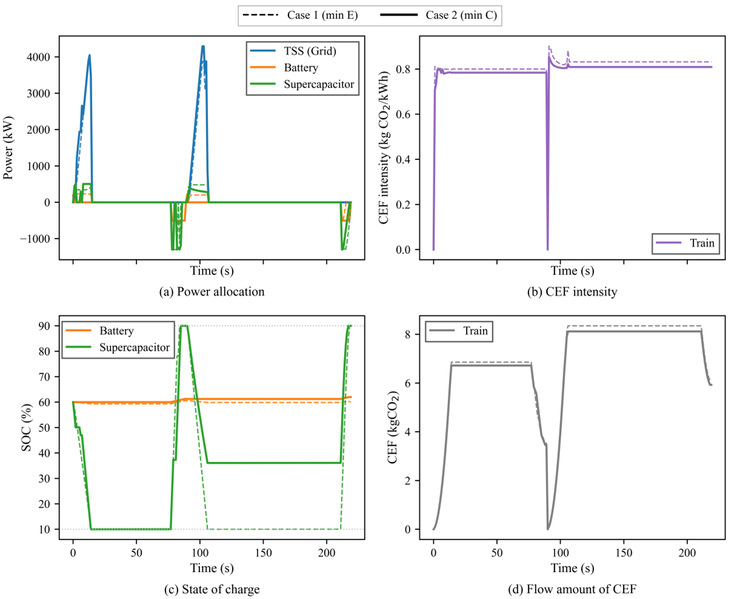
Strategy Comparison Based on Guangzhou Metro Line 7Data.The carbon-optimized strategy (Min C)achieves a lower total carbonemission by intelligently adjusting the timing of energy storage charging anddischarging.
Experimental results showed that compared to the traditional Min E strategy, the team's carbon flow optimization strategy achieved a 2.39% reduction in carbon emissions with only a 1.51%increase in energy consumption. This effectively demonstrates the significant potential of a carbon flow-centric optimization approach for deepdecarbonization.
Team's Future Outlook
This innovative research was completed by the school's Intelligent Transportation and Energy Systems team,including core members Luo Haifeng, Ding Yifeng, and Xu Rang, under the guidance of Professor Lu Shaofeng.
Professor Lu's team has long been dedicated to cutting-edge interdisciplinary research in intelligent control,power system operation, and traffic management, aiming to tackle sustainability challenges in critical infrastructure using advanced AI and engineering control technologies.
Looking ahead, the team plans to expand the application of carbon flow theory. This includes scaling from single-train optimization to system-level optimization involving stationary storage and multi-train coordination, and integrating advanced AI to manageuncertainties like PV generation fluctuations, ultimately contributing tohigh-level autonomous low-carbon rail transit operation.(Photo and text credits to:Shien-MingWu School of Intelligent Engineering)
