News & Events


Title: Theoreticalaspects of ferroelectric nematic liquid crystals
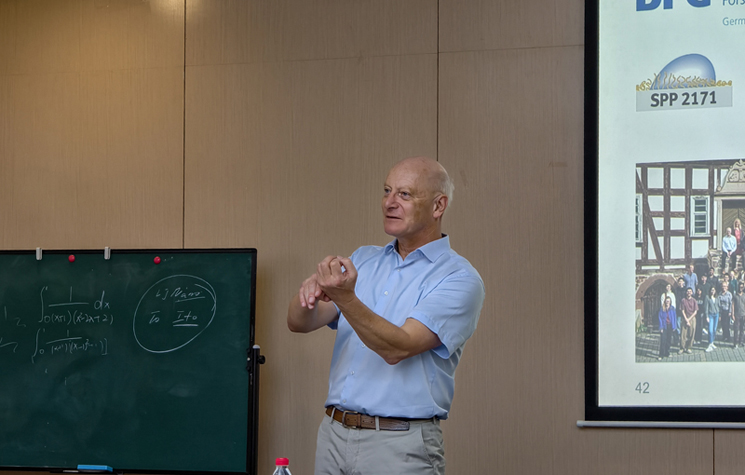
Speaker: Prof. AlexanderEmelyanenko(Lomonosov Moscow State University)
Time: 10:00 AM on November19,2026
Location: LectureRoom 324,AISMST
Abstract:
Recently, new classes ofliquid crystals—ferroelectric nematics—have been discovered. These materials exhibit a giant dielectricanisotropy (exceeding 3000) while remaining resistant to mechanical stress,unlike ferroelectric smectics. The structure and properties of ferroelectric nematicsare determined by the polar shape of their molecules and their longitudinalmolecular dipoles. A high spontaneous polarization—comparable to that ofsolid ferroelectrics—emerges along the local director. In many cases, due to the flexoelectriceffect, the director field exhibits splay or twist deformations withnon-trivial topology. The behavior of ferroelectric nematics in an electricfield is also non-trivial; for instance, the formation of fractals can occur underspecific conditions. This presentation will examine theoretical approaches tothe study of these phenomena.
Speaker Biography:
Alexander Emelyanenkograduated from Lomonosov Moscow State University (MSU). He currently is aprofessor at the Russian Academy of Sciences, heads the Laboratory of LiquidCrystals in MSU, and is the chairman of the Russian Liquid Crystal Society.Together with A. R. Khokhlov, he developed a molecular theory of transitionsbetween smectic, nematic, and isotropic phases in liquid crystals. Incollaboration with M. A. Osipov, he developed a molecular theory describing thehierarchy of intermediate (ferrielectric) phases in antiferroelectric smectics.He also developed a molecular theory of polar nematics, as well as a theory offractals in ferroelectric nematics. Based on his research, new materials havebeen created for displays that do not require color filters, as well as for chemicalsensors and prototypes of biomimetic devices.
Guangzhou International Campus: 777 Xingye Avenue East, Panyu District, Guangzhou, 511442
TEL.: +86-20-39381048; +86-20-39381029
© 2025 South China University of Technology. All Rights Reserved.