Highlights





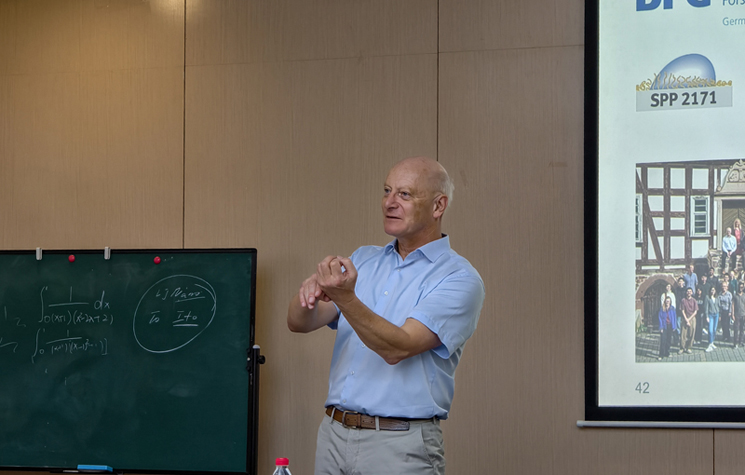
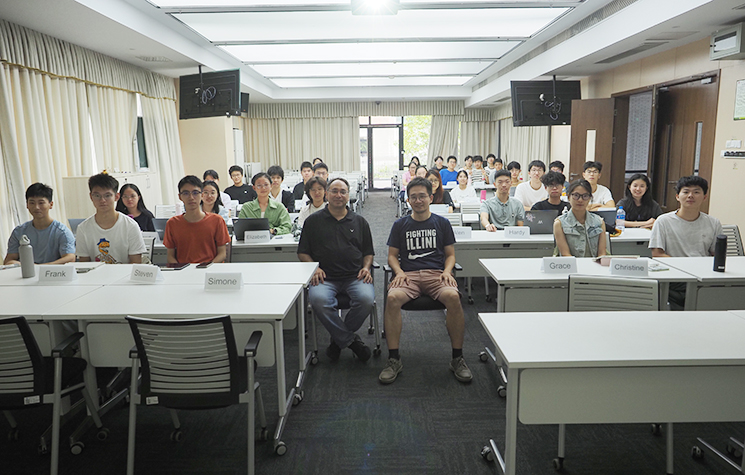
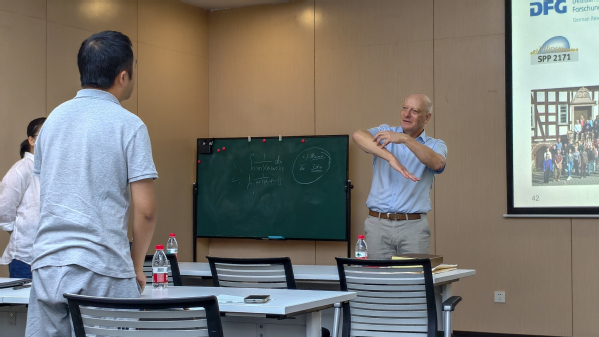
A water drop sliding across a solid surface may leave charge in its wake. This seemingly ordinary event is closely linked to droplet resistance to motion and changes in contact angle, and may even alter the electrical and chemical behavior of material surfaces. On October 28, the School of Emergent Soft Matter at South China University of Technology welcomed Professor Hans-Jürgen Butt, Member of Academia Europaea and Director of the Max Planck Institute for Polymer Research, to the Guangzhou International Campus for a lecture entitled “Wetting: The mystery of contact angle hysteresis.” Starting with a sliding water drop, Professor Butt guided the audience through how interfacial charge is generated, measured, and what consequences it can have.
From Contact Angle Hysteresis to “Slide Electrification”
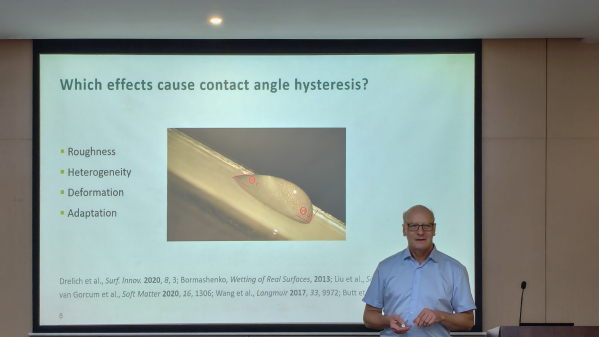
Wetting describes the interfacial configuration that forms when a liquid contacts a solid. For a stationary drop, the contact angle reflects the balance of interfacial energies. When a drop moves, however, its advancing and receding contact angles are generally different; this difference is known as contact angle hysteresis. It influences whether a drop can slide and whether it remains pinned on an inclined surface. Conventional explanations focus largely on surface roughness and chemical heterogeneity, but these factors do not account for every observation. Professor Butt therefore posed a key question: could charge separation also play an important role? As a water drop slides over a hydrophobic surface, an electric double layer forms at the liquid-solid interface. The motion of the contact line separates positive and negative charges: the drop becomes positively charged, while negative charge is left on the solid near the trailing three-phase contact line. Under certain geometries, the resulting electrical potential can easily exceed 1 kV. This liquid-based counterpart of frictional electrification is known as slide electrification.
Three Experimental Approaches Reveal Interfacial Charge
The lecture presented three complementary ways to probe charge in different droplet processes. For a sliding drop, the drop moves down an inclined hydrophobic surface and passes over a detection electrode. A low-noise current amplifier records the resulting discharge pulse, and integration of the current gives the drop’s charge. For an impacting or rebounding drop, a freely falling drop strikes a hydrophobic surface; its deflection in an electric field as it rebounds is used to estimate its charge. For an evaporating drop, red and black toner dust indicate negative and positive charge, respectively, allowing residual surface charge to become visible after the water has evaporated. Together, these approaches capture charging during sliding, impact, and evaporation, providing complementary evidence for charge behavior at dynamic liquid-solid interfaces.
A Cascade of Effects: Changing Droplet Motion and Damaging Material Surfaces
Once charge accumulates on a surface, it can alter the motion of subsequent drops. When the interval between successive sliding drops increased from about 1 s to 43.6 s, the measured charge rose from approximately 0.4 nC to 1.1 nC, highlighting the roles of surface-charge accumulation and dissipation. Sliding resistance was also influenced by substrate properties and the history of surface charging: even with the same surface chemistry, drops moved differently on different substrates. In another experiment, grounding a 5-μL water drop sliding at 2 mm/s increased its advancing contact angle by about 10°. These findings show that charge separation can affect not only droplet motion but also dynamic contact angles.
Although the total charge carried by an individual drop is small, its electrical potential can reach about 1 kV, with consequences for the underlying material. In a comparison experiment, a surface showed no obvious damage after approximately 3,000 impacts by neutral water drops. By contrast, the same number of impacts by charged drops damaged the coating. Atomic force microscopy revealed holes and corrosion pathways extending through the polymer layer and, in places, into the copper substrate. These observations suggest that charge separation may contribute to surface chemical changes or electrochemical corrosion, although the precise reaction pathways remain to be established.
Where Does the Charge Come From? A Dual-Mechanism Hypothesis Involving Ion and Electron Transfer
To investigate the origin of the charge, the team compared the charging behavior of different liquids and their frozen states. Liquid water carried approximately 1 nC of charge between 0 and 20 ℃, while ice reached about 2.2 nC near its melting point, suggesting that more than one charging process may be involved. Polar liquids carried substantially more charge than nonpolar liquids, whose charge was roughly ten times lower; nevertheless, nonpolar liquids also became charged. On this basis, the team proposed a dual-mechanism hypothesis: ion transfer is likely to dominate in polar liquids, whereas electron transfer may play a more important role in nonpolar liquids and frozen systems.
Conclusions and Discussion
Beginning with the familiar phenomenon of contact angle hysteresis, Professor Butt used experiments involving sliding, impacting, and evaporating drops to progressively investigate the origins and consequences of interfacial charging. Quantitative measurements and discussions of possible mechanisms were carefully woven together, making the complex physics accessible without losing its scientific depth. During the discussion, participants raised questions about why different liquids charge differently, how charge is transferred across an interface, and how accumulated charge affects contact angles and material surfaces. By bringing wetting, interfacial electrostatics, and surface chemistry into a common framework, the lecture offered a fresh, electrically informed perspective on dynamic interfaces and inspired further discussion among faculty and students.
Guangzhou International Campus: 777 Xingye Avenue East, Panyu District, Guangzhou, 511442
TEL.: +86-20-39381048; +86-20-39381029
© 2025 South China University of Technology. All Rights Reserved.