Highlights


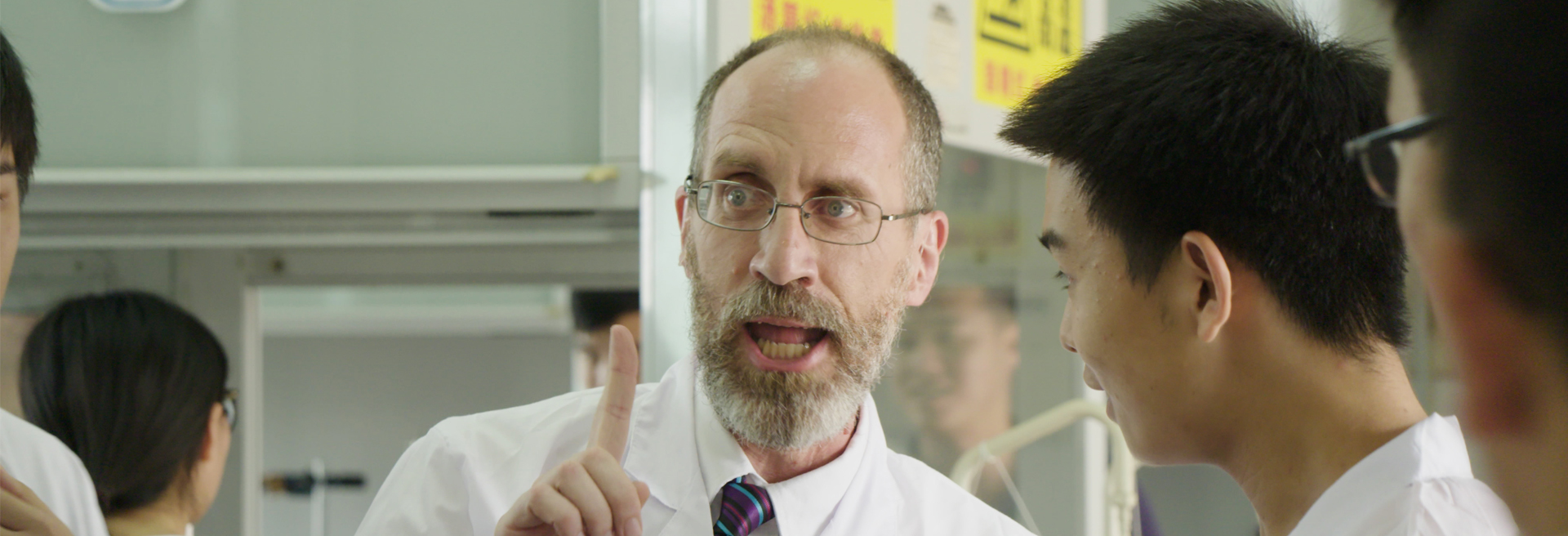

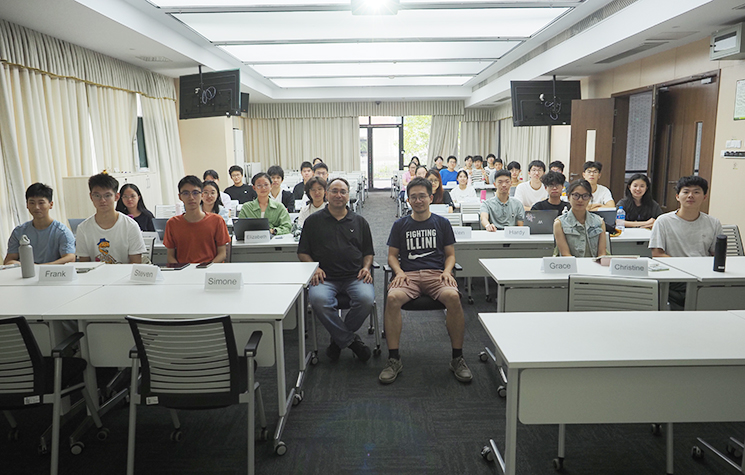
In the morning of December 13th, the Academician Lecture Hall of the Advanced Institute of Soft Matter Science and Technology once again welcomed world-known guests. Virgil Percec, a foreign academician of the Royal Swedish Academy of Sciences and the Romanian Academy of Sciences, and Wang Zhengang, an academician of the American Academy of Engineering, visited the Guangzhou International Campus of South China University of Technology. They conducted in-depth sharing on the cutting-edge fields of from new synthesis methods and self-assembly to mRNA based therapy and vaccine development and ion correlation in polymer nanostructures: from block copolymers to end charged mixtures, attracting more than 100 teachers and students from both inside and outside of the university to participate.
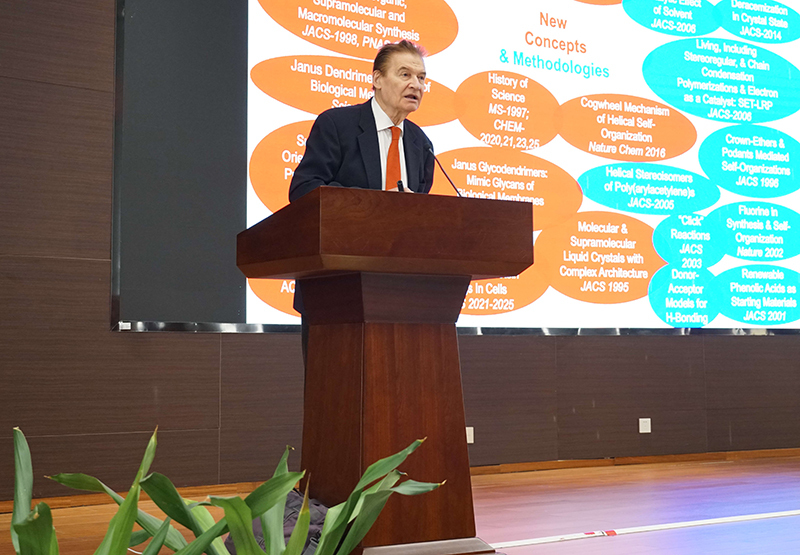
Prof. Virgil Percec: Exploring breakthroughs in nickel catalysis and dendritic molecules, biomimetic technology, and vaccine innovation
Prof. Virgil Percec focused on novel synthesis methods and self-assembly design of soft matter, showcasing the laboratory's milestone achievements in nickel catalyzed coupling reactions and dendritic macromolecules. He introduced that low-cost nickel catalysts can replace traditional palladium, activate aryl chlorides and ester substrates, and promote the green transformation of the pharmaceutical industry; Through the dual ligand design strategy, nickel intermediates can be stored at room temperature for a long time, significantly improving reaction controllability. In response to the deactivation problem caused by steric hindrance in the synthesis of high generation dendritic molecules, the Percec team proposed a solution where the convergence method is superior to the divergence method, and revealed the core contradiction between the dynamic instability of low-generation dendrimers and the chemical inertness of high-generation dendrimers, laying the foundation for precise design of functional materials. In the biomedical field, the low-charge polymer carrier developed by the Percec team effectively solves the dual challenges of mRNA vaccine targeting and room temperature stability by optimizing packaging efficiency through microfluidic technology; The self-assembled vesicles based on amphiphilic Janus dendritic polymers have successfully simulated the sugar chain structure of cell membranes, providing a new tool for cancer treatment and vaccine development.
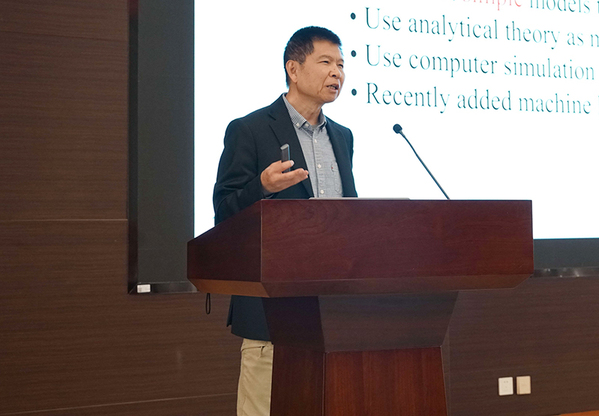
Prof. Wang Zhengang: Sharing the Basic Theory of Charge Regulation to Disruptive Applications
Academician Wang Zhengang focuses on polymer self-assembly driven by ion interactions, revealing how charges reshape the microstructure of materials. He proposed that by introducing electrostatic correlation effects, the balance of neutral systems can be broken, driving the separation of layered, columnar and other microphases; The difference in ion size provides key parameters for customizing nanomaterials. Their team successfully predicted and experimentally verified non-classical phase structures such as Plumber's Nightmare by combining self-consistent field theory and Gaussian fluctuation theory, opening up new paths for solid-state batteries, polymer capacity expansion, and other fields.
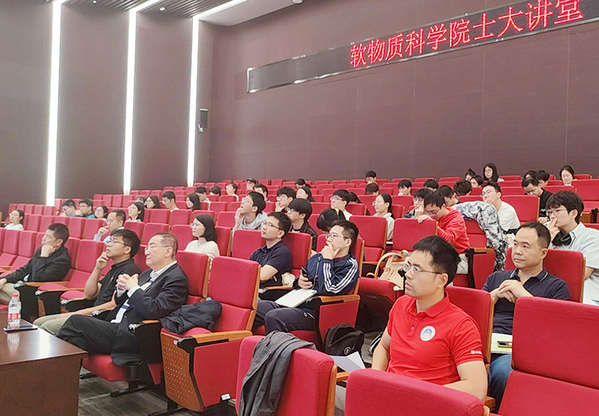
Dialogue: Methodology and Philosophy of Science
Interactive session, aimed at addressing the confusion of young scholars about their research life. Prof. Cheng, based on his own experience, emphasizes the importance of exploring new fields every decade and encourages young scholars to break through their comfort zones; Prof. Percec, through his years of persistence and research, explains the crucial role played by his pure interest and passion for scientific research. When answering the limitations of theoretical models, Prof. Cheng and Prof. Wang unanimously believe that further integration of multi-scale models such as dynamic dielectric changes is needed to better simulate real physical scenarios.
The Academician Lecture Hall on Soft Matter not only presents the hard-core achievements of top international scientists, but also provides methodological insights for researchers through interdisciplinary thinking collisions. The college will continue to build a high-level academic exchange platform to support the growth of innovative talents and promote interdisciplinary integration to new heights.
Guangzhou International Campus: 777 Xingye Avenue East, Panyu District, Guangzhou, 511442
TEL.: +86-20-39381048; +86-20-39381029
© 2025 South China University of Technology. All Rights Reserved.