Principles of Economics
The course mainly teaches the basic knowledge, principles, and methods of economics. Train students to understand and master the basic ideas, concepts, and analytical methods of microeconomics and macroeconomics; Cultivate students' ability to observe and analyze real economic behaviors and phenomena.
Introduction to Big Data Management
The course mainly includes the basic concepts of big data, data collection and governance, data management, data analysis, and other related knowledge. Enable students to use scientific methods based on the principles of big data to study business problems, conduct big data analysis and interpretation, propose reasonable conclusions and valuable management strategies.
Principles of Management
The course aims to guide students to understand and apply the basic concepts, theories, and practices of management. It adopts diverse teaching methods, including case studies, group discussions, etc., to enhance students' understanding and application ability of theoretical knowledge.
Advanced Language Programming (Java)
The course introduces the basic concepts, principles, and technologies of Java language. The course content is divided into three major parts: Fundamentals of Programming, Object Oriented Programming, and Common Java Class Libraries and Principles of Use. Cultivate students' ability to use Java language and technology to solve problems.
Digital Supply Chain
The course aims to enable students to apply the concept of digital supply chain management to strategic matching and demand forecasting of enterprises, and master production planning and supply and demand planning, inventory management and planning, transportation and procurement management strategies, coordination, and pricing decisions in the supply chain environment.
Statistics
The course will systematically introduce the basic thinking, methods and applications of statistics. It enables students to have basic statistical thinking, master basic statistical methods and apply these methods and software tools such as Excel, SPSS, R, Python to process and analyze data, and cultivate the ability to solve practical problems. At the same time, it will lay a good foundation for further study and research in the future.
Operational Research
The course mainly covers fundamental operational research models and their solution methods, with an emphasis on problem modeling techniques and the use of relevant software for solving and analyzing output results. It aims to equip students with proficiency in using management operational research software, such as QM software, EXCEL solver, LINGO, etc. for problem-solving, conducting sensitivity analysis on output results, and correctly interpreting and applying the solution results.
Database Principles & Applications
The course introduces the basic principles, design, and application technologies of database systems. Enable students to use database operation language to achieve data queries and updates, and to analyze and design commonly used databases.
Data Structures
The course adopts an object-oriented approach to discuss data structures, using Java language as a means of expression to help students understand and master various algorithms. Enable students to design reasonable data structures and algorithms, build efficient software systems and program structures, and solve practical problems.
Data Mining
The course introduces the core ideas, main principles and core technologies of data mining, covering the basic concepts and algorithms of data preprocessing, classification and regression, association analysis, cluster analysis, anomaly detection and other topics. Through the study of this course, students will have a thorough understanding of the basic knowledge of data mining, and acquire the basic ability to use the knowledge of data mining to solve practical problems while learning basic data mining concepts and case studies.
Python for Data Analysis
The course comprehensively utilizes various open-source Python libraries to help students comprehensively grasp the basic knowledge and skills of data analysis, providing necessary programming skills for data analysis.
Econometrics
Econometrics builds upon students' foundational knowledge in probability theory, statistics, and other related subjects. It provides further education on the fundamental principles and analytical methods of econometric theory. Simultaneously, it equips students with proficiency in software methods for econometric modeling, such as Stata.
Optimization Theory and Methods
The course mainly focuses on the basic knowledge and application principles of optimization. The main content includes matrix algebra and geometric properties, steepest descent method, Newton's method, and gradient descent method, etc. It provides students with the initial capability to construct and solve optimization models for straightforward data analysis issues.
Mathematical Modeling and Optimization
The course integrates mathematics, mathematical software, and computer programming to cultivate students to translate real-life issues into mathematical models, solve them through computational means, and apply the results to reality.
Machine Learning
The course primarily covers classical machine learning theories and includes practical exercises. Students will learn to develop appropriate machine learning models for their specific objectives, create suitable algorithms for these models, and assess the rationale behind the design plans.
Data Governance
The course focuses on data quality and compliance, utilizing cutting-edge data management methods and technologies to standardize, optimize, and increase the reliability and value of information. Its objective is to guarantee the integrity, dependability, consistency, and data security.
Deep Learning Fundamentals
The course covers fundamental concepts of deep learning such as forward and backward propagation, loss functions, and optimization algorithms, enabling students to apply deep learning to practical business challenges through analytical research.
Planning and Design of Big Data System
The course systematically introduces the key technologies of big data system, including big data foundation, big data storage and management, big data processing and analysis, big data application, etc. At the same time, entry-level experiments are arranged for relevant chapters to help students successfully complete the construction of big data experimental environment.
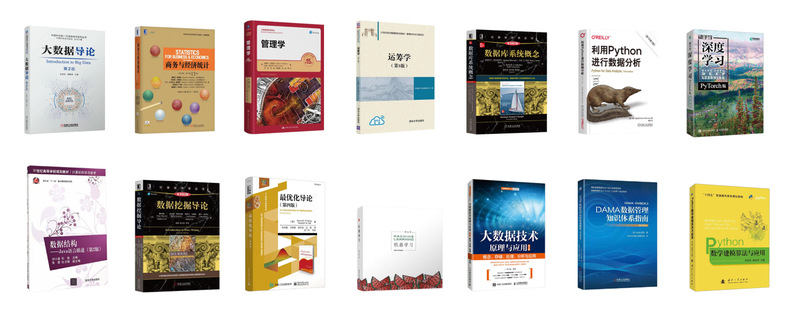
Part of textbook display
 Introduction to the Main Courses of Big Data Management and Application.pdf