
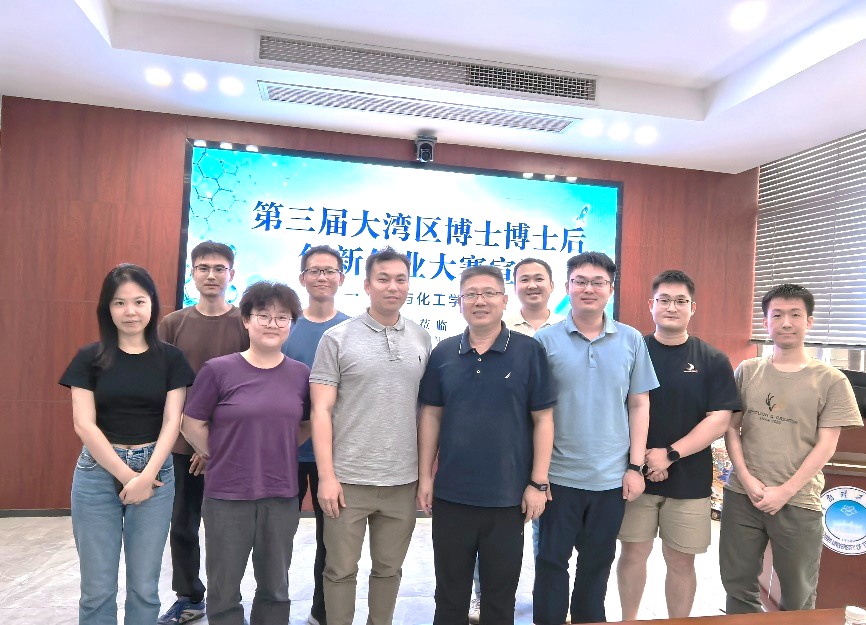
On July 7, 2026, the information session for the 3rd Guangdong-Hong Kong-Macao Greater Bay Area Doctoral & Postdoctoral Innovation and Entrepreneurship Competition took place in Meeting Room 105, Shaw Engineering Building, at South China University of Technology (SCUT). Prof. Huang Guoqing, Party Secretary of the School of Chemistry and Chemical Engineering, attended and delivered the opening address. Dr. Li Xinxin, a postdoctoral researcher at the School, presided over the session.
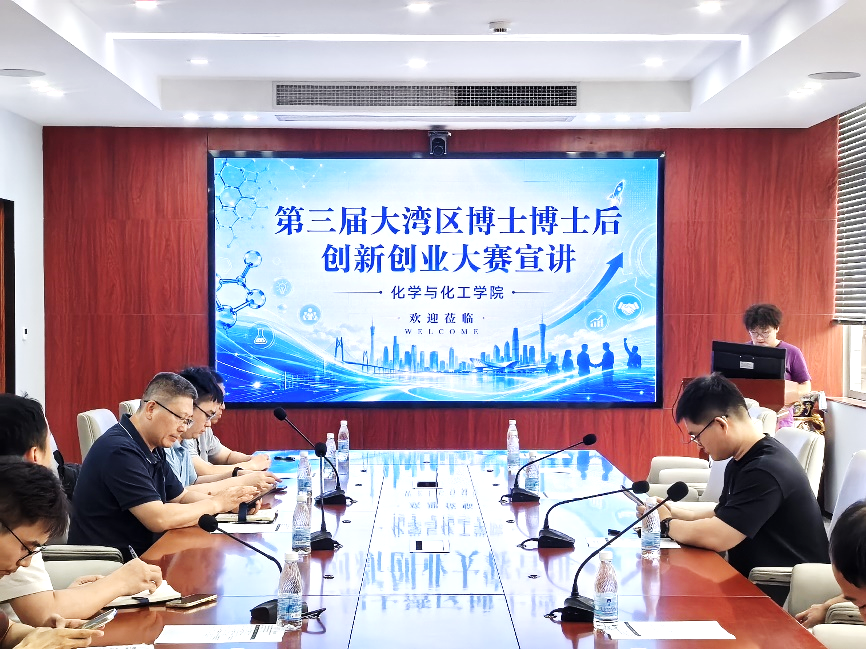
Competition Promotion to Fuel Innovation and Entrepreneurship Enthusiasm
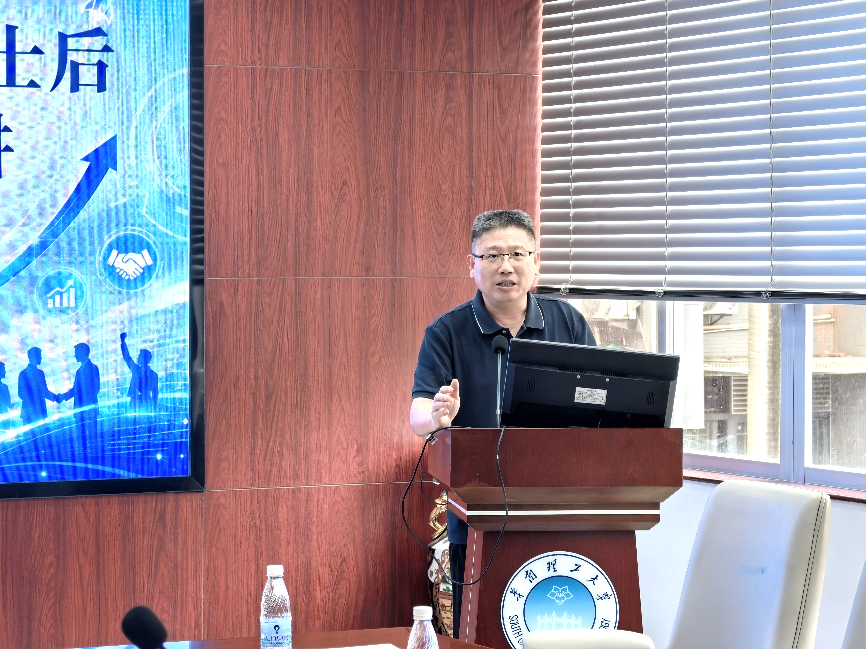
In his opening speech, Secretary Huang Guoqing emphasized that the Guangdong-Hong Kong-Macao Greater Bay Area Doctoral & Postdoctoral Innovation and Entrepreneurship Competition is a premier event targeting high-level young scientific and technological talents. It serves as a vital platform for doctoral and postdoctoral researchers to showcase innovative achievements and connect with industrial resources.
He pointed out that the Greater Bay Area boasts a robust industrial foundation in manufacturing and the real economy, combined with strong fiscal policies supporting scientific and technological innovation, creating a fertile ground for young talents to pursue innovation and entrepreneurship. Secretary Huang specifically noted that the School of Chemistry and Chemical Engineering has strong academic strengths, with both its Chemistry and Chemical Engineering disciplines ranking among the world’s top tiers—Chemistry in the global top 30 and Chemical Engineering in the global top 15. He encouraged the School’s doctoral and postdoctoral researchers to fully leverage their disciplinary advantages and actively register for the competition.
He also mentioned that the School of Business Administration, the School of Economics and Finance, and the Educational Technology Centre of the university can provide comprehensive support for participants, including access to business plan mentors, PPT refinement, and roadshow coaching, to enhance the quality and competitiveness of the submitted projects.
Secretary Huang encouraged participating doctoral and postdoctoral fellows to advance both research and industrial application through the competition, thereby translating scientific achievements into tangible productive forces that address societal needs.
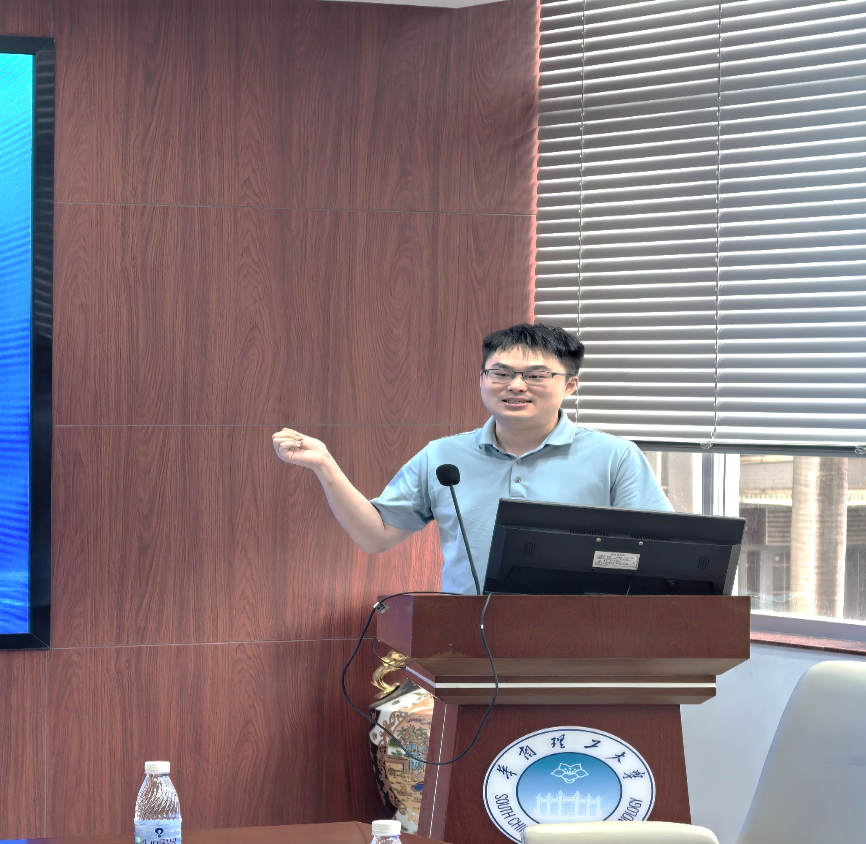
Dr. Li Xinxin then gave a detailed presentation on the overall arrangement, competition structure, and supporting policies of the 3rd Competition. Centered on the theme “Gathering Talents for the Greater Bay Area, Forging an Innovative Future”, the competition comprises three divisions: the Innovation Contest, the Entrepreneurship Contest, and the Challenge-Oriented Problem Solving Contest. It covers ten strategic emerging industry tracks, including Next-generation Information Technology and Artificial Intelligence, New Energy and Energy Conservation & Environmental Protection, New Materials and Petrochemical Engineering, Biomedicine, and others.
Experience Sharing by Past Award Winners to Pass on Practical Insight
During the experience-sharing session, Researcher Ling Ziye from the School of Chemistry and Chemical Engineering drew on his award-winning experience in the Challenge-Oriented Problem Solving Contest of the 1st National Postdoctoral Innovation and Entrepreneurship Competition and the 8th China International “Internet+” College Students Innovation and Entrepreneurship Competition. He shared hands-on insights on topic selection, project preparation, and roadshow defense.
Adopting a “five-dimensional dimensionality reduction expression” approach, Researcher Ling elaborated on how to effectively shift from a research-oriented mindset to a business-oriented mindset. He particularly reminded the audience that “dimensionality reduction does not mean lowering technical sophistication, but lowering the cognitive threshold for judges.” Taking his award-winning project “Special Phase-change Radiator” as an example, he explained key points for preparing defense PPTs in plain terms, covering project positioning, core competitiveness, market potential, technical barriers, team composition, and expert advisors. He advised participants to focus on their core technical strengths, precisely align with industrial demands, and fully demonstrate the project’s innovation and application prospects within limited time.
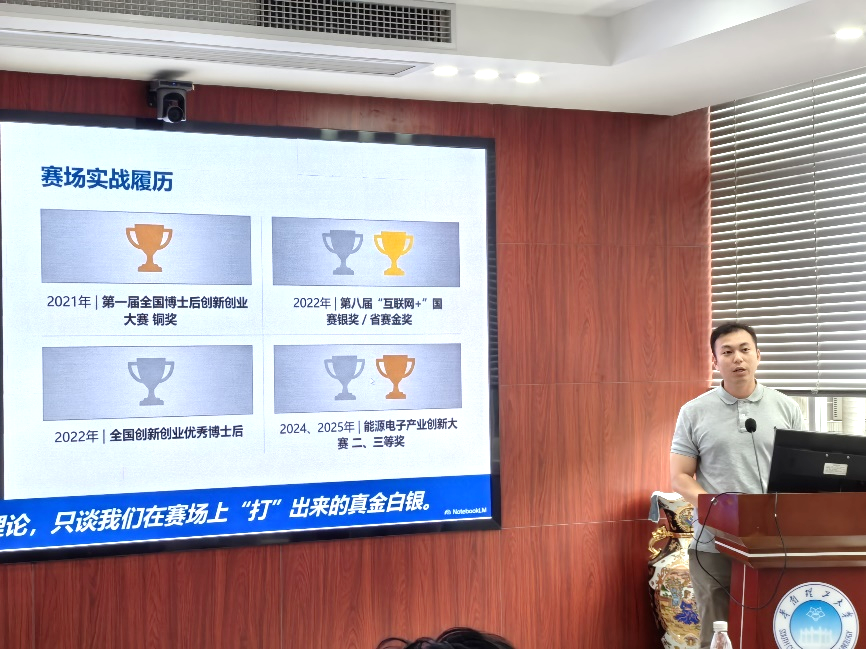
Associate Professor Tang Haoran from the School of Materials Science and Engineering, a silver medalist of the 1st Guangdong-Hong Kong-Macao Greater Bay Area Doctoral & Postdoctoral Innovation and Entrepreneurship Competition and a gold medalist of the 3rd National Postdoctoral Innovation and Entrepreneurship Competition, shared his extensive competition experience. He offered a thorough breakdown of competition rules and scoring criteria for the Innovation Contest, Entrepreneurship Contest, and Challenge-Oriented Problem Solving Contest, clarifying the frameworks for drafting business plans.
Mr. Tang reminded attendees that outstanding achievements require credible peer evaluation and verification. For the core technical support of projects, both papers and patents should demonstrate distinct technical contributions: papers showcase technical advancement and scientific soundness, while patents serve as critical tools for intellectual property protection and subsequent achievement transformation. In addition, he highlighted that participants should flexibly adjust PPT emphasis according to the defense order to highlight project strengths. Given the production-related features of chemical engineering projects, he suggested that teams give advance consideration to environmental and safety assessments to reinforce project compliance in these aspects. He encouraged young researchers to step out of the laboratory and bring original scientific research outcomes to the broader industrial arena.
The session also featured a Q&A and open discussion. Faculty and students present engaged in in-depth interactions with the guest speakers on hot-button issues such as eligibility criteria, track selection, project evaluation standards, and defense representative selection. Many participants stated that they gained a clearer understanding of the competition and showed significantly stronger willingness to participate.
Text & Photos: Lu Zong, Sun ZhaoPreliminary Review: Sun ZhaoSecondary Review: Ling Ziye, Tang HaoranFinal Review: Huang Guoqing