
Title: Artificial Chloride Channels
Speaker: Prof. Wang Dexian (Institute of Chemistry, Chinese Academy of Sciences)
Host: Prof. Huang Liangbin
Time: 16:00–17:00, Thursday, 12 March 2026
Venue: Conference Room 105 of the Shaw Engineering Building Campus, Wushan Campus
Organizers: School of Chemistry & Chemical Engineering
Biography of the Speaker
Wang Dexian is a Research Professor and doctoral supervisor at the Institute of Chemistry, Chinese Academy of Sciences, and a recipient of the National Science Fund for Distinguished Young Scholars. His research group has long been committed to addressing core issues in supramolecular chemistry and related fields. Guided by novel interaction modes and based on new host molecules, the group has systematically carried out research on supramolecular recognition and assembly. He has made pioneering contributions to the mechanism of anion-π interactions and their applications in molecular recognition and assembly, taking the lead in proposing the theory of interactions between electrically neutral electron-deficient aromatic rings and anions, and designing multi-cavity macrocycle systems to achieve highly selective recognition of complex anions. His research interests cover multiple cutting-edge fields including molecular cage structure design, anion transmembrane transport, radical magnetic regulation and biocatalysis. He has published more than 170 SCI papers in journals such as Angewandte Chemie and Journal of the American Chemical Society. In recent years, he has achieved a series of innovative results in the field of machine learning-assisted biocatalysis, publishing more than ten papers in journals including Angew. Chem. Int. Ed., Nat. Commun. and ACS Catal.. His future research plans to further conduct in-depth studies on machine learning models and their applications for enzyme catalytic performance. He presides over a number of national scientific and technological projects and has been granted a number of invention patents.
Abstract
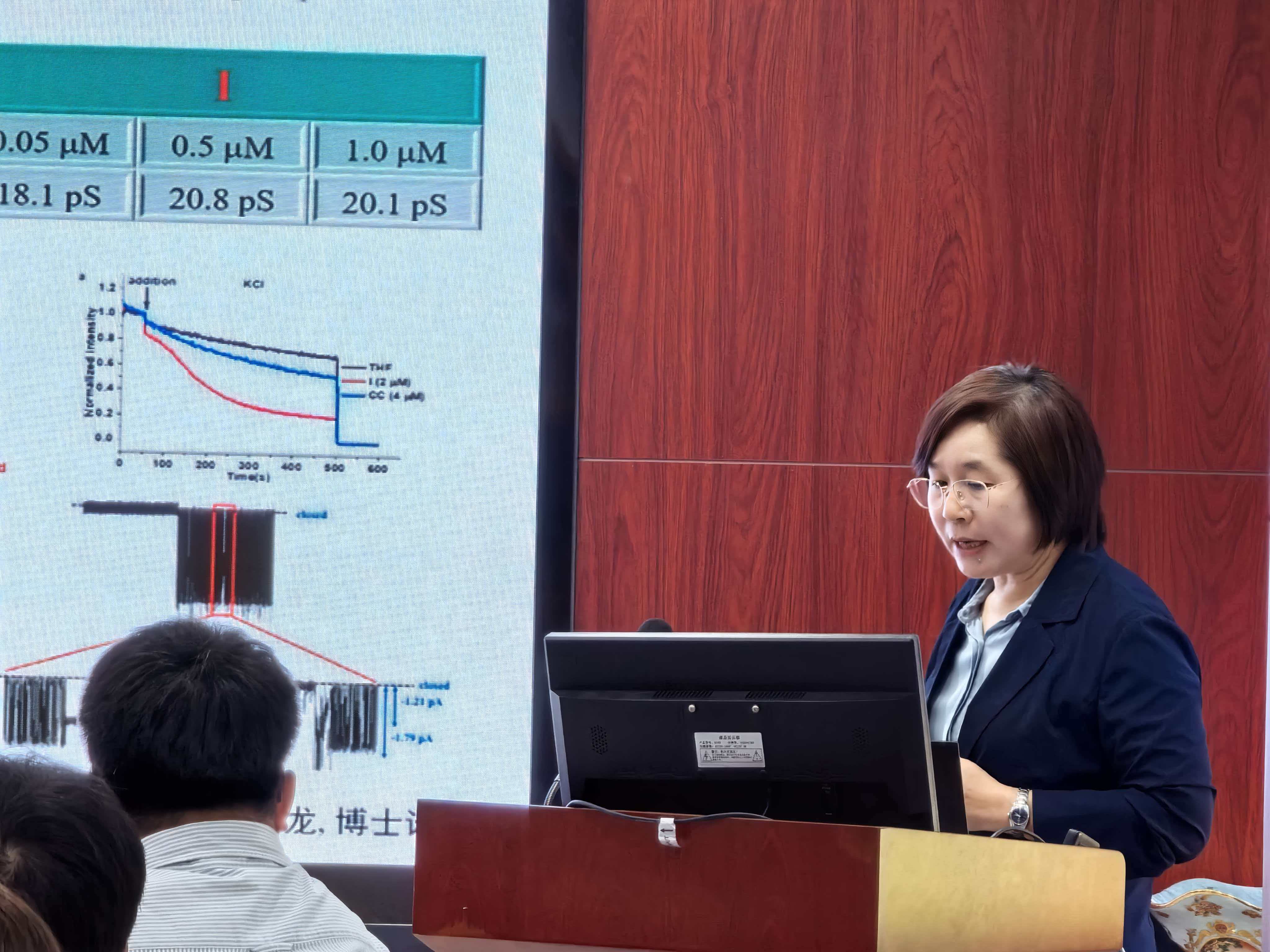
Chloride ions are the major permeable anions in biological systems, and their transmembrane transport undertakes important physiological functions such as the generation and conduction of electrical signals, maintenance of electrolyte balance inside and outside cells, and regulation of cell volume. Dysfunctional chloride channels can cause a variety of severe channelopathies. Chloride channel proteins possess unique pore structures that enable the selective transport of chloride ions, and also exhibit gating coupled with ion transport, rectification and subconductance properties. Among these, the multi-conductance state behavior (or subconductance) is an important physiological activity. Although its underlying mechanism remains unclear, investigating the generation and regulatory mechanisms of subconductance states is considered a key step to deepen the structure-activity relationship of ion channel transport. Benefiting from the advantages of facile synthesis and well-defined structures, biomimetic artificial channels can provide simple molecular models for exploring ion transport mechanisms and processes, and deeply reveal the structure-function relationship. However, it is extremely challenging to reproduce the functions of natural ion channels using artificial channels. This report details the design concept and synthesis method of artificial unimolecular channels based on the oxacalix[2]arene[2]triazine scaffold, the chloride ion transport activity, selectivity and other functions of the channel molecules, and elucidates the transport mechanism of artificial chloride channels.
Announced by School of Chemistry and Chemical Engineering.