

NEWS & EVENTS

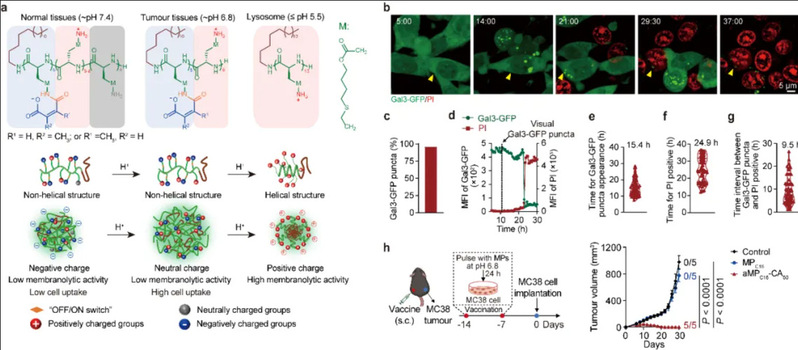
On August 5, an original study on cancer immunotherapy was published in Nature under the title “Membranolytic peptide programs immunogenic cell death for cancer therapy”. The study was conducted by Professor Xiong Menghua’s team at South China University of Technology (SCUT), in collaboration with Sun Yat‑sen Memorial Hospital of Sun Yat‑sen University, Westlake University, University of Science and Technology of China, and other institutions. Through chemical design, Professor Xiong’s team precisely programmed the temporal sequence of tumour cell death and established a mode of immunogenic cell death independent of pore-forming cytolysins, thereby providing new insights for enhancing immunotherapy efficacy.
Current immune checkpoint blockade therapy has low clinical response rates. Naturally occurring immunogenic cell death relies on pore-forming cytolysins such as Gasdermin and MLKL, and its application is constrained by tumour heterogeneity and interference from complex signalling pathways. The team developed a synthetic-acid-responsive membranolytic peptide (aMP), aMPC16-CA50, which leverages the acidic tumour microenvironment to induce a sequential cell death featuring initial lysosomal membrane rupture followed by delayed plasma membrane rupture, thereby establishing a mode of immunogenic membranolytic cell death independent of cytolysins. This temporal process enables sufficient release of lysosomal contents, thereby activating tumour inflammatory programmes and promoting antigen presentation and T‑cell activation. Moving forward, the team will advance the development of sequence-controlled membranolytic peptides and strive to achieve tumour‑selective activation upon intravenous administration, thereby promoting clinical translation of this technology and supporting precision cancer immunotherapy.
Source from SCUT News
For Collaborations, Tel: +86-20-81181636/1631 Email: global@scut.edu.cn
For Study at SCUT, Tel: +86-20-81182580/2585 Email: sieinfo@scut.edu.cn
For Jobs, please click https://www2.scut.edu.cn/gzic_en/2025/0820/c44854a599684/page.htm
to find job vacancies.


2018 © Guangzhou International Campus, SCUT. All Rights Reserved