

NEWS & EVENTS

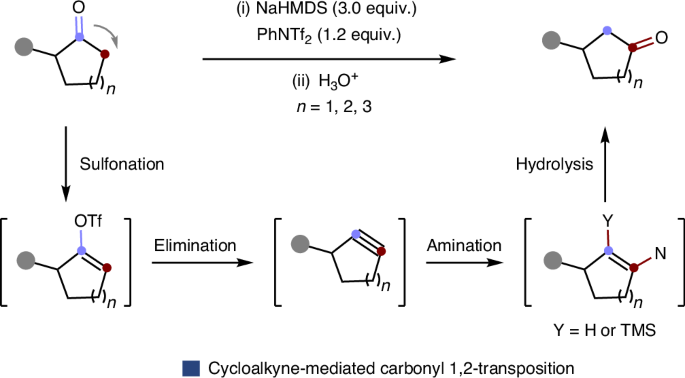
Recently, the research group led by Professor Wu Zhao from the School of Emergent Soft Matter at South China University of Technology (SCUT) developed a new strategy for the precise editing of molecular architectures.
The work, entitled Angle-strained cycloalkyne-mediated carbonyl 1,2-transposition, was published in Nature Synthesis.
This approach employs highly strained cycloalkyne intermediates as a molecular engine to enable an efficient and general strategy for carbonyl 1,2-transposition. It addresses a longstanding synthetic challenge in the skeletal editing of small-ring ketones and shows broad potential in drug discovery and precision synthesis.
As a key functional group in organic molecules, the carbonyl group's precise positioning can profoundly influence molecular properties and unlock new bioactivities, rendering its manipulation highly valuable for drug discovery. However, conventional methods for carbonyl transposition often suffer from high cost, limited substrate scope, and poor compatibility with small-ring systems.
By harnessing the intrinsic strain energy of small-ring cycloalkynes to drive a fundamental functional-group transposition, this work enables rapid access to complex structures and natural product analogues via late-stage functionalization.
Providing a direct, one-step solution to a classic synthetic challenge, this cycloalkyne-mediated carbonyl transposition strategy is poised to find broad application in the synthesis of complex molecules and to streamline the preparation of bioactive analogues in medicinal chemistry.
Source: SCUT News
For Collaborations, Tel: +86-20-81181636/1631 Email: global@scut.edu.cn
For Study at SCUT, Tel: +86-20-81182580/2585 Email: sieinfo@scut.edu.cn
For Jobs, please click https://www2.scut.edu.cn/gzic_en/2025/0820/c44854a599684/page.htm
to find job vacancies.


2018 © Guangzhou International Campus, SCUT. All Rights Reserved