

NEWS & EVENTS

Recently, a research team led by Professor Bian Liming from the School of Biomedical Sciences and Engineering at SCUT achieved a major breakthrough in biomimetic underwater adhesion.
On March 30, the research findings titled “Superspreading and Ultra-Infiltrative Coacervate Mediates Strong Underwater Adhesion on Hydrated and Lipidic Substrates”were published in Nature Chemistry.
Inspired by the mechanism through which barnacles secrete proteins to form coacervates for strong underwater adhesion, the team developed novel coacervates, addressing long-standing challenges in underwater sealing and tissue repair.
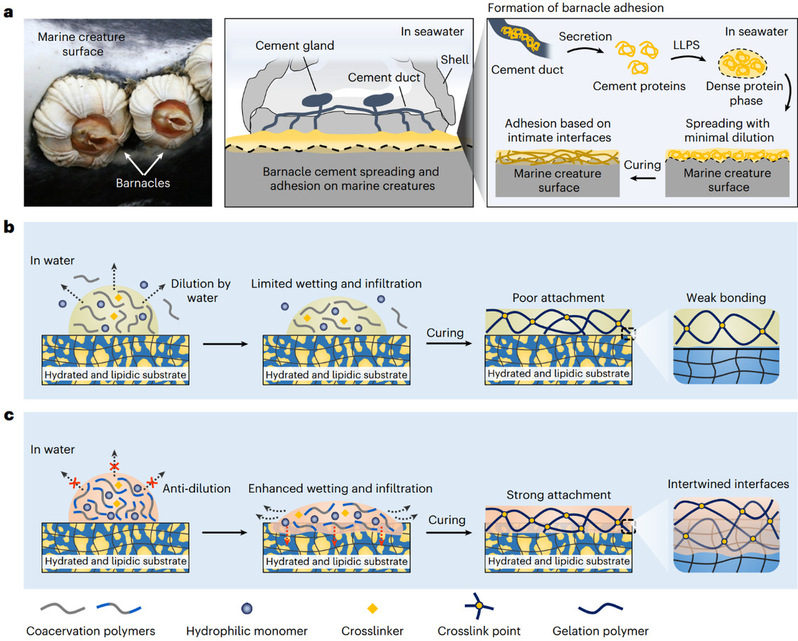
Conventional adhesives often perform poorly underwater due to interference from hydration layers and water-related swelling. The team designed an end-group functionalized polypropylene glycol polymer that spontaneously forms stable coacervates in water.
It boasts three major advantages, super-spreading, ultra-infiltration, and strong dilution-resistance, allowing it to adapt to complex underwater environments, including extreme pH and high salinity conditions.
Experimental results show that the adhesive achieves an adhesion strength of 479 kPa on porcine skin and a burst pressure of 436 kPa, outperforming most existing underwater sealants.
It also demonstrates good biocompatibility, successfully sealing perforations in porcine intestines and cardiac tissues, as well as repairing gastric perforations in rats.
This research provides a novel biomimetic strategy for designing high-performance underwater adhesives and highlights the innovative strength of SCUT in the field of biomedical science.
Source: SCUT News
For Collaborations, Tel: +86-20-81181636/1631 Email: global@scut.edu.cn
For Study at SCUT, Tel: +86-20-81182580/2585 Email: sieinfo@scut.edu.cn
For Jobs, please click https://www2.scut.edu.cn/gzic_en/2025/0820/c44854a599684/page.htm
to find job vacancies.


2018 © Guangzhou International Campus, SCUT. All Rights Reserved