


News & Notices

[Academic Achievement] Professor Qiu Guanglei's Team of Our School Publishes Latest Research in The ISME Journal
Time:2026-01-09
Views:10
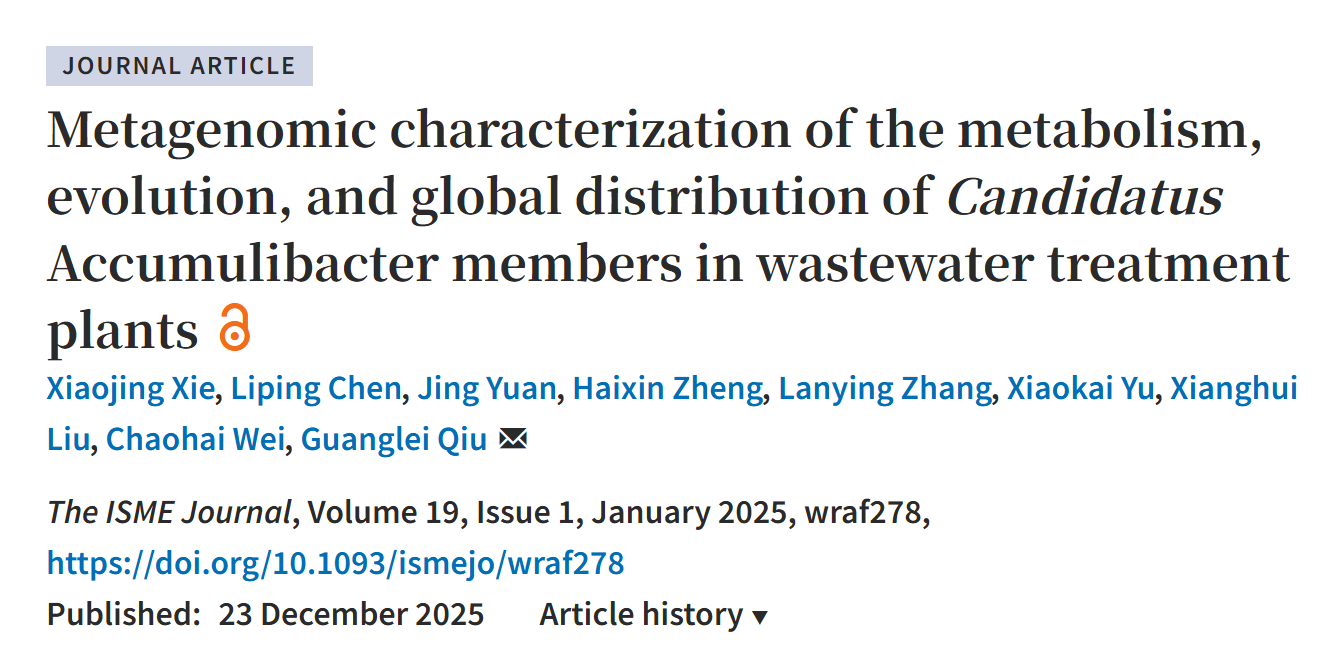
On December 23, 2025, The ISME Journal, a leading international journal in microbial ecology, published online the research achievement entitled Metagenomic characterization of the metabolism, evolution, and global distribution of Candidatus Accumulibacter members in wastewater treatment plants by Professor Qiu Guanglei's team from our School.
Enhanced Biological Phosphorus Removal (EBPR) is a key technology for efficient and stable phosphorus removal in current urban wastewater treatment, and its operational performance largely depends on polyphosphate-accumulating organisms (PAOs). Among them, Candidatus Accumulibacter is the core functional group driving the biological phosphorus removal process in wastewater and dominates the global activated sludge microbial communities.
However, for a long time, the understanding of this group has been mainly based on ppk1 gene-based phylogenetic classification and limited molecular detection methods. Such methods have obvious limitations in coverage and resolution, leading to the underestimation or even omission of a large number of lineages. Its true phylogenetic diversity, metabolic potential and ecological adaptation strategies have not been fully characterized.
Based on the systematic integration and analysis of large-scale metagenomic data covering activated sludge samples from wastewater treatment plants across China and six continents worldwide, the research team has essentially expanded the genomic resources of Ca. Accumulibacter and identified a new clade (Clade IV) with global distribution characteristics, thus reshaping the understanding of the diversity of this group at the phylogenetic level. Further comparative analysis showed that significant differences exist among different clades in terms of carbon source utilization capacity, integrity of amino acid synthesis and evolutionary trajectories, reflecting the formation of highly differentiated and interdependent metabolic strategies in the engineered environment of wastewater treatment plants. Meanwhile, the analysis of antiviral defense systems and their potential interactions with viruses revealed that viral pressure may play an important role in shaping the population structure of Ca. Accumulibacter and maintaining the functional stability of the community. Overall, these findings redefine the functional role and adaptation mechanisms of this globally dominant PAO from genomic and ecological scales, providing a new perspective and important theoretical basis for an in-depth understanding of the functional evolution and diversification of functional microorganisms in engineered ecosystems.
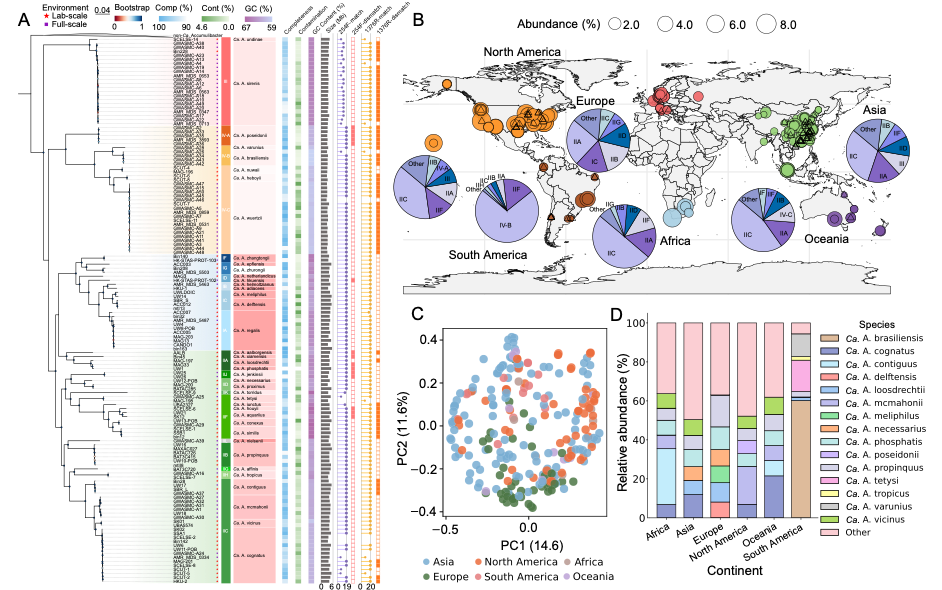
Figure 1. Phylogenomics and global biogeographic distribution of Candidatus Accumulibacter
The first completing unit of this paper is South China University of Technology. Dr. Xie Xiaojing (2024 cohort) is the first author, and Professor Qiu Guanglei is the corresponding author. This work was supported by the National Natural Science Foundation of China, the National Key Research and Development Program of China, the Pearl River Talent Recruitment Program of Guangdong Province, the Key Research and Development Program of Guangzhou City and other projects.
Article Link: https://doi.org/10.1093/ismejo/wraf278
Author Profiles:
First Author: Xie Xiaojing, a doctoral candidate of South China University of Technology (2024 cohort). She has published 5 first-author papers in journals including Nature Water, The ISME Journal, Environmental Science & Technology, ISME Communications and Environmental Science and Ecotechnology. She has been awarded the National Scholarship and the Doctoral Special Funding of the Young Science and Technology Talents Training Program of the China Association for Science and Technology, among other honors.
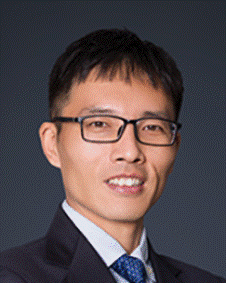
Corresponding Author: Qiu Guanglei, Professor, Doctoral Supervisor and Vice Dean of the School of Environment and Energy, South China University of Technology. His main research focuses on the principles of biological wastewater treatment processes, biological nitrogen and phosphorus removal, water treatment microbiomics and bioinformatics. He has published more than 120 SCI papers in journals such as Nature Water, The ISME Journal, Environmental Science & Technology, ISME Communications and Water Research, with an H-index of 46. He has presided over more than 20 scientific research projects including the National Natural Science Foundation of China. He has won awards such as the 2015 "Outstanding Young Researcher" of the Singapore Section of the American Institute of Chemical Engineers (AIChE), the 2023 Gold Award of the Ecological Environment Youth Technology Award of the Guangdong Environmental Science Society, the 2023 First Prize of the Innovation Award of the Invention and Entrepreneurship Award of the China Association of Inventions, the 2023 Second Prize of the Environmental Science and Technology Progress Award of the China Environmental Protection Industry Association, and the 2025 Second Prize of the Environmental Protection Science and Technology Award. He was selected into the Guangdong Provincial Talent Program in 2019. He serves as a Young Editorial Board Member of journals including Environmental Science and Ecotechnology, Chinese Chemical Letters, Environmental Chemistry and Safety and Environmental Engineering, and an Expert Member of the Guangdong Association of Environmental Protection Industry, among other positions.
Pictures & Text: Qiu Guanglei
First Review: Le Xianghui
Second Review: Wu Zhangyi
Final Review: Yan Keyou/Zhu Nengwu
Add.: School of Environment and Energy , Building No.4, 382 Outer Ring Road, Guangzhou University City, Panyu District, Guangzhou, P.R.China. Zip code: 510006
Email:scutg01@scut.edu.cn
2020 © South China University of Technology. All Rights Reserved.粤ICP备05084312号


微信公众号
扫一扫关注我们