

About


The School was established in 2004, originally named as the School of Environmental Science and Engineering, and was renamed as the School of Environment and Energy in 2012. The School has achieved rapid development. In 2006, it was granted the authority to award doctoral degrees in the first-level discipline of Environmental Science and Engineering. In 2007, a Postdoctoral Research Station in Environmental Science and Engineering was established. In 2016, the National Engineering Laboratory for Volatile Organic Compounds (VOCs) Pollution Control Technology and Equipment was approved for construction. In 2017, the Environment/Ecology discipline of our university entered the top 1% of the global ESI rankings for the first time, and the Environmental Science and Engineering discipline received an A- rating since the fourth round of the national discipline assessment. In 2019, the College successfully applied for and was granted a professional doctoral degree program in the Resources and Environment category. In 2026, the Environment/Ecology discipline of our university entered the top 1‰ of the global ESI rankings .
The School has established 10 teaching and research institutes based on disciplinary directions: Water Engineering Technology, Industrial Wastewater Treatment, Atmospheric Environment and Pollution Control, Soil Pollution Control and Remediation, Solid Waste Treatment and Resource Utilization, Pollution Control Materials and Technology, Environmental Resources and Ecology, New Energy, Environment and Energy Integration, and Environmental Health. We currently have 90 faculty and staff members.
The School is one of the first institutions in China authorized to grant Master's (1984) and Doctoral (1986) degrees in Environmental Engineering. It possesses the authority to grant Master's and Doctoral degrees in the first-level discipline of Environmental Science and Engineering and hosts a Postdoctoral Research Station, forming a complete talent training system covering undergraduate, master's, doctoral, and postdoctoral levels. Currently, there are 44 full-time postdoctoral researchers. The total student enrollment is 1,450, consisting of 459 undergraduates, 236 academic doctoral students, 114 engineering doctoral students, 320 academic master's students, and 321 full-time professional master's students.

The School has developed comprehensively in pollution control for environmental media such as water, air, solid waste, and soil, as well as in new energy development and utilization. It holds pronounced strengths in areas such as industrial wastewater treatment for typical sectors, VOCs control, and contaminated site remediation. It provides technical support for pollution control and remediation, particularly in industrial clusters. Technologies like the novel biological three-phase fluidized bed for wastewater treatment, VOCs control, and simultaneous removal of heavy metals and organic pollutants from contaminated soil have reached a domestically leading level.

The interdisciplinary focus on Green Energy Chemistry and Technology, formed through the integration of environmental and energy research, utilizes modern high-precision in-situ testing technologies. It emphasizes research on energy conversion and storage mechanisms, waste-to-energy technologies, and pollution control during energy utilization. Significant breakthroughs have been made, such as using microorganisms for in-situ reduction and extraction of precious metals from waste circuit boards and developing efficient electrocatalysts for hydrogen production. Related achievements have been published in top-tier international journals including Nature, Nature-branded journals, J. Am. Chem. Soc., and Angew. Chem. Int. Ed.

Addressing major national needs for pollution prevention and control in key regions, the College has developed engineering technologies for wastewater and waste gas treatment in key industries (e.g., coking, papermaking, printing/dyeing, petrochemicals), pollution remediation in metal mining areas and farmlands, and the disposal and resource utilization of desulfurization ash/slag from thermal power plants. A mature "Government-Industry-University-Application" mechanism for technology transfer and promotion has been established, accelerating practical engineering applications. These technologies have been implemented in over 200 projects, including in the Yantai Economic and Technological Development Zone (Shandong), Guiyu Circular Economy Industrial Park (Guangdong), Chongqing Automotive Industry Park, and Tianjin Tiantie Group, generating significant economic, social, and environmental benefits.
The School is committed to promoting teaching through research, ensuring mutual reinforcement between teaching, research, and engineering practice. It aims to cultivate academic leaders with an international perspective and strong innovative capabilities, as well as high-level technical professionals who understand industry trends and possess solid engineering skills. Initiatives include implementing an undergraduate tutorial system for comprehensive, all-round talent development; establishing various corporate scholarships and collaborating with enterprises to create an integrated "industry-academia-research" training model; incorporating research findings into undergraduate teaching to foster innovation; offering a full English-taught Environmental Engineering program to cultivate internationally competent talents; and conducting joint training programs such as "2+2", "3+2", "3+1+1", and short-term exchanges with renowned overseas universities like Rutgers University (USA), University of Edinburgh (UK), and University of Western Australia (Australia). The College has received the Second Prize of the Guangdong Provincial Teaching Achievement Award four times. It has been approved to establish 1 National First-Class Undergraduate Major, 2 National First-Class Undergraduate Courses, 1 National Boutique Video Open Course, 1 Guangdong First-Class/Key Major, 3 Guangdong First-Class Undergraduate Courses, and 1 Guangdong Curriculum Ideological and Political Demonstration Course.Regarding undergraduate programs, the College offers two majors: Environmental Engineering and Environmental Science and Engineering. Since 2018, it has admitted students under the broad category of Environmental Science and Engineering. Starting in 2025, enrollment will be conducted jointly with the School of Light Industry and Engineering Sciences and the School of Chemistry and Chemical Engineering under the "Intelligent Chemical Engineering and Low Carbon Engineering" Engineering Experimental Class.
The Environmental Engineering major has passed the National Engineering Education Accreditation four times (2011, 2014, 2017, 2023). This program aims to equip students with fundamental knowledge of environmental engineering principles, methods, and techniques, focusing on developing environmental engineering expertise, technical skills, and practical abilities.
Launched in 2019, this major offers two study modules: Environmental Science (balancing environmental science theory, environmental management, and engineering practice) and Water Engineering (focusing on water supply, wastewater treatment technology, and engineering practice). Students select one of these modules for specialized study starting from the third semester.
Starting in 2025, enrollment for this Engineering Experimental Class will be conducted as a broad category under a "1+3" training model. After completing required foundational courses in the first two semesters, students will be assigned entirely based on their preference to one of the 8 majors within this class. Students choosing Environmental Engineering or Environmental Science and Engineering in our College will begin their specialized studies in the third semester.
Enrollment for this program began in 2012, aiming to cultivate elite talents with innovative thinking and international competence. Students master the fundamental principles, methods, and techniques of environmental science and engineering, gaining engineering knowledge in pollution prevention/control (water, air, solid waste) and environmental planning/management, along with excellent English proficiency. Except for ideological and political courses, all courses are taught in English using internationally recognized textbooks from renowned universities. Faculty include in-service teachers with overseas experience and visiting professors from prestigious international institutions. Students in this program have distinct advantages in participating in international joint programs, applying to top global universities for further studies, and pursuing careers in multinational corporations. This special program was discontinued in 2025.
Enrollment for this joint program with the University of Western Australia (ranked 77th in the 2026 QS World University Rankings) began in 2017. Students spend their first three years studying alongside the Environmental Engineering (English-taught Class) at South China University of Technology. Upon meeting SCUT's credit requirements and UWA's English language requirements by the end of the third year, they transfer to UWA. Upon fulfilling the degree requirements of both universities, students receive a Bachelor's degree from SCUT and a Master's degree from UWA. This special program was discontinued in 2025.

Picture with the outstanding graduates in the 2+2 joint training program with Rutgers University
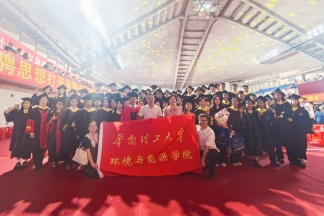
2024 Degree Conferral Ceremony Scene
The School is authorized to grant academic Master's and Doctoral degrees in the first-level discipline of Environmental Science and Engineering, and professional degrees in the Resources and Environment category. It has a well-established team of supervisors, comprising 61 doctoral supervisors and 76 master's supervisors. To date, it has conferred 489 doctoral degrees and 2,347 master's degrees. The quality of graduate training continues to improve, with a 100% pass rate in post-graduation thesis spot checks. Over the past five years, graduate students have published over 260 SCI-indexed papers annually. In 2023, the College successfully passed the verification review for its professional doctoral and master's degree programs in Resources and Environment, as well as the self-assessment for its doctoral degree program in Environmental Science and Engineering. The internationalization of graduate education is also advancing, with an increasing number of students pursuing studies abroad. In the past five years, 21 graduate students have received scholarships from the China Scholarship Council and other sources to conduct exchange studies at world-renowned universities such as the University of Washington, Columbia University, MIT, Kyoto University, and Karlsruhe Institute of Technology.
These programs cultivate academic master's and doctoral students. Since 2010 (for doctoral) and 2018 (for master's), the College has recruited and trained students under the first-level discipline of Environmental Science and Engineering, moving away from previous secondary disciplines (Environmental Engineering, Environmental Science, Environmental Ecology, Green Energy Chemistry and Technology). The programs offer six research directions: Water Environment and Pollution Control; Atmospheric Environment and Pollution Control; Theory and Technology for Contaminated Soil and Ecosystem Remediation; Solid Waste Treatment and Resource Utilization; Carbon Neutrality Theory and Technology; and New Pollutants and Environmental Health.
These programs cultivate professional master's and engineering doctoral students. Previously, the professional master's program was categorized under Engineering with a focus on Environmental Engineering, and the engineering doctoral program focused on Energy and Environmental Protection. Since 2020, both the professional master's and engineering doctoral programs have been categorized under Resources and Environment.
Focusing on national strategies for ecological environment and new energy development, and addressing key scientific and technological challenges related to water, air, soil, solid waste, carbon, and environmental health in the rapidly developing South China region, the College conducts both frontier basic research and high-level applied research. It operates 20 high-level innovation platforms, including 1 national-level (National Engineering Laboratory) and 9 provincial/ministerial-level platforms (e.g., Key Laboratory of the Ministry of Education, Guangdong Provincial Key Laboratory). Over the past five years, the College has undertaken 628 research projects with an average annual funding of approximately 70 million RMB. Faculty and students have published over 2,000 high-quality papers in journals such as Nature, Nature series, JACS, Angew, EST, WR, and EES. On average, more than 120 invention patents are granted annually, with about 12 patents transferred or licensed each year (generating an average annual licensing revenue of 1.9 million RMB). Three faculty members have been listed as 'Highly Cited Researchers' globally, one has been named an Elsevier 'Highly Cited Chinese Researcher', and twelve were included in the 2023 'Global Scholars Academic Influence Ranking'. Research outcomes have been widely applied across the country, particularly in the Guangdong-Hong Kong-Macao Greater Bay Area, creating distinctive impacts and yielding significant social, environmental, and economic benefits. The College has received 4 National Science and Technology Progress Awards (Second Prize), over 60 provincial/ministerial-level science and technology awards, 1 Chinese Patent Gold Award, 1 Silver Award, and 6 Excellence Awards.
The School undertakes research tasks related to national and local policies, regulations, development plans, and industry standards, providing advisory suggestions that have been adopted by decision-makers. It provided technical support for the national '14th Five-Year Plan' on air pollution prevention and control and the VOCs treatment plan. It has contributed to the development of 3 national/local standards, 2 industry standards, and 1 group standard, promoting technological progress in sectors like industrial coating, printing, and new energy.
The School actively participates in major national projects such as the Water Pollution Prevention and Control Action Plan ('Water Ten'), the Blue Sky Protection Campaign, the Soil Pollution Prevention and Control Action Plan ('Soil Ten'), and the Pearl River Delta Water Resources Allocation Project. It has contributed to air quality assurance, coordinated prevention and control of PM2.5 and O3 pollution, and city-specific policy research for major events like the Beijing Winter Olympics, Shanghai China International Import Expo, and the 15th National Games, receiving commendations for its work. Numerous technologies in wastewater treatment, VOCs and O3 pollution control, soil remediation, solid waste resource utilization, and carbon neutrality have been commercialized and implemented in 382 projects across 25 provinces and cities, supporting the normal operation of industries with a total output value of approximately 500 billion RMB.
The School has overcome several technical challenges, including potassium extraction from potash feldspar, heavy metal passivation, and soil compaction remediation. These technologies have been adopted by three enterprises, generating annual economic benefits of up to 1 billion RMB, improving cultivation practices over 667,000 hectares of farmland, cumulatively helping lift 5 million people out of poverty, and increasing farmer income by over 15,000 RMB per hectare.
The School has organized over 30 public science lectures, more than 160 technical training sessions on low-carbon and eco-environmental topics for industry professionals, and hosted over 3,000 student visits to its laboratories.
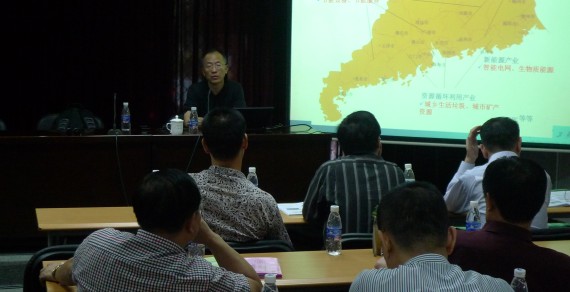
Professor Dang Zhi gave a lecture on popular science
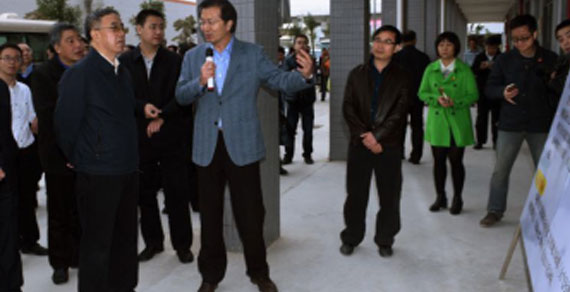
Professor Ye Daqi explained to Secretary Hu Chunhua about VOCs treatment system in Guangdong Guiyu Industrial Park
Add.: School of Environment and Energy , Building No.4, 382 Outer Ring Road, Guangzhou University City, Panyu District, Guangzhou, P.R.China. Zip code: 510006
Email:scutg01@scut.edu.cn
2020 © South China University of Technology. All Rights Reserved.粤ICP备05084312号


微信公众号
扫一扫关注我们


