


News & Notices

[Academic Achievement] Professor Chen Guangxu / Professor Qiu Guanglei’s Team of Our School Publishes Latest Achievement in Nature Water
Time:2025-09-30
Views:10
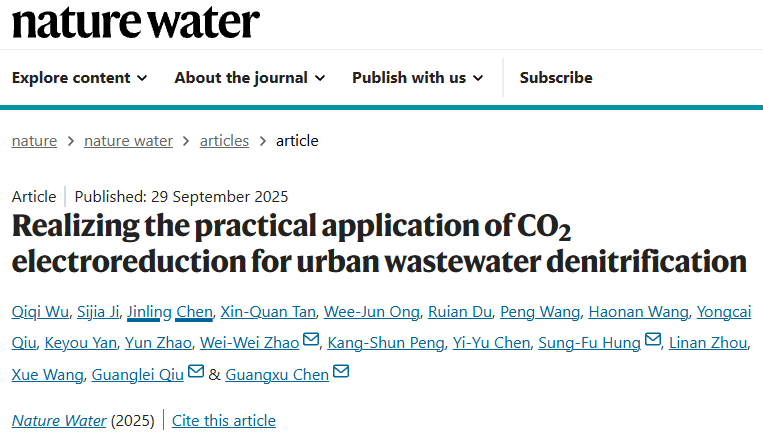
On September 29, 2025, the international top journal Nature Water published online the energy-environment integration research achievement titled Realizing the practical application of CO₂ electroreduction for urban wastewater denitrification by the team of Professor Chen Guangxu and Professor Qiu Guanglei from the School of Environment and Energy, South China University of Technology. This is also the first time that the School of Environment and Energy, South China University of Technology has published an academic research paper in Nature Water as the first corresponding unit.
CO₂ resource utilization is regarded as an important approach to achieve carbon neutrality, but a long-standing challenge is how to directly use electrochemical reduction products without complex separation and purification. At the same time, the denitrification process in urban wastewater treatment requires additional carbon sources, while existing commercial carbon sources (such as acetate) are costly and have application limitations. Based on this, the team of Professor Chen Guangxu and Professor Qiu Guanglei from our School deeply integrated disciplinary characteristics and experimental platforms. By carefully comparing the characteristics of the two systems (CO₂RR and urban wastewater denitrification treatment), they proposed a new type of electrochemical-biological coupling system, which combines CO₂ electroreduction with the urban wastewater denitrification process.
In this system, the electrocatalytic reaction efficiently generates formate (formate-e) in a neutral electrolyte, which directly serves as the carbon source and energy carrier for microbial denitrification. The experimental results show that this system not only achieves an excellent nitrate removal rate (~3.06 mg/L/h), but also that the denitrification effect of formate-e surpasses that of the traditional commercial carbon source (acetate) after long-term continuous acclimation of specific microbial communities. Further environmental and techno-economic analysis shows that if combined with an electrochemical recovery and separation system, the electrolyte cost can be significantly reduced, creating conditions for the large-scale application of this coupling system. This research provides a new idea for the coordinated development of CO₂ emission reduction and urban wastewater treatment, and also demonstrates the great potential of directly applying electrochemical products to environmental governance.
This electrochemical-biological coupling system provides a promising strategy for the direct utilization of CO₂RR products, which can be driven by photovoltaic energy, wind energy or off-peak grid power. Future research will focus on developing stable and efficient CO₂RR/CORR systems (including reaction devices and catalysts) to achieve efficient synthesis of C₂+ liquid products such as ethanol, acetate and n-propanol. These small molecules with high energy density are expected to further improve the efficiency and economy of biological denitrification. Moreover, with the continuous optimization of engineering design, this system has the potential to achieve the unification of technical feasibility and economic feasibility. More importantly, by recovering and using CO₂ released from thermal power generation, sludge or waste incineration, and biological denitrification as reaction raw materials, it is expected to achieve net-zero emissions and even move towards carbon-negative emissions. In general, this research establishes a sustainable path for the industrial application of CO₂RR and provides the possibility for expansion to other electrochemical synthesis reactions.
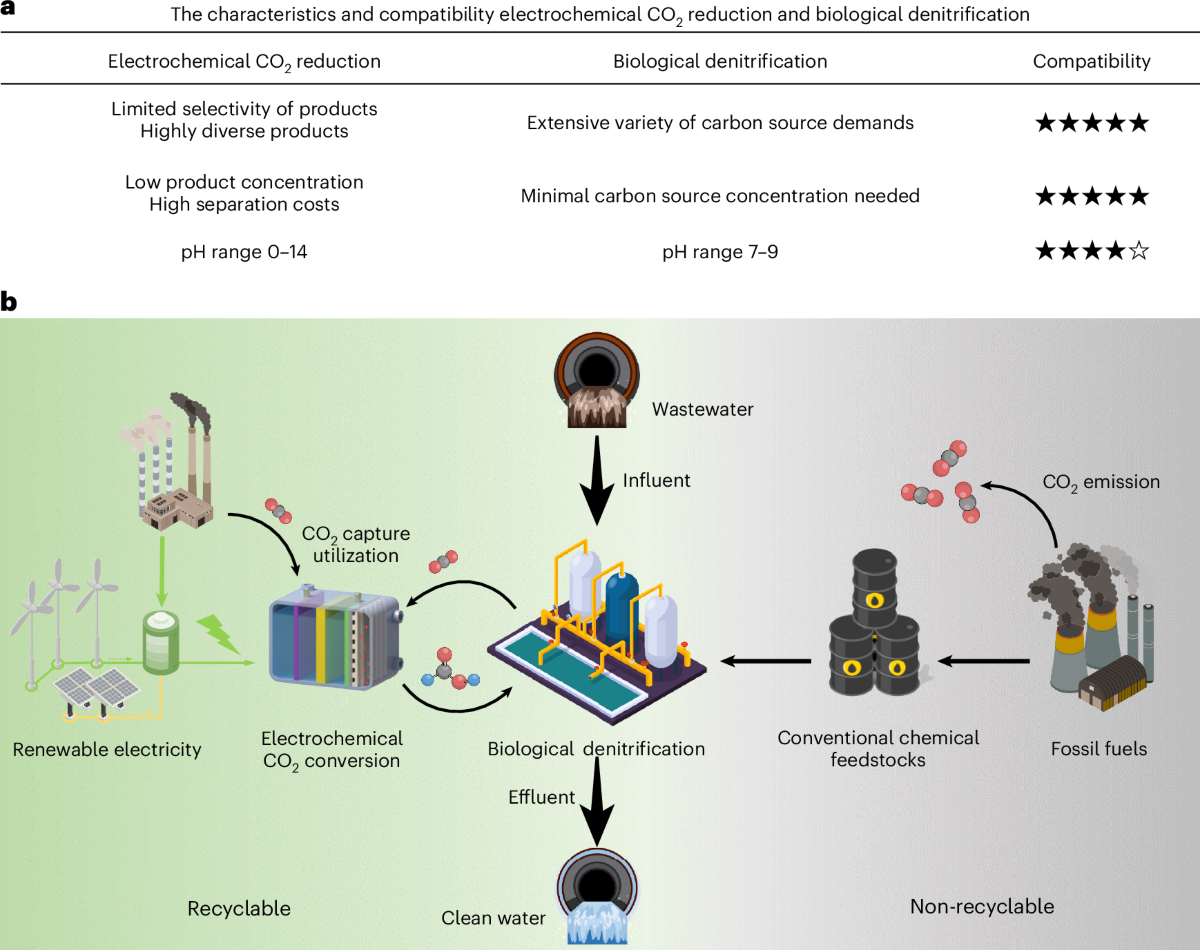
Figure 1. Electrochemical-biological denitrification coupling system
The first completing unit of this paper is South China University of Technology. Dr. Wu Qiqi (2020 cohort), Ph.D. student Ji Sijia (2025 cohort) and Master Chen Jinling (2021 cohort) are the co-first authors. Professor Chen Guangxu, Professor Qiu Guanglei and Professor Zhao Weiwei from Nanjing University are among the co-corresponding authors. This work has received strong support from funds such as the National Natural Science Foundation of China, Guangdong Provincial Talent Program, and Xinghua Talent Program.
Author Profiles:
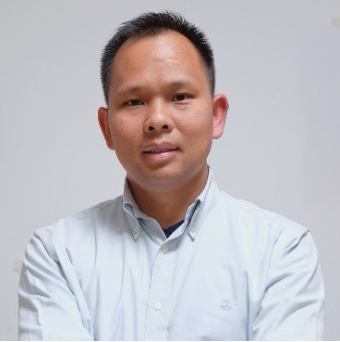
Chen Guangxu, Professor and Doctoral Supervisor of South China University of Technology, National High-Level Overseas Young Talent. He studied under Academician Zheng Nanfeng of Xiamen University for his doctoral degree and Academician Cui Yi of Stanford University for his postdoctoral research. His main research focuses on the basic research of precise and efficient conversion of small molecules in energy and environment, including the controlled synthesis of functional nanomaterials, structural characterization, electro/thermal catalytic performance, reaction mechanisms, and the design and development of reaction systems. He has successively undertaken the National High-Level Overseas Young Talent Program, served as the principal investigator of a key project under the "Key Technologies and Equipment for Circular Economy" key special project of the Ministry of Science and Technology’s Key R&D Program (1 project), presided over General Programs of the National Natural Science Foundation of China (2 projects), a foreign expert project of the Ministry of Science and Technology (1 project), Guangdong Provincial Talent Programs (2 projects in total), and Guangdong Provincial-level projects (6 projects). In recent years, he has published more than 60 SCI papers in internationally renowned journals, among which the first author (including co-first author) or corresponding author papers include Science (1), Nat. Mater. (1), Nat. Catal. (1), Nat. Water (1), Nat. Commun. (4), JACS (1), ACS Catal. (2), Nano Lett. (2), Adv. Funct. Mater. (1), Environ. Sci. Technol. (2), ACS Nano (5), Small (2) and iScience (1). His papers have been cited more than 15,000 times (Google Scholar), including 7 ESI Highly Cited Papers, and his current H-index is 49. He has applied for 19 national invention patents (8 authorized), 1 PCT patent, and 2 patents have been transformed. He won the 2018 National Natural Science Second Prize for Surface Coordination Chemistry of Metal Nanomaterials.

Qiu Guanglei, Professor, Doctoral Supervisor and Vice Dean of the School of Environment and Energy, South China University of Technology. His main research focuses on the principles of biological wastewater treatment processes, biological nitrogen and phosphorus removal, water treatment microbiomics and bioinformatics. He has published more than 120 SCI papers in journals such as Nature Water, Environ Sci Technol, ISME Commun and Water Res, with an H-index of 42. He has presided over more than 20 projects including the National Natural Science Foundation of China. He has won awards such as the 2015 "Outstanding Young Researcher" from the Singapore Section of the American Institute of Chemical Engineers (AIChE), the 2023 Gold Award of the Ecological Environment Youth Technology Award of the Guangdong Environmental Science Society, the 2023 First Prize of the Innovation Award of the Invention and Entrepreneurship Award of the China Invention Association, and the 2023 Second Prize of the Environmental Science and Technology Progress Award of the China Environmental Protection Industry Association. He was selected into the Guangdong Provincial Talent Program in 2019. He serves as a young editorial board member of journals such as Environmental Science and Ecotechnology, Chinese Chemical Letters, Environmental Chemistry and Safety and Environmental Engineering, and an expert member of the Expert Technical Committee of the Guangdong Environmental Protection Industry Association.
Text & Photos: Chen Guangxu/Qiu Guanglei
First Review: Le Xianghui
Second Review: Chen Li’e
Final Review: Yan Keyou/Zhu Nengwu
Add.: School of Environment and Energy , Building No.4, 382 Outer Ring Road, Guangzhou University City, Panyu District, Guangzhou, P.R.China. Zip code: 510006
Email:scutg01@scut.edu.cn
2020 © South China University of Technology. All Rights Reserved.粤ICP备05084312号


微信公众号
扫一扫关注我们