SCUT’s Proposal Wins Concept Design Award at the "Better Design Award" International Design Competition: Bridging National Innovation, Industrial Upgrading, and Social Welfare Through Design Collaboration Technology
发布时间:2026.04.22
Recently, the results of the 2025 “Better Design Award” (BDA) were announced, and the awards ceremony was broadcast simultaneously on China Media Group’s video platform and CCTV-4 (Chinese International Channel). As an international comprehensive design competition established under the guidance of China Media Group, the People’s Government of Guangdong Province, the People’s Government of Guangzhou, and the People’s Government of Shenzhen, the competition has become an important platform for showcasing Chinese design concepts and promoting international design exchange.
Competition of this year focuses on the development of “new-quality productive forces”, with an evaluation framework centered on “forward-looking vision, industrial applicability, and people-oriented principles.” Among the 15,691 entries submitted from 69 countries and regions worldwide, the School of Design leveraged South China University of Technology (SCUT)’s strengths in engineering, actively collaborated with multiple schools, and promoted deep synergy between design and cutting-edge technologies, fully demonstrating the significant value of design in facilitating technology transfer and addressing real-world needs.
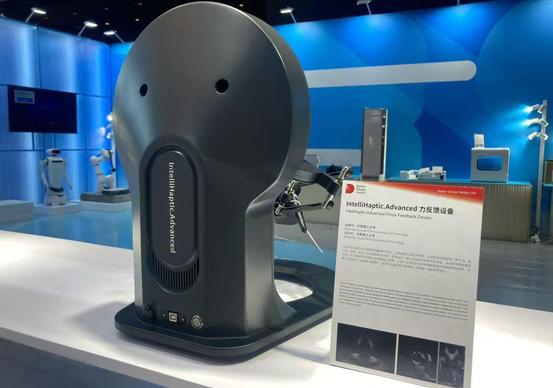
The SCUT’s entry, “IntelliHaptic.Advanced Force Feedback Device”, won the Concept Design Award. The project is based on the National Key Research and Development Program project titled “Highly Immersive Natural Human-Computer Interaction System with Multi-Channel Audio-Visual-Tactile Fusion”, led by Professor Xu Xiangmin and Professor Wang Qinghui. It was jointly developed by Liao Dan, an associate professor at the School of Design, along with students Zeng Zhiquan and Ding Wanchun, and the engineering and technical team, and was showcased at the exhibition held concurrently with the awards ceremony.
Centered on the integration of visual, auditory, and tactile channels, this project explores systematic design approaches focused on haptic interaction and typical application scenarios. Through the deep integration of technology and design, it demonstrates significant social value and promising prospects for industrial application: in the fields of industrial teleoperation and medical virtual training, the equipment offers exceptional immersion and safety, effectively addressing perception challenges in complex operations and accelerating the industrialization of high-tech innovations; In the cultural tourism sector, the system enables audiences to “touch” the textures of millennia-old artifacts from a distance, using digital experiences to revitalize cultural memory and foster cultural confidence and innovation in cultural tourism; in the realm of social care, the team collaborated with Associate Professor Liao Dan’s Ministry of Education Humanities and Social Sciences research project, “Study on the Assessment of Cognitive Decline in the Elderly and the Design of Intervention Scenarios”, integrating VR technology to build an immersive experience platform that provides new pathways for the assessment and intervention of cognitive decline in the elderly. The project fully demonstrates the design discipline’s ability to systematically design and translate interactive logic, user experience, aesthetic value, and practical utility within complex technological systems.
This award and participation in the exhibition represent a milestone achievement in our university’s ongoing efforts to promote interdisciplinary collaborative education and deepen the integration and innovation of “design, technology, and industry”. Through the platform of the “BDA” International Design Competition, the university has used design as a key link to establish effective connections between national strategies, industrial needs, and public concerns, continuously proposing “SCUT’s Solutions” that are grounded in engineering, oriented toward practical applications, and centered on human-centered values.