In the field of condensed matter physics and spintronics research, topological magnetic solitons have attracted much attention due to their unique stability and controllability. Representative examples include the widely studied two-dimensional Skyrmion and the cutting-edge three-dimensional Hopfion. Due to its characteristics such as closed winding and three-dimensional spatial localization, Hopkinson is expected to be developed as the next generation of high-density and low-power information functional devices. Previously, studies have found that Hopkinson can stably coexist with skyrmions to form circular structures, but the experimental discovery of isolated and stable Hopkinson remains challenging.
Recently, a research team from South China University of Technology, in collaboration with Nankai University and South China Normal University, as well as theoretical teams from Germany's Ulrich Research Center and Sweden's Uppsala University, published a research paper in Nature Physics. Using femtosecond laser pulses, stable nucleation of isolated Hopkins was achieved in chiral magnet FeGe.
Research has found that femtosecond pulses of ultrafast lasers can effectively achieve transitions between various metastable states, effectively increasing the probability of isolated Hopkinson nucleation. Based on theoretical calculations, it was further discovered that the nucleation of Hopf bosons originates from the topological transition of skyrmion anti skyrmion pairs to Hopf bosons. This work also demonstrates that femtosecond lasers can effectively achieve the writing of topological states, providing another powerful technical means for subsequent research on topological magnetism and the development of topological spintronics devices.
This work has received support from the National Natural Science Foundation of China, the National Key Research and Development Program, the Guangdong Quantum Science Strategic Special Project, the Guangzhou Basic and Applied Basic Research Program, and the Xiaomi Foundation.
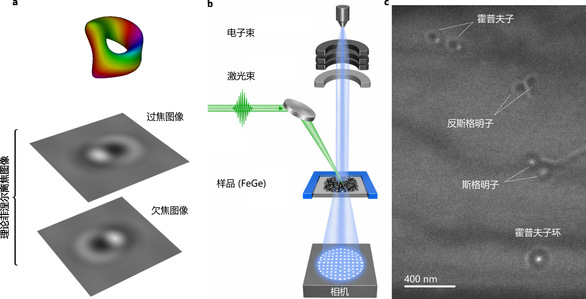
Figure a, Schematic diagram of the magnetic configuration of isolated Hopkinson and its theoretical Fresnel defocused electron microscopy image; b, Schematic diagram of in-situ ultrafast laser Lorentz transmission electron microscope; c, Ultrafast laser pulses induce the nucleation of various topological magnetic solitons.
Paper Information:Chen, X. et al. Laser-induced nucleation of magnetic hopfions. Nature Physics (2026). https://www.nature.com/articles/s41567-026-03236-0