The research group led by Associate Professor Wen Yang from our School has recently achieved a series of important breakthroughs in the field of Gallium Nitride (GaN) power devices. The related studies have been published in leading international journals in power electronics and microelectronic devices, including IEEE Transactions on Power Electronics, Applied Physics Letters, and IEEE Transactions on Electron Devices. These achievements span the entire research chain from reliability physics under extreme stress conditions, intelligent modeling technologies, to online monitoring techniques for GaN power devices, forming a comprehensive closed-loop technological framework.
1. Online Monitoring Method for p-GaN Power Devices Based on the Variation Rate of On-State Drain Current
In practical power electronic systems, p-GaN power devices are frequently subjected to repetitive electrostatic discharge (ESD) stress, while their degradation states are difficult to capture in real time using conventional offline characterization methods. Therefore, the development of non-invasive online monitoring techniques is of great engineering significance. To address this challenge, the research team, for the first time, established a direct correlation between the variation rate of drain current and the operating state of the device. Based on the physical relationship between the variation rate of on-state drain current and key device parameters such as threshold voltage and interface-state density, a non-invasive sensing circuit platform embedded into the operating loop was developed. This platform successfully enabled online prediction of the degradation trends of device characteristic parameters under gate ESD stress.
This work was published in IEEE Transactions on Power Electronics, with Xiangxing Jiang, a master’s student enrolled in 2023, as the first author.
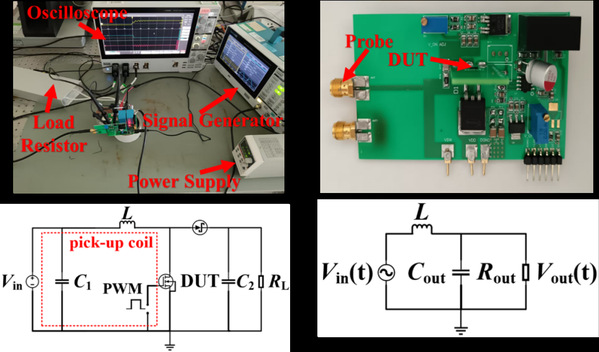
Figure 1. Circuit platform and equivalent circuit diagram for p-GaN device condition monitoring.
Article link: https://doi.org/10.1109/TPEL.2026.3651313
2. Investigation of Interface Bond-Breaking Dynamics and TDDB Degradation Mechanisms in GaN FinFETs
GaN FinFETs exhibit excellent gate control and high power-density potential, making them highly promising for high-frequency power-electronic applications such as tertiary power supplies in data centers. However, due to the coexistence of polar and non-polar crystal planes at the bipolar gate interface, the degradation mechanisms of these devices are significantly more complex than those of conventional planar devices. A clear physical understanding is still lacking, which severely limits the establishment of reliable reliability evaluation and lifetime prediction methodologies. To address this issue, the research group systematically conducted constant-voltage stress tests at both room temperature and elevated temperatures. The study revealed the existence of two competing failure mechanisms in the devices and further proposed an interpretation model based on “bond-breaking dynamics.” This model corrected the lifetime prediction deviation caused by the traditional Area Scaling Law based approach and established a physical foundation for accurate lifetime prediction of GaN FinFET devices.
This work was published in Applied Physics Letters, with Peng Wu, a Ph.D. student enrolled in 2023, as the first author.
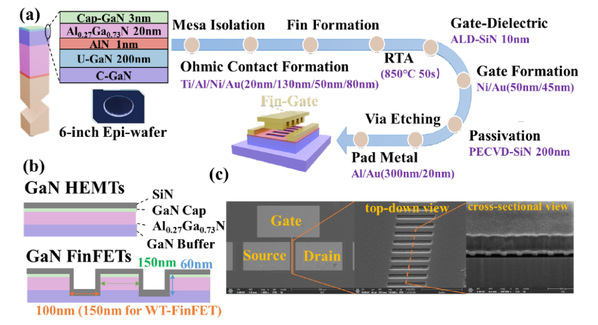
Figure 2. Mechanism analysis and cross-sectional experimental images of the GaN FinFET interface.
Article link: https://doi.org/10.1063/5.0327282
3. Gate Reliability and Degradation Mechanisms of p-GaN HEMTs Under Cryogenic Conditions
Cryogenic environments encountered in deep-space exploration and quantum computing systems place urgent demands on highly reliable power devices. However, the gate degradation mechanisms and trap behaviors of p-GaN HEMTs under extremely low temperatures remain insufficiently understood, particularly regarding the influence of trap-freezing effects. Thus, the research team systematically investigated the threshold-voltage degradation mechanisms of p-GaN HEMTs under Positive-Bias Temperature Instability (PBTI) stress at an ambient temperature of 10 K. The study focused on gate-trap behaviors induced by trap-freezing effects and innovatively discovered that the threshold-voltage jump under cryogenic conditions exhibits a non-Arrhenius relationship. These findings deepen the understanding of trap dynamics in GaN devices operating under ultra-low-temperature conditions.
This work was published in IEEE Transactions on Electron Devices, with Chuan Song, a Ph.D. student enrolled in 2024, as the first author.
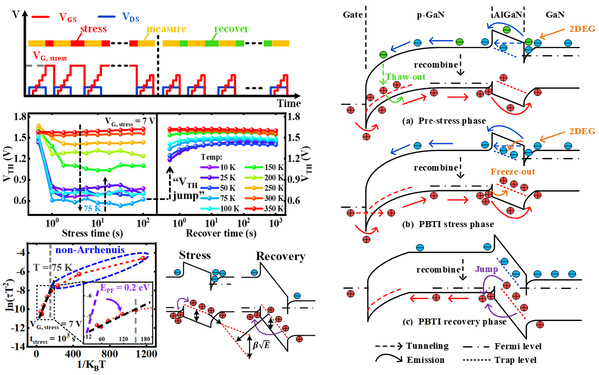
Figure 3. Experimental results and mechanism illustrations of p-GaN HEMTs under cryogenic conditions.
Article link: https://doi.org/10.1109/TED.2026.3688227
4. Accurate Dynamic On-Resistance Modeling of GaN HEMT Devices Based on Neural Networks
Accurate modeling of the dynamic on-resistance of GaN HEMT power devices is critical for the design of power electronic converters. However, conventional methods rely heavily on large amounts of experimental data and often fail to simultaneously account for physical laws and device-to-device variations, resulting in limited modeling efficiency and generalization capability. To overcome these limitations, the research group proposed a Device-Adaptive Physics-Informed Neural Network (DA-PINN) framework and its sequential variant. By using static on-resistance as a bridge and incorporating physics-based constraints, the proposed method enables accurate extrapolation and prediction with only a small amount of measurement data. This work provides a new method for reliability-oriented design and performance evaluation of GaN devices that is both data-efficient and physically consistent.
This work was published in IEEE Transactions on Electron Devices, with Jingyun Guan, a direct-entry Ph.D. student enrolled in 2024, as the first author.
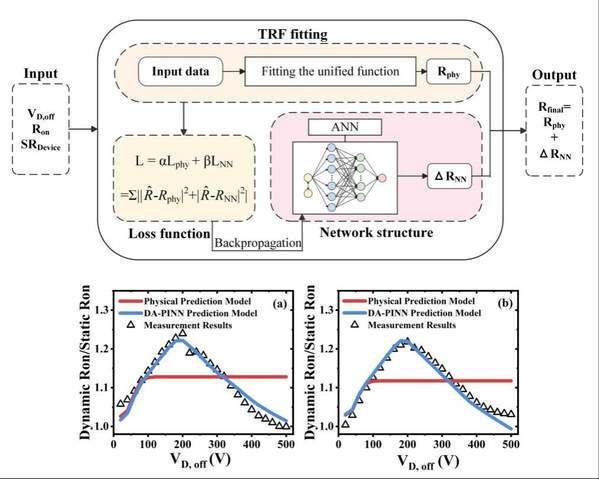
Figure 4. Schematic illustration of the DA-PINN framework and leave-one-out prediction results for two representative devices.
Article link: https://doi.org/10.1109/TED.2026.3691728
All of the above studies were conducted with Associate Professor Wen Yang as the corresponding author, and South China University of Technology as the first affiliated institution. From the exploration of fundamental semiconductor failure physics, to accurate modeling using state-of-the-art AI algorithms, and further to system-level non-invasive online monitoring, these research achievements effectively address critical industry challenges faced by GaN power devices under extreme operating conditions, including difficulties in lifetime prediction, large device-to-device variations, and insufficient condition-monitoring techniques. The work provides both theoretical support and engineering methodologies for the design and evaluation of next-generation highly reliable power electronic systems.
Author Introduction
Wen Yang is an Associate Professor and Ph.D. advisor at South China University of Technology and has been selected for the Guangdong Provincial High-Level Talent Program. He received his Ph.D. degree from the University of Central Florida and has long been engaged in research on the reliability of wide-bandgap semiconductor devices, failure analysis of power semiconductors, and the reliability of mixed-signal integrated circuits. He possesses extensive international industrial experience and previously worked as a Senior Engineer at Analog Devices (ADI), one of the world’s leading semiconductor companies. During his tenure, he led failure analysis, process optimization, and yield enhancement for mixed-signal integrated circuits, providing key technical support for the mass production of multiple process platforms. He has published more than 20 papers in leading international journals and conferences, including IEEE Electron Device Letters (IEEE EDL), Applied Physics Letters (APL), IEEE Transactions on Electron Devices (IEEE T-ED), and the IEEE International Reliability Physics Symposium. He has also delivered four oral presentations at top international conferences such as the IEEE International Reliability Physics Symposium and the International Symposium on Power Semiconductor Devices and ICs. In addition, he previously served as Chair of the IEEE Electron Devices Society Orlando Section. He is currently leading and participating in eight research projects related to the reliability of wide-bandgap power semiconductor devices, including projects funded by the National Natural Science Foundation of China, the Guangdong Natural Science Foundation, Guangdong Provincial Key R&D Programs, and open research programs of State Key Laboratories. He has also established long-term collaborations with several leading institutions and companies in the power semiconductor industry.
Journal Introduction
IEEE Transactions on Power Electronics (IEEE T-PE)
Published by the IEEE Power Electronics Society, IEEE Transactions on Power Electronics is one of the world’s leading journals in the field of power electronics. It serves as a benchmark for both academic research and engineering applications in power electronics, representing the highest technical standards in power conversion, power semiconductor applications, and control technologies.
Applied Physics Letters (APL)
Applied Physics Letters is a long-established and highly prestigious international journal in the field of applied physics. As one of the most influential rapid-publication journals in this area, APL focuses on the fast dissemination of highly innovative research findings with immediate physical significance.
IEEE Transactions on Electron Devices (IEEE T-ED)
Published by the IEEE Electron Devices Society, IEEE Transactions on Electron Devices is one of the most authoritative and longstanding top-tier journals in microelectronics and semiconductor devices. It is widely recognized as a flagship journal in the field of electronic-device research.