To further promote international exchange and cooperation in civil engineering at the School of Civil Engineering and Transportation and broaden the academic horizons of its faculty and students, the School of Civil Engineering and Transportation successfully held the 3rd session (the total of 103 overall sessions) of its FUSE: Future Urban Systems Engineering Lecture Series on the morning of May 15, 2026, in Conference Room 7201 of Building 7. The event featured Associate Professor Jingyao Zhang from the Department of Architecture, Graduate School of Engineering, Kyoto University, as the keynote speaker. The session was co-hosted by Associate Professor Taicong Chen, Deputy Director of the Urban Operation and Maintenance Management Department, and Professor Xinhao He from the Green Digital Intelligence Construction Department. A total of eight faculty members and over 40 students attended the lecture and engaged in academic exchanges.
This lecture focused on recent advancements in structural stiffness identification, time-frequency analysis, and sensing technologies under seismic loads (Title: Structural Stiffness Identification, Time-Frequency Analysis, and Sensing Technologies Under Seismic Action). As Japan is located in a seismically active region, building structural stiffness identification and damage assessment technologies serve as fundamental pillars for post-earthquake safety evaluation, disaster prevention and mitigation, and structural reinforcement. Professor Zhang systematically presented several cutting-edge breakthroughs in this field, drawing on both current industry developments and his extensive research experience.
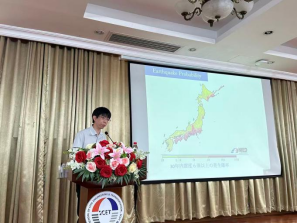
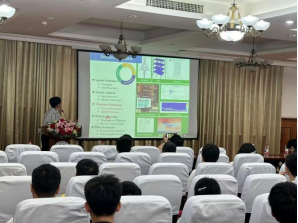
During the presentation, Professor Zhang first introduced a groundbreaking method for assessing structural stiffness. This approach eliminates the complex frequency extraction processes inherent in traditional methods, delivering significant improvements in real-time computational efficiency, calculation accuracy, and overall system stability. To address stiffness degradation under seismic loads, he developed a stiffness identification framework based on modal parameters such as natural frequencies and vibration modes, enabling precise capture of dynamic stiffness variations throughout earthquake events. For analyzing nonlinear and non-stationary response signals characteristic of building structures, he created an efficient time-frequency analysis technique. Considering the common phenomenon of stiffness recovery after structural damage, this method balances analytical precision with operational simplicity while integrating theoretical rigor with practical engineering applicability, effectively tracking structural transient responses during earthquakes. Finally, Professor Zhang showcased his team's latest high-precision acceleration sensor, specifically optimized for low-frequency vibration detection, further enhancing the hardware capabilities of structural monitoring systems.
The entire lecture was comprehensive and logically structured, closely addressing cutting-edge topics in the field of disaster prevention and mitigation engineering. During the Q&A session, attendees actively raised questions regarding technical principles, practical engineering applications, and research directions discussed in the lecture, which Professor Zhang addressed meticulously one by one, fostering a lively interactive atmosphere. Additionally, during the post-lecture guidance sessions for graduate students, he shared insights on academic planning and research methodologies based on his overseas study and teaching experience, offering guidance on cultivating a rigorous and pragmatic research approach. Participants unanimously agreed that the lecture not only provided an in-depth understanding of recent advancements in earthquake engineering and structural monitoring but also broadened their international academic perspectives, proving highly enlightening for their future academic studies and research endeavors.
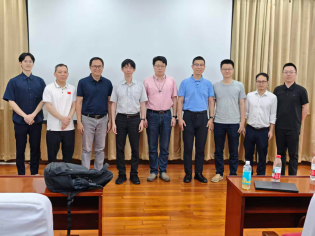
The School has long been committed to establishing the FUSE Lecture as a high-level international academic exchange platform, consistently inviting renowned experts and scholars from around the world to deliver academic presentations, and striving to foster an open, innovative, and diverse academic environment. The hosting of this lecture has further strengthened our institute's academic ties with prestigious Japanese universities and advanced research in architecture and civil engineering, particularly in areas such as earthquake disaster prevention and structural monitoring. Moving forward, the institute will continue organizing a series of international academic events to harness global expertise, promote high-quality disciplinary development, and actively support major national strategies for disaster prevention and mitigation.
[Profile of the Speaker] Associate Professor Jingyao Zhang possesses a solid academic foundation and extensive experience in international research and teaching. He graduated with a bachelor's degree from Zhejiang University in 2001 and obtained his Master's and Ph.D. degrees in Engineering from Kyoto University in 2005 and 2007, respectively. Prior to joining Kyoto University, he served as a researcher at Kyoto University, lecturer at Ritsumeikan University, and associate professor at Nagoya City University, where he has dedicated years to advancing research in structural engineering. His primary research focuses include shape optimization and stability theory for novel spatial structures such as tensioned structures, nonlinear dynamic analysis of structures, and structural health monitoring. Recognized for his outstanding contributions, he has received prestigious awards including the Japan Architectural Society Award (Paper Category) and the Hangai Prize from the International Association for Shell and Spatial Structures (IASS). Additionally, he holds multiple academic positions, including Secretary of the Asia-Pacific Conference on Spatial Structures (APCS 2025), Standing Member of the Kinki Branch of the Japan Architectural Society, and holds significant influence in the global fields of architectural and spatial structure research.

