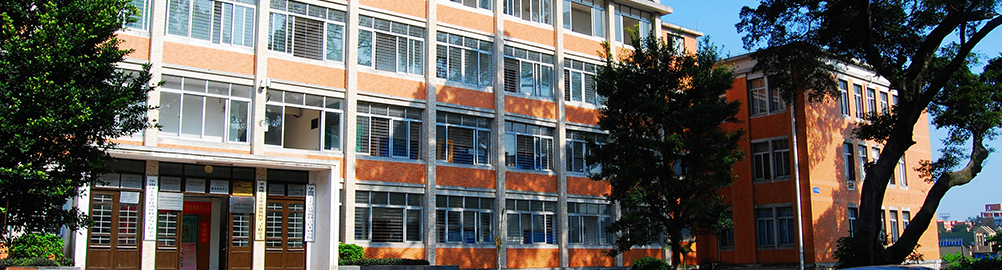
The 2026 International Conference on Complex Systems and Automation Control (CSAC 2026) successfully wrapped up in Guangzhou on June 6, 2026. Hosted by South China University of Technology (SCUT) and undertaken by the School of Automation Science and Engineering of SCUT, the event received strong support from IEEE SMC Guangzhou Chapter, IEEE CSS Guangzhou Chapter, IEEE Technical Committee on Cybernetics of Complex Systems and other organizations.
Scholars, experts and technical professionals from numerous domestic and overseas universities, research institutions and industrial enterprises gathered at the conference. Participating institutions include Harbin Institute of Technology, Northeastern University, Tongji University, Shandong University, National University of Defense Technology, Air Force Early Warning Academy, Minzu University of China, Guangdong University of Technology, Southwest Jiaotong University, The Chinese University of Hong Kong and more. Participants conducted in-depth exchanges on the latest research hotspots, innovative achievements and industrial practices in complex systems, automation and advanced control, bringing new perspectives and inspirations for future theoretical research and engineering applications.
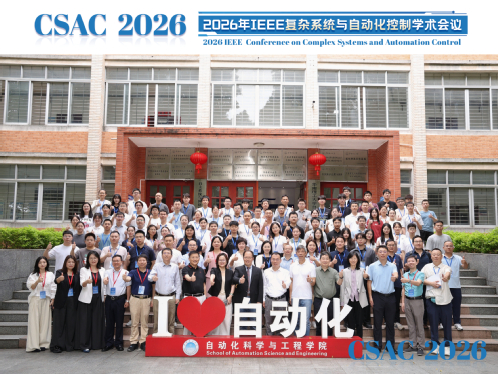
Group Photo of All Participants
The opening ceremony was presided over by Professor Cong Yang, Dean of the School of Automation Science and Engineering, SCUT. Professor Xu Yong, Vice President of SCUT, attended and delivered an opening speech. On behalf of the organizer, Professor Xu extended a sincere welcome to academicians, experts, scholars and industrial guests from home and abroad. Focusing on three cutting-edge directions — complex systems, automation and advanced control — he elaborated on the conference background, disciplinary value and the significance of industry-university-research collaborative development. After the speech, all attendees took a group photo, setting a rigorous, pragmatic and academically vibrant tone for the whole event.
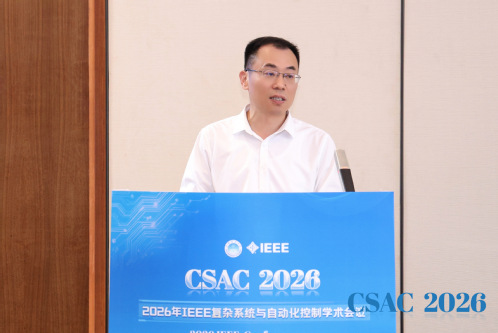
Professor Xu Yong delivers the opening speech
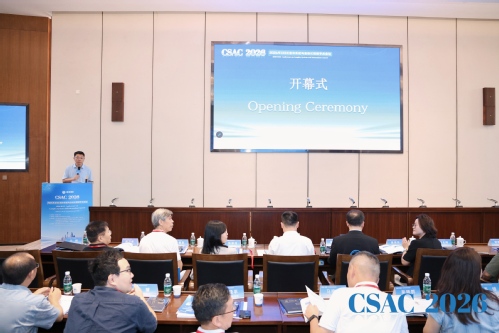
Professor Cong Yang presides over
Five distinguished experts and national talents delivered keynote speeches, sharing cutting-edge research outcomes, unique insights as well as the development trends and future research directions of the industry. Their remarkable presentations sparked heated discussions among attendees and fully demonstrated the academic depth and influence of the conference.
1.Academician Duan Guangren, Harbin Institute of Technology
Speech Title: FAS Approach: From State Feedback to Output Feedback
Academician Duan systematically illustrated the background and evolution of the Fully Actuated System (FAS) approach, and mainly presented its application in output feedback control of nonlinear dynamic systems, proposing a new theoretical framework and ideas for control system design.
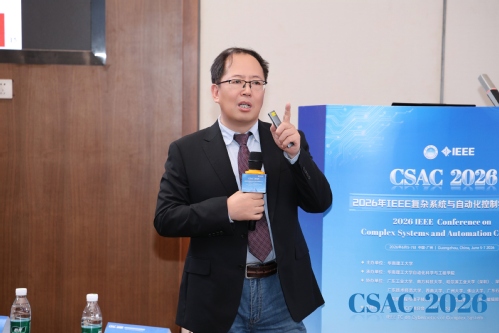
Keynote Speech 1: Professor Duan Guangren
2.Professor Zhang Yingwei, Northeastern University
Speech Title: Intelligent sensing, intelligent control, intelligent scheduling, and AI security
Professor Zhang shared an innovative intelligent perception method that realizes virtual-real twin evolution and reverse reasoning of manufacturing operations based on the Industrial Internet. He also discussed the challenges and corresponding solutions for intelligent control, scheduling and AI security.
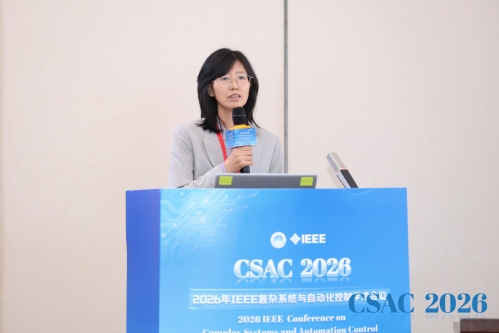
Keynote Speech 2: Professor Zhang Yingwei
3.Professor Dong Hairong, Tongji University
Speech Title:Key Technologies for Autonomous Rail Transit and AI-Enabled Maintenance
Centering on autonomous operation and intelligent maintenance of rail transit, Professor Dong introduced the latest research progress in holographic perception, embodied driving, collaborative control, intelligent scheduling and digital-intelligent operation & maintenance, providing technical support for building a new generation of safe and smart rail transit systems.
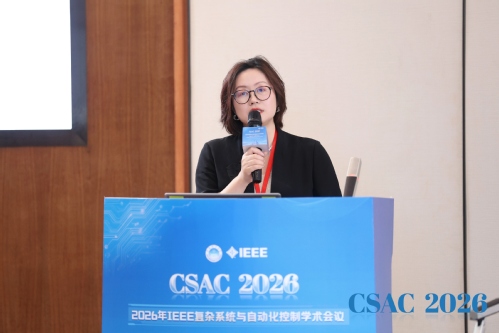
Keynote Speech 3: Professor Dong Hairong
4.Professor Liu Yungang, Shandong University
Speech Title: Hyperexponential stability and stabilization for uncertain nonlinear systems
Professor Liu defined super-exponential stability under a unified framework and established its necessary and sufficient conditions. He also designed feedback control schemes to achieve global super-exponential stabilization for a class of uncertain nonlinear systems.
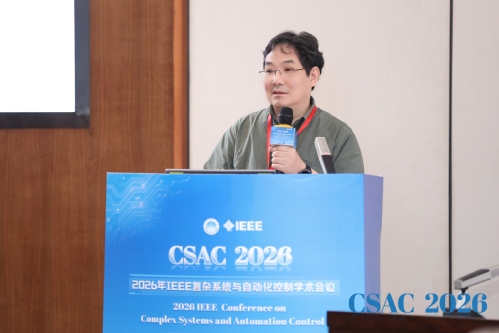
Keynote Speech 4: Professor Liu Yungang
5.Professor Cong Yang, South China University of Technology
Speech Title: Robot 3D Embodied Artificial Intelligence and Autonomous Manipulation
Aiming to improve the autonomous manipulation capability of embodied intelligent systems, Professor Cong analyzed key challenges including visual recognition, scene generalization, and manipulation of long-sequence and non-rigid objects under complex conditions, and put forward novel solutions.
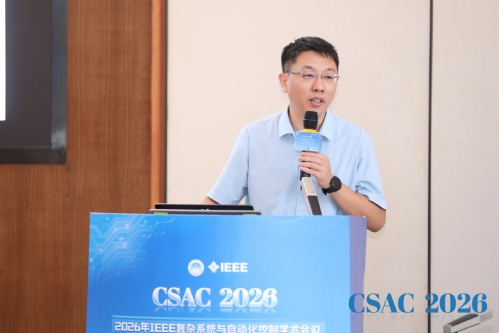
Keynote Speech 5: Professor Cong Yang
Three industrial experts and technical specialists shared practical cases and application achievements of cutting-edge technologies, and discussed industrial pain points and future development directions. Their speeches facilitated in-depth dialogues and integration between academia and industry.
1.Dr. Ma Xiaoliang, China Telecom Guangdong Branch
Speech Title: Research and Application of 5G Cloud-Based Control in the AI Era
Supported by national key R&D programs, Dr. Ma introduced the construction of an innovative terminal-network-cloud-application control architecture and the self-developed domestic 5G cloud-based PLC system, which has been applied in scenarios such as Midea Lighthouse Factory. The results provide solid support for independent and controllable industrial control systems as well as industrial digital transformation.
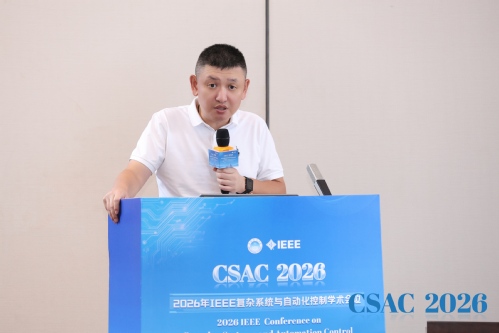
Industrial Report 1: Dr. Ma Xiaoliang
2.Mr. Tao Yang, Guangzhou Robustel Internet of Things Technology Co., Ltd.
Speech Title: Industrial Edge Infrastructure for Physical AI:Bridging Cloud Intelligence and Real-World Systems
Mr. Tao discussed key technologies including industrial edge networks and edge computing platforms. He also presented the architecture of an open industrial edge infrastructure oriented to Physical AI and its global deployment cases, offering a new paradigm for connecting cloud intelligence and physical world systems.
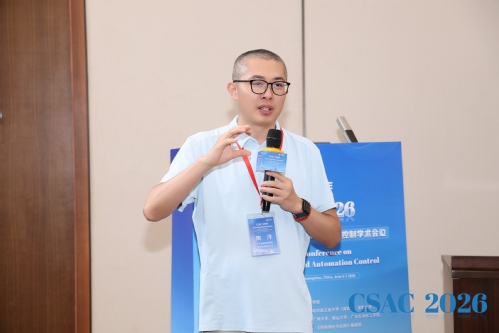
Industrial Report 2: Mr. Tao Yang
3.Dr. Dai Zhen, China Southern Power Grid Digital Group
Speech Title: AI-powered scientific computing in power systems contributes to safe and efficient grid analysis and control
Dr. Dai elaborated on the application of AI-based electric scientific computing in power grid operation. He introduced the development of large-scale electric scientific computing models and multi-business intelligent agents, which enable efficient and high-precision solutions for core tasks and guarantee the construction of new-type power systems.
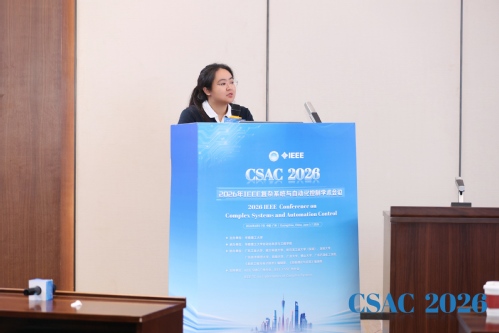
Industrial Report 3: Dr. Dai Zhen
The conference was divided into two parallel sessions after the keynote and industrial reports.
Parallel Session 1: Nominated Excellent Paper Presentations:
Nine young scholars from Air Force Early Warning Academy, Minzu University of China, Guangdong Polytechnic College, Guangdong University of Technology, Foshan University, National University of Defense Technology, Guangxi University, SCUT and other institutions delivered presentations. Their research topics cover fault prediction of phased array radar T/R modules, deliberation convergence control of LLM multi-agents, analytical tuning of PI parameters for permanent magnet synchronous motors, edge-cloud collaborative gas decoupling framework, sampler-based observer design for uncertain stochastic nonlinear systems, adaptive operation methods for aerospace TT&C systems, periodic event-triggered consensus control of stochastic multi-agent systems, indefinite linear quadratic optimal control of stochastic impulsive systems, and stabilization of stochastic sampled-data networked control systems. All presentations showcased high-level research achievements and innovative ideas.
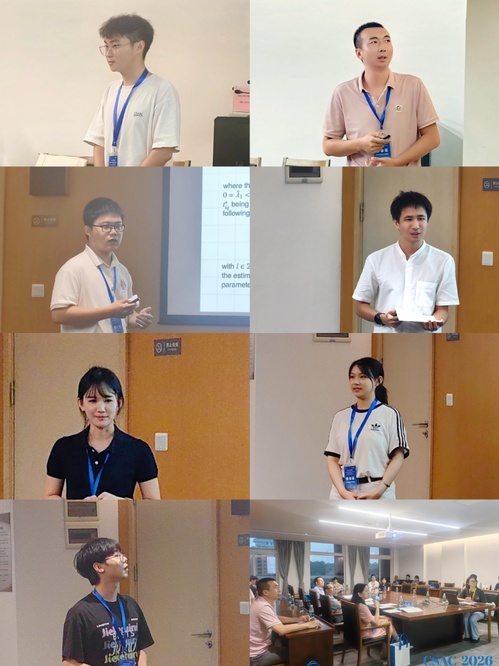
Selected Nominated Presentations of Excellent Papers
Parallel Session 2: Invited Presentations:
1.Dr. Wang Ji, Xiamen University
Speech Title: Safe output regulation of distributed parameter systems
Focusing on distributed parameter systems described by partial differential equations, Dr. Wang constructed a boundary control framework combining backstepping method and control barrier functions to balance steady-state performance and operational safety. Adaptive identification optimization was also adopted to reduce the conservatism of secure control for uncertain systems.
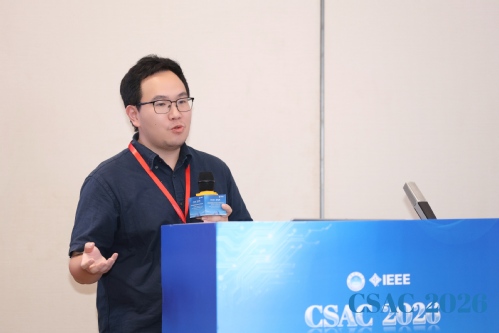
Invited Speech 1: Wang Ji
2.Dr. Hu Zhipei, South China University of Technology
Speech Title: Consensus Control of Multi-Agent Systems under Energy Harvesting Constraints
Dr. Hu established a coupling error model integrating stochastic sampling and energy constraints, and deduced the probabilistic recurrence law of system energy. Based on the equivalence theory of continuous and discrete stability, he designed controllers to achieve leader-follower consensus of multi-agent systems under limited hardware resources.
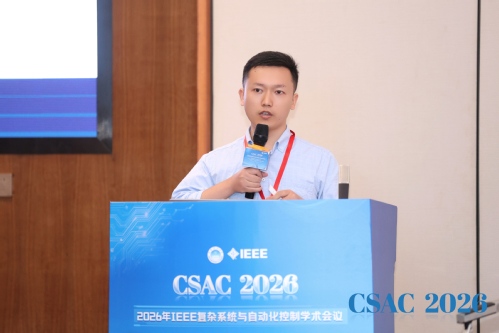
Invited Speech 2: Hu Zhipei
Oral presentations followed afterwards. Eight young teachers and doctoral researchers from Guangdong University of Technology, Southwest Jiaotong University, Guangdong Polytechnic Normal University, South-Central Minzu University, SCUT, The Chinese University of Hong Kong and other institutions shared their findings on semantic segmentation algorithms, complex network topology identification, distributed control of fractional-order multi-agent systems, noise-induced system stabilization, stability of stochastic time-delay networked systems under attacks, attraction domain estimation driven by Gaussian processes, offline safe reinforcement learning and other fields.
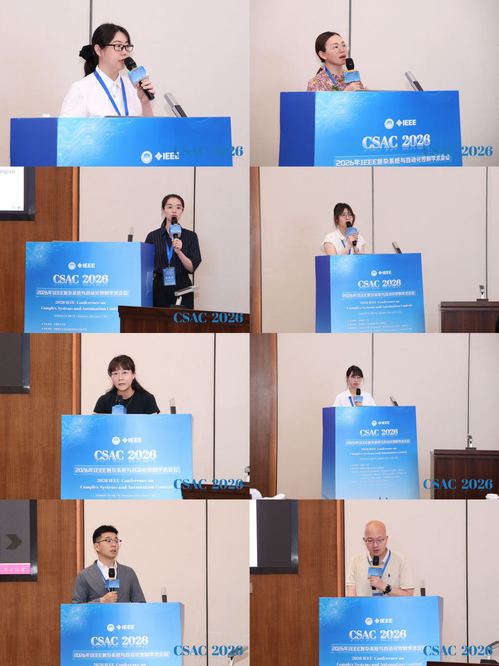
Oral Presentations
A poster exhibition was also held during the conference. Researchers displayed their latest achievements in multiple fields including UAV path planning, offline multi-lingual signature verification, scheduling of comprehensive energy stations at ports, fault diagnosis of millimeter-wave radars, and control strategies for tiltrotor UAVs, creating a flexible platform for in-depth academic communication.
After all academic reports, the closing and award ceremony was held. Based on comprehensive evaluation of paper innovation, presentation quality and poster academic standard, the organizing committee presented Excellent Paper Awards and Excellent Poster Awards to outstanding young researchers. The awards aim to encourage young scholars to devote themselves to scientific research and keep pursuing innovation.
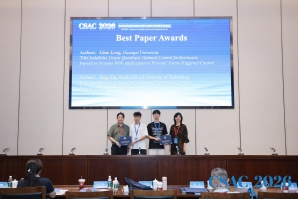
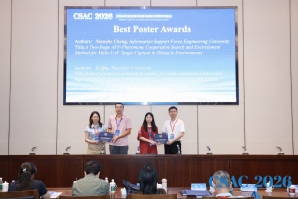
Award Ceremony for Excellent Papers & Excellent Posters
The 2026 International Conference on Complex Systems and Automation Control (CSAC 2026) has come to a successful end. Adhering to innovation and forging ahead, the conference will continue to explore opportunities and challenges in complex systems, automation, advanced control and other frontier fields. It is committed to promoting theoretical breakthroughs and engineering applications, advancing high-level self-reliance in science and technology, and facilitating talent cultivation as well as interdisciplinary and cross-industry collaborative innovation. We look forward to more wonderful achievements in the next conference!