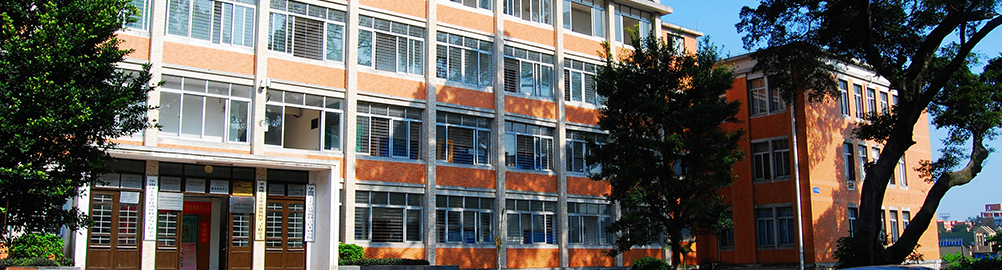
On January 14, 2026, the 15th IEEE Symposium on Complex Systems and Cybernetics and the 10th IEEE Symposium on Artificial Intelligence, jointly organized by the IEEE CSS & IEEE SMC Guangzhou Chapter, the IEEE Technical Committee on the Cybernetics of the Complex Systems, and the School of Automation Science and Engineering of South China University of Technology (SCUT), were successfully held in Room 3A02, Building 37, Wushan Campus of SCUT.
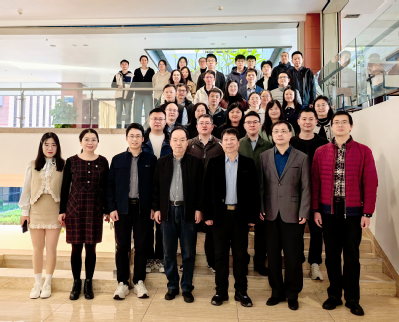
Focusing on cutting-edge issues such as modeling and analysis, optimal control, and secure operation of new-type power systems under the “dual-high” background (high penetration of renewable energy and high proportion of power-electronic equipment), the symposium featured a series of high-level academic talks that showcased the latest research advances and engineering practices in the application of complex systems and artificial intelligence (AI) to power systems. The symposium was chaired by Professor Feiqi Deng from SCUT and invited Professor Shengwei Mei (Tsinghua University), Professor Xiangjie Liu (North China Electric Power University), Professor Ping Ju (Hohai University/Zhejiang University), Professor Junbo Zhang (SCUT), Professor Yuanzheng Li (Huazhong University of Science and Technology), Assistant Professor Wei Qiu (Hunan University), Associate Professor Xiaobing Kong (North China Electric Power University), Engineer Zhuolin Huang (Guangdong Power Grid Co., Ltd.), and Dr. Jie Hu (Shenyang University of Technology) to deliver academic presentations. Nearly 50 experts, scholars, and students from various universities and enterprises attended the event.
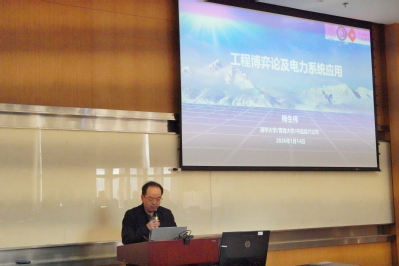
Professor Shengwei Mei from Tsinghua University delivered a talk entitled “Engineering Game Theory and Its Applications in Power Systems.” He systematically presented the basic theories and methods of applying game theory to engineering control and decision-making, and demonstrated its progress and applications in robust control of large power generation equipment, security defense of AC/DC hybrid grids, and secure and economic operation of renewable energy systems.
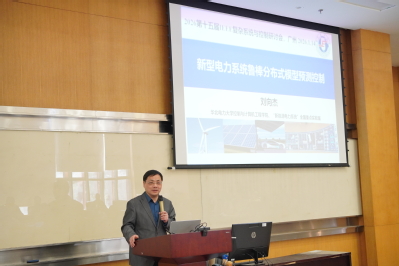
Professor Xiangjie Liu from North China Electric Power University gave a talk on “Robust Distributed Model Predictive Control for New-Type Power Systems.” Addressing the stochasticity and uncertainty introduced by high renewable penetration, he introduced stabilizing stochastic model predictive control strategies for wind power systems, as well as robust distributed model predictive control methods for load frequency control in new-type power systems.
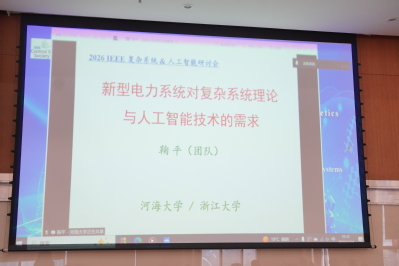
Professor Ping Ju from Hohai University/Zhejiang University delivered an online talk titled “Demands of New-Type Power Systems for Complex Systems Theory and Artificial Intelligence Technologies.” From the perspectives of modeling and forecasting, dynamic analysis, and oscillation control, he outlined the key scientific problems faced by new-type power systems and emphasized the important driving role of complex systems theory and AI techniques in their development.
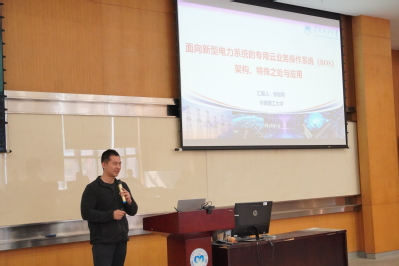
Professor Junbo Zhang from SCUT presented a talk on “A Dedicated Cloud Business Operating System for New-Type Power Systems: Architecture, Distinctive Features, and Applications.” Targeting issues such as severe cross-business data silos and low efficiency of large-scale complex computation in the digital and intelligent transformation of power system services, he proposed a dedicated cloud business operating system for new-type power systems and demonstrated, via engineering case studies, its effectiveness in enabling cross-business data integration and high-performance complex computing.
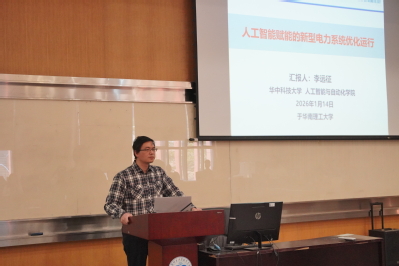
Professor Yuanzheng Li from Huazhong University of Science and Technology delivered a talk titled “AI-Enabled Optimal Operation of New-Type Power Systems.” Focusing on perception, optimization, and decision-making in new-type power systems, he introduced statistical modeling of renewable generation, deep-reinforcement-learning-based many-objective distribution network reconfiguration, and evidence-theory-based comprehensive decision-making, highlighting the great potential of AI in enhancing operational optimization and decision support.
Assistant Professor Wei Qiu from Hunan University presented a talk on “Research on Physics–Data-Driven Power Grid Fault Perception and Tracing Technologies.” In response to the diverse fault types and complex fault locations in new-type power systems, he proposed a physics–data-driven approach to grid fault perception and tracing, significantly improving fault detection and localization capabilities.

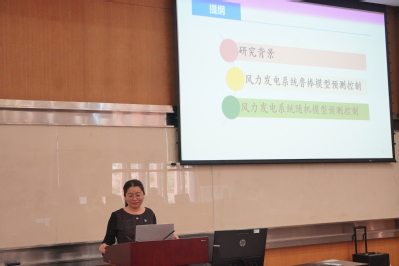
Associate Professor Xiaobing Kong from North China Electric Power University delivered a talk on “Applications of Model Predictive Control in Uncertain Wind Power Generation Systems.” He proposed a tube-based robust economic model predictive control strategy and a stochastic predictive control strategy combining robust and probabilistic tubes, thereby enhancing the robustness and economic performance of wind power systems under uncertain conditions.
Engineer Zhuolin Huang from Guangdong Power Grid Co., Ltd. gave a talk titled “Multi-Agent Collaborative Safety Management and Control for Power Operations.” He shared AI-empowered safety supervision practices covering the whole process of power field operations, including intelligent work-order checking, multimodal violation detection, key-process intelligent warning, and post-operation intelligent review, and explored a new safety supervision paradigm of “intelligent control + human confirmation.”
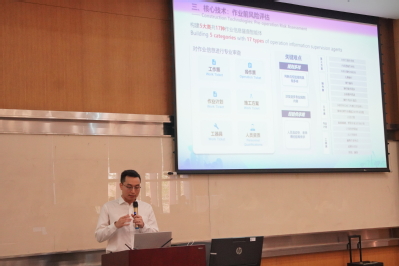
Dr. Jie Hu from Shenyang University of Technology delivered a talk on “Privacy-Preserving Distributed Cooperative Control of Source–Load–Storage in New-Type Power Systems under the ‘Dual-High’ Background.” He proposed a distributed cooperative control framework integrating privacy protection mechanisms, providing technical references for building safe and flexible new-type power systems.

Through invited talks, academic exchanges, and open discussions, the symposium broadened the academic horizons of participating teachers and students, strengthened frontier academic communication and industry–academia–research collaboration, and provided a solid academic platform and technical support for advancing the national “dual-carbon” strategy and the construction of new-type power systems.