| 祝贺陈书奇同学在《Macromolecular Rapid Communications》上发表文章! |
| 发布时间: 2026-03-06 浏览次数: 174 |
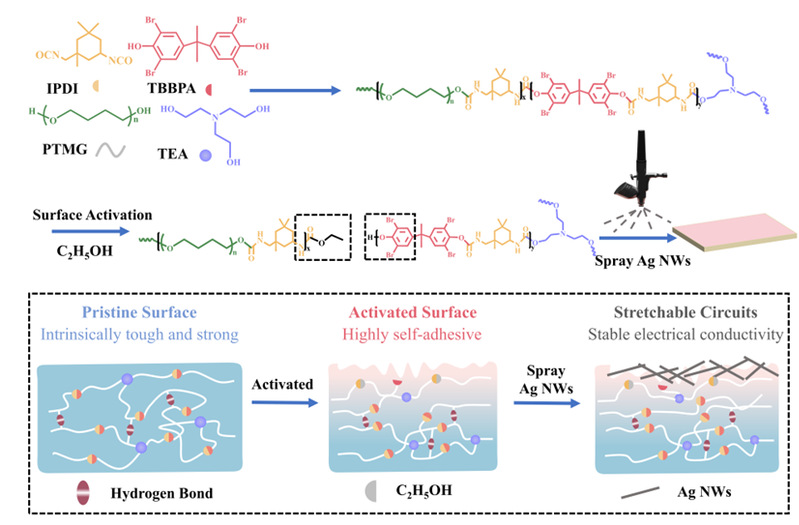
Surface-Activated Phenol-Urethane ElastomerEnablingTough, Adhesive, and Conductive Interfacesfor Stretchable Hybrid ElectronicsShuqi Chen, Zelin Liu,Liwei Lu, Xueling Yan, Siyu Gan, Lan Liu* Abstract Interfacialmismatch between soft substrates and rigid components fundamentally limits thereliability of stretchable hybrid electronics (SHEs), especially whenattempting to simultaneously achieve high bulk strength and strong interfacialadhesion. Here, we introduce a surface activation strategy based on dynamicphenol-urethane bond exchange to enable self-adhesive and conductivestretchable conductors, allowing rigid electronic devices to be directlyattached to the substrate in a plug-and-play manner. A dynamic bisphenol polyurethaneelastomer (BPU) was designed to unify high intrinsic strength with tunabledynamic activity by programming phenol-urethane bonds, resulting in broadlytunable mechanical properties, with tensile strength ranging from 15 to50 MPa and elongation from 395% to 757%. After 45 min ofethanol-vapor activation, the BPU surface achieved a peeling strength of 10.5N/cm while maintaining high mechanical strength (26.6 MPa). Asemi-embedded conductive network was constructed by thermally induced reorganizationof Ag nanowires (Ag NWs), yielding stretchable conductors with low sheetresistance (11 Ω/sq), strong adhesion (7.75 N/cm), and high stretchability(≈270%). The prepared SHEs sustain up to 250% strain and retain stableconductivity after 4000 cycles under 30% strain, demonstrating theeffectiveness of surface activation in strengthening soft/hard interfaces.
文章链接: https://doi.org/10.1002/marc.202500959 |