ENGLISH



近日,课题组与合作者在准二维层状磁性材料的巨磁电阻(CMR)效应研究方面取得新进展。研究团队通过Te掺杂Cr2Se3,成功诱导出团簇玻璃磁基态,并观测到显著的CMR效应。相关成果以“Cluster glass state and colossal magnetoresistance in layered Cr-Se-Te compounds”为题发表于Physical Review Materials (Phys. Rev. Mater. 9, 124416 (2025))。
研究团队采用化学气相输运(CVT)法生长出Cr0.98SeTe0.27单晶。磁性测量表明,该材料在28 K以下进入团簇玻璃态,其特征弛豫时间τ₀≈ 2.06×10⁻⁹ s,证实了铁磁团簇在反铁磁基质中的随机分布与慢磁弛豫行为。电输运测量显示,该材料为窄带隙半导体(激活能6.84 meV),在5 K、60 kOe磁场下表现出32%的负磁电阻效应。角度依赖磁电阻测量进一步表明,随着磁场增大,磁电阻符号由正变负,直接反映了磁场对电子能带结构的显著重构。DFT计算揭示,Te掺杂使Cr2Se3的磁基态从完全补偿亚铁磁转变为铁磁态,为CMR效应的微观起源提供了理论支撑。作为对比,Te过量组分呈现铁磁金属行为,CMR效应降至12%,进一步证实了竞争磁相互作用在CMR中的核心地位。
该工作揭示了团簇玻璃态中磁场诱导电子相变是CMR效应的关键驱动力,为在层状磁性材料中设计新型磁电耦合器件提供了新的材料平台。
Recently, our group, in collaboration with partners, has made new progress in the study of the colossal magnetoresistance (CMR) effect in quasi-two-dimensional layered magnetic materials. By doping Cr2Se3 with Te, we successfully induced a cluster glass magnetic ground stateand observed a significant CMR effect. The related work is published in Physical Review Materials under the title 'Cluster glass state and colossal magnetoresistance in layered Cr-Se-Te compounds' (Phys. Rev. Mater. 9, 124416 (2025)).
We grew Cr0.98SeTe0.27 single crystals using the chemical vapor transport (CVT) method. Magnetic measurements reveal that the material enters a clusterglass state below 28 K, with a characteristic relaxation time τ0 ≈ 2.06×10⁻⁹ s, confirming the random distribution of ferromagnetic clusters in the antiferromagnetic matrix and slow magnetic relaxation behavior. Electrical transport measurements show that the material is a narrow-bandgap semiconductor (activation energy 6.84 meV), exhibiting a 32% negative magnetoresistance effect at 5 K under a 60 kOe magnetic field. Angle-dependent magnetoresistance measurements further demonstrate that as the magnetic field increases, the magnetoresistance sign changes from positive to negative, directly reflecting a significant reconstruction of the electronic band structure by the magnetic field. DFT calculations reveal that Te doping transforms the magnetic groundstate of Cr2Se3 from a fully compensated ferrimagnetic state to a ferromagnetic state, providing theoretical support for the microscopic origin of the CMR effect. For comparison, the Te-excess composition exhibits ferromagnetic metal behavior with the CMR effect reduced to 12%, further confirming the central role of competing magnetic interactions in CMR.
This work reveals that the magnetic-field-induced electronic phase transition in the cluster glass state is the key driving force behind the CMR effect, providing a new material platform for designing novel magnetoelectric coupling devices in layered magnetic materials.
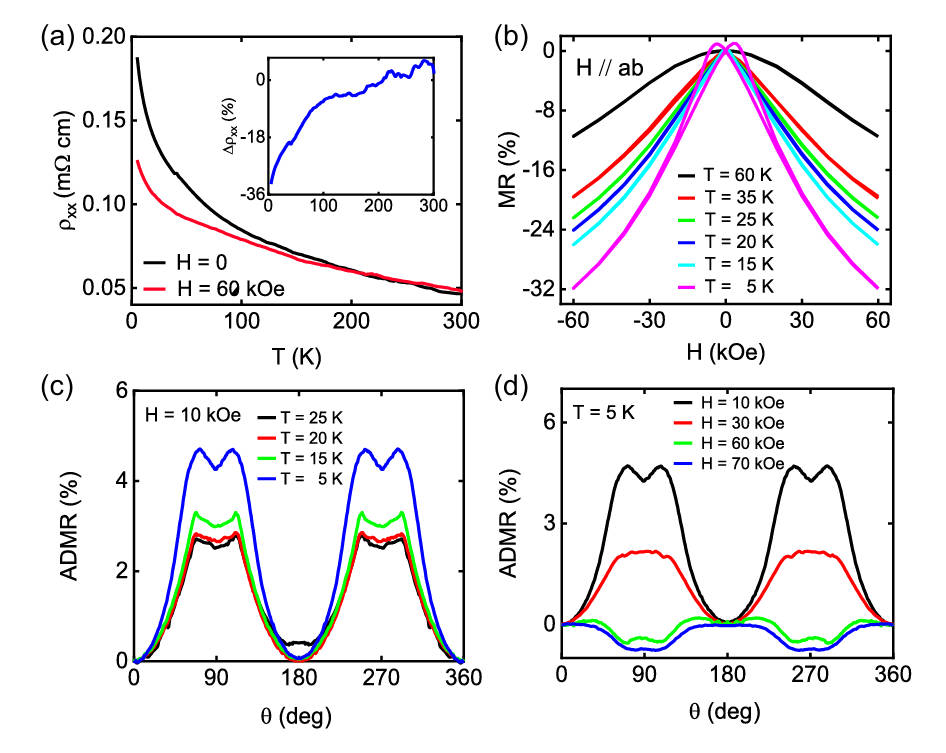
图1 电输运性质。(a) 在0和60 kOe磁场下,面内电阻率ρxx随温度的变化,呈现半导体行为。插图为两个磁场下磁电阻差异的温度依赖关系。(b) 在5 K至60 K温度范围内,面内磁场依赖的磁电阻(MR)随磁场H的变化(H∥ab配置)。(c) 在10 kOe面内磁场下,不同温度的磁电阻角度依赖(ADMR)。(d) 在5 K时,不同外加磁场下的ADMR曲线。
课题组博士后Suman Kalyan Pradhan博士为论文第一作者。论文链接: https://journals.aps.org/prmaterials/abstract/10.1103/x8qg-zk66