Yang Cheng Discusses Crisis Management and Strategic Communication in the Age of Artificial Intelligence
School of Journalism and Communication, South China University of Technology

Professor Yang Cheng delivered the lecture
On the afternoon of June 2, the Guangdong-Hong Kong-Macao Greater Bay Area Institute for International Communication successfully held the 18th session of the “GBA International Communication Frontier Lecture” series. Yang Cheng, a tenured full professor in the Department of Communication at North Carolina State University and Director of the Center for Artificial Intelligence Communication, was invited to deliver a lecture titled “Crisis Management and Strategic Communication in the Age of Artificial Intelligence.” The lecture was held in Conference Room 307 of the School of Journalism and Communication and was chaired by Yuanhang Lu, Associate Professor of the School of Journalism and Communication and Director of the Center for Intelligent Computing and Innovation in International Communication at the Guangdong-Hong Kong-Macao Greater Bay Area Institute for International Communication.
Professor Cheng first explained concepts such as “artificial intelligence” and “crisis communication,” noting that AI is driving crisis communication from passive response toward predictive intelligence. She also elaborated on the full-cycle application of AI before, during and after crises. She then introduced the theoretical framework of Contingent Organization-Public Relationships (COPR). Through cases such as the McDonald’s rainforest dispute, she empirically demonstrated how the COPR framework can measure multimodal and dynamic relationships between organizations and publics, ranging from high conflict to limited cooperation.
In the second half of the lecture, Professor Cheng turned to academic research scenarios and focused on AI-assisted writing and academic integrity, issues of common concern to faculty members and students. In response to the question of how to verify references provided by AI, she offered practical methods, including exact-phrase searches, checking original abstracts and searching by DOI. She emphasized that the proper order of writing should be “human first, AI-assisted”: independent thinking, planning and research should come first, followed by the use of AI to refine, challenge or expand one’s ideas. Relying on AI-generated content from the very beginning, she noted, may weaken understanding, critical thinking and original expression.
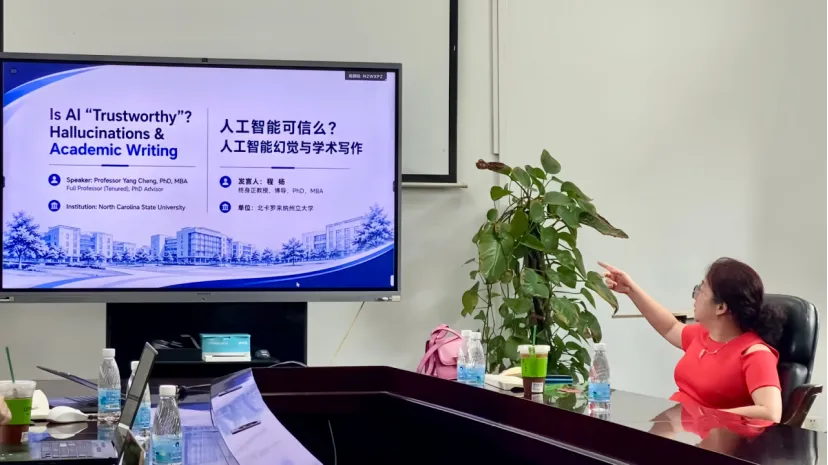
The discussion session
During the discussion session, faculty members and students raised questions on topics including the distinction between crisis communication and risk communication, strategies for using AI to assist manuscript review, and international research paradigms in AI ethics. Professor Cheng suggested that before submission, researchers could ask AI to play the role of a reviewer to identify potential problems in advance and improve their manuscripts. Regarding AI ethics research, she noted that international scholarship values both quantitative and qualitative approaches, and that the field still has ample scope for further research.

Group photo after the lecture
The lecture covered frontier theories on AI-empowered crisis communication and responded to practical concerns about the use of AI in academic writing. It deepened faculty members’ and students’ understanding of both crisis management and academic ethics in an intelligent communication context. Moving forward, the school will continue to build high-level platforms for academic dialogue and support the cultivation of outstanding international communication talent with both technological insight and awareness of academic norms.