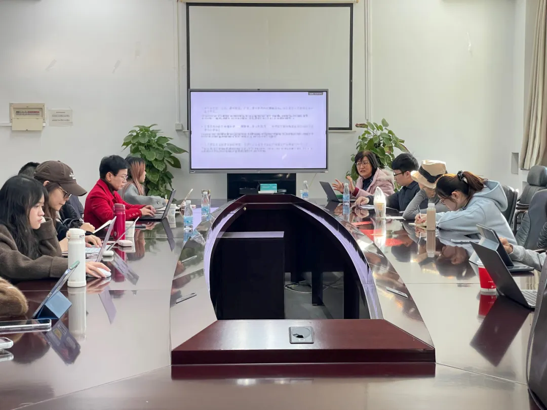
On the morning of January 9, theGuangdong-Hong Kong-Macao Greater Bay Area Institute for InternationalCommunication successfully held the 16th session of the “GBA InternationalCommunication Frontier Lecture” series. Haiqing Yu, Professor at the School ofMedia and Communication at RMIT University, was invited to deliver a lecturetitled “Development Strategies of Chinese Digital Transaction Platforms inSoutheast Asia.” The lecture was held in Conference Room 307 of the School ofJournalism and Communication and was chaired by Yuanbo Qiu, Assistant Professorof the Department of Internet Communication.
Professor Yu examined the topic from thebroader perspective of Chinese enterprises’ overseas expansion strategies,focusing on the “Double-Zoning” framework adopted by Southeast Asiangovernments in platform governance. Taking the cooperation between TikTok andTokopedia in Southeast Asia as a representative case, she analyzed in detailthe agency of local actors in shaping platform governance and explained thedevelopment strategies of Chinese digital transaction platforms in SoutheastAsian countries.
She pointed out that digital transactionsare not merely economic exchanges, but also representations of emergingtransaction cultures and governance systems shaped by politics, history anddistinctive cultural contexts. She emphasized that the “Double-Zoning”framework better reveals the agency of local actors in the global platformeconomy. This perspective not only helps explain the overseas development logicof Chinese digital platforms, but also provides new theoretical insights forresearch on digital governance and the transnational digital economy.
During the discussion session, facultymembers and students raised questions on topics including the universality andspecificity of double-zoning theory, the overseas expansion of large AI models,and theoretical innovation in international communication research. ProfessorYu responded to the questions with reference to her own research, generating anactive academic exchange.
The lecture broadened the horizons offaculty members and students in digital platform studies, deepened theirunderstanding of the overseas development of Chinese digital transactionplatforms and regional digital governance, and provided an important referencefor academic research and practical exploration in related fields.