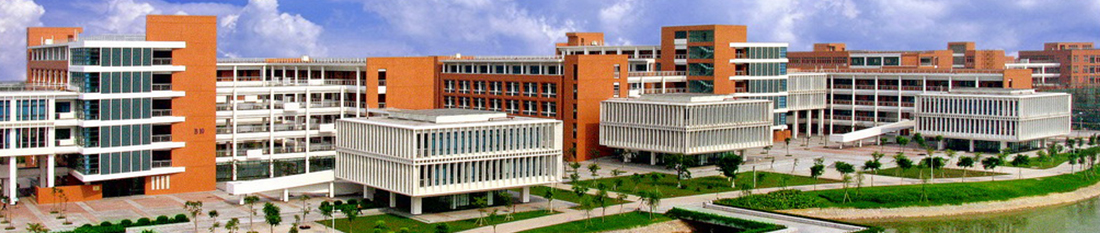
On the evening of March 16, the secondsession of the “Internet and New Media with Warmth #Ask Me Anything”teacher-student interactive salon was held in Room B9-301 of the School ofJournalism and Communication, South China University of Technology. Organizedby the Department of Internet Communication, the salon wasdesigned for undergraduates from the Class of 2025.
Eleven faculty members from the Departmentof Internet Communication joined 25first-year students for an open conversation in a relaxed setting withrefreshments. The discussion covered program selection, academic explorationand life choices, creating a teacher-student dialogue marked by warmth, depthand engagement.
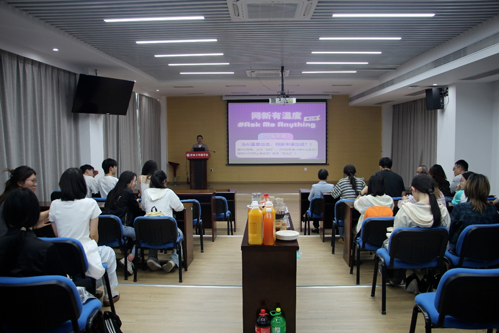
The “Internet and New Media with Warmth”teacher-student interactive salon
MultipleAnswers to Questions about the Program and Life
At the beginning of the event, Jian Rui,Xiaochuan Yu, Bing Hu and Yindi Liu shared their reflections on professionallearning and personal growth based on their own experiences.
Professor Jian Rui drew on his extensiveexperience in undergraduate teaching and program development to give students acomprehensive introduction to the positioning, features and training pathwaysof the Internet and New Media program, covering both the curriculum system andcompetency structure.
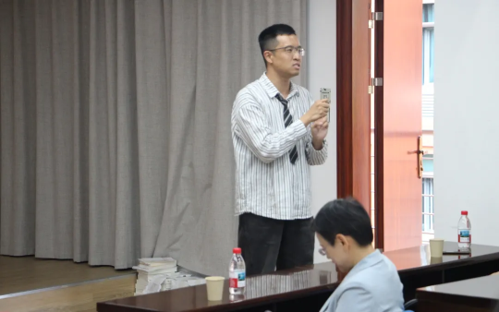
Professor Jian Rui introducedthe Internet and New Media program
With her characteristic humor, lecturerXiaochuan Yu vividly explained the corequalities needed in the study of Internet and New Media: user-centered thinkingand humanistic warmth. Her sharing resonated strongly with the students.
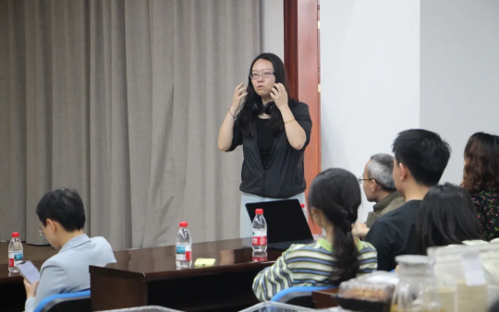
Xiaochuan Yu shared her views onprofessional learning
Professor Bing Hu analyzed the structuralchanges taking place in the Internet and New Media program in response to thereal-world impact of artificial intelligence. He encouraged students to staysensitive to frontier technologies and responded actively to change.
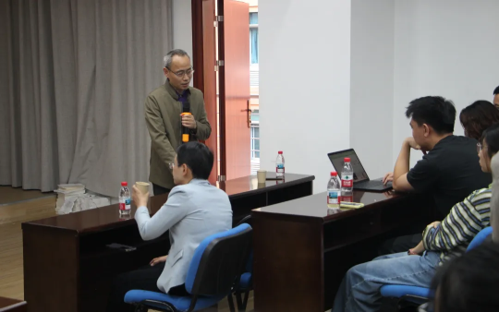
Professor Bing Hu discussed professionaltransformation in the age of AI
Professor Yindi Liu shared her observationson the challenges and growth opportunities in Internet and New Media studiesbased on her teaching practice. Drawing on hands-on experience, she encouragedstudents to build core competitiveness through challenges.
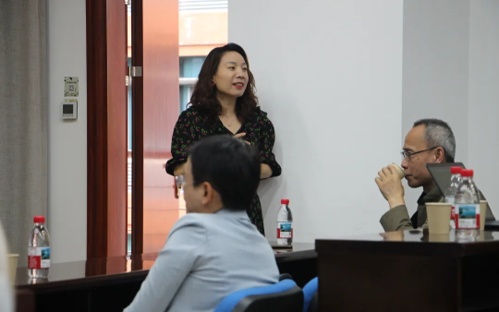
Professor Yindi Liu shared her teachingexperience and observations
WhenAI Makes Its Move, How Should Internet and New Media Respond?
Later, Associate Professor Yuanhang Lu,Deputy Head of the department, delivered a program introduction under the theme“When AI Makes Its Move, How Should Internet and New Media Respond?” Startingfrom industry demand, he pointed out that the Internet and New Media industryneeded versatile professionals who understood the full process of research,planning, production, marketing and operation.
Drawing on detailed data in hispresentation, Lu demonstrated the strong foundation of the Internet and NewMedia program. The program has 11 full-time faculty members, including fourprofessors and two associate professors. Eight faculty members have beengranted national-level research projects, seven have overseas study experience,and faculty members have been listed among Elsevier Highly Cited Researchersfor five consecutive years.
In terms of further study and employment, 57graduates had continued their studies over the past three years, and the numberof admissions to leading overseas universities had increased for threeconsecutive years. Graduates entering government agencies, state-ownedenterprises and the forefront of market innovation had shown a balanceddistribution, demonstrating strong competitiveness.
In response to the rise of AI, AssociateProfessor Yuanhang Lu argued that AI eliminates standardization and liberatescreativity. Students in Internet and New Media should master AI without blindlyfollowing it, and understand the ambiguity andcomplexity of human needs in order to respond to real-world demands.
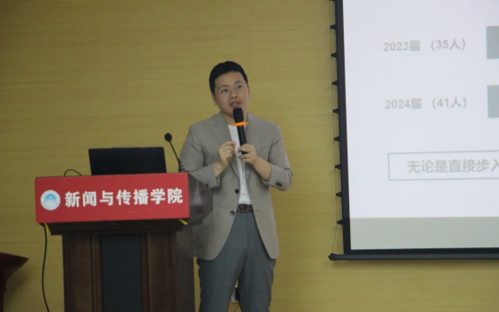
Associate Professor Yuanhang Lu deliveredthe keynote introduction
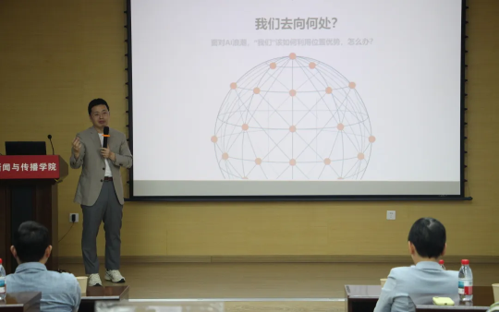
Associate Professor Yuanhang Lu introducedprogram development with data
Morethan 30 Questions, Each Carefully Answered
The teacher-student interaction brought theevent to a climax. More than 30 questions collected through a questionnairewere discussed one by one, covering program selection, academic research,teaching styles, campus life and personal concerns. Yunjuan Luo, Quanyi Zou andYuanhang Lu sat with students for an open exchange, with laughter and applausefilling the room.
In response to the question “What are thedistinctive features of Internet and New Media?” Associate Professor YuanhangLu explained that the core of the program lies in data thinking, technologicalcompetence and operational ability. In the wave of AI, its distinctiveadvantages have become more evident: faster transformation, a more systematicteaching model and more thorough ways of thinking.
When asked what first-year students could doto prepare for academic research, Quanyi Zou advised students to observe dailylife more closely and remain curious. He also noted that several research teamsin the department welcomed new members. During the session, Zou listenedcarefully to students’ needs, exchanged contact information with them andencouraged them to reach out proactively.
When asked about the teaching style offaculty members in Internet and New Media, Professor Yunjuan Luo, Head of thedepartment, said that she deeply valued genuine interaction with students inclass. She believed that such human connection represented a unique value thatenabled people to move beyond AI technologies. She also noted that thedepartment’s educational philosophy was student-centered: faculty members aimto guide students and inspire each student’s inner potential.
Some students also raised questions aboutlife, asking when they could truly relax without worries. Faculty membersresponded that, in addition to studying, students should learn to set asideanxiety and experience the beauty of university life itself, leaving room formoments that may seem “useless” but are deeply valuable. They also encouragedstudents to develop sports interests and recommended several books foremotional comfort, including Alain de Botton’s StatusAnxiety, Orhan Pamuk’s The Museum of Innocence and Richard Yates’sEleven Kinds of Loneliness.
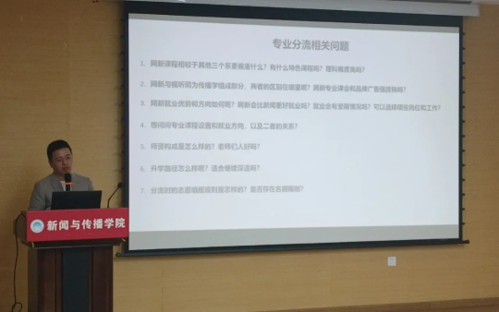
The #AMA interactive Q&A session
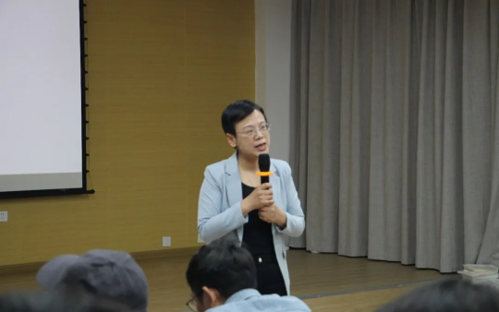
Discussion on life and personal growth
GoodLuck and Warmth
At the end of the event, students whosubmitted questions through the questionnaire or asked questions on site joineda special lucky draw. Chen Hou received a Jimeng AI membership, while GuijiangOu took home three selected books recommended by the teachers. These specialgifts carried the blessings and expectations of the Internet and New Mediafaculty members, bringing the evening to a warm and fulfilling close.
A group photo captured the warm moments ofthe evening of March 16. As participants left Room B9-301, the campus remainedquiet and gentle under the night sky, while the dialogue and resonance betweenteachers and students continued.
The salon was able to answer students’questions with care thanks to the active participation and sincere questions of25 students, as well as the dedicated involvement of 11 faculty members.Through one and a half hours of sincere exchange, students felt that inInternet and New Media, every question is taken seriously.
Moving forward, the“Internet and New Mediawith Warmth”#AMA teacher-student interactive salon series will continue toinvite more faculty members and build bridges for teacher-student communicationaround different themes, allowing ideas to meet and warmth to be passed on.