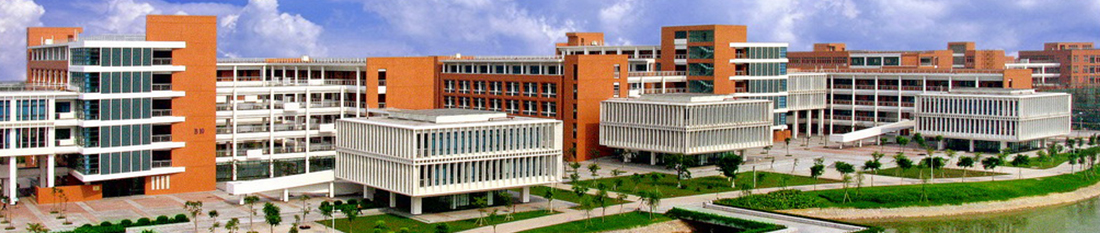
Poster for the Audiovisual Communication “Navigation”Program Introduction Session
On the afternoon of March 19, the Communication Studies (AudiovisualCommunication) Program Introduction Session, themed “Telling You What We See,”was held at the University Town Campus. Xi Chen, Head of the Department ofAudiovisual Communication, introduced the program overview, disciplinedevelopment and strengths, and talent cultivation outcomes. To help studentsgain a more direct and close understanding of the department’s trainingobjectives and achievements, three outstanding students from CommunicationStudies (Audiovisual Communication), representing different developmentpathways, were invited to share their personal growth experiences. Theirstories presented the department’s training model for versatileinterdisciplinary talent and its development outcomes in the era of “omnimedia+ audiovisual communication.”
To help students better understand the program and discuss theirquestions in a more relaxed atmosphere, the session invited Qiaoyi Wang, anoutstanding fourth-year student, to serve as the host. From the perspective ofa senior student in the same department, she connected the informative and warmmoments of the session.
Part 1:Program Positioning
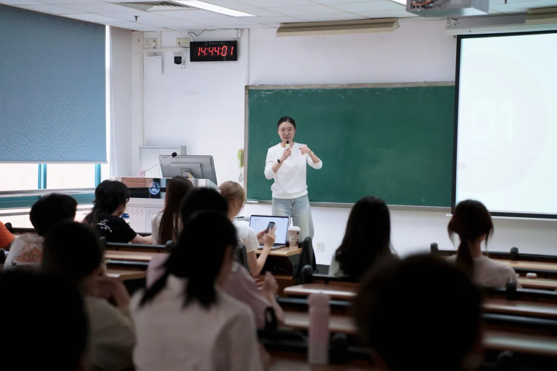
Xi Chen introduces the Audiovisual Communicationprogram
ProfessorXi Chen gave a comprehensive interpretation of the corestrengths of Communication Studies (Audiovisual Communication) from threedimensions: disciplinary structure, industry trends and talent cultivation. Shehighlighted the program’s strength as a national first-class undergraduateprogram construction site, its interdisciplinary training model integratinghumanities and engineering, and its high-quality resources supported by fourcurriculum matrices and top-tier practice platforms. Her introduction clearlyoutlined the program’s development blueprint in the era of large-scaleaudiovisual communication and its goal of cultivating versatile leadingcreative talent, helping students build a complete understanding of theprogram.
Part 2:Growth Pathways
Qiaoyi Wang from the Class of 2022 offered a highly practicalsharing session on personal growth. Drawing on her own dual-track experience inresearch and competitions, she explained how she connected an undergraduateinnovation and entrepreneurship training project with conference paperpublication, national-level gold-award competitions and AI video production,thereby maximizing learning efficiency by turning one project into multipleoutcomes.
She also advised younger students to identify their personalpositioning as early as possible. Those planning to pursue further study shouldfocus on research achievements, while those preparing for employment shouldaccumulate internship experience early. She encouraged students to polish theircoursework in depth so that every effort could be transformed into a visibleoutcome of growth.
Biqi Huang from the Class of 2021 shared her cross-disciplinaryexploration driven by personal interests. She described how her studies inCommunication Studies (Audiovisual Communication) at the School enabled her tostudy as an exchange student at Hong Kong Baptist University and broaden herprofessional vision in audiovisual communication. She also shared internshipexperiences in different fields at Guangdong Radio and Television, GuangzhouOpera House, Mango TV and ByteDance, illustrating through her own path thatinterest can be the best guide to career development.
Due to her passion for film and television theory, she had been recommended for postgraduate study at the School of Drama andFilm, Communication University of China. Her experience helped students see thediverse possibilities for further study and development behind the AudiovisualCommunication track of Communication Studies.
Ruiqi Luo from the Class of 2019 shared her cross-disciplinaryreflections on moving from audiovisual recording to academic research. Startingfrom her graduation project in Audiovisual Communication, a visual anthropologydocumentary about migrant workers in Guizhou, she explained how she extractedresearch questions from audiovisual creation, turned her attention to spatialissues in urban-rural fringe areas, and then moved toward urban studies andhuman geography.
She also shared her international academic experiences through theErasmus Programme at institutions including the University of Copenhagen andthe University of Vienna, as well as her internship at Guangdong Times Museum,where she applied audiovisual skills to archive digitization and experimentalvideo creation. Her experience allowed students to see how audiovisualcommunication skills could be integrated withacademic research and contemporary art. Ruiqi Luo had received an offer of admission to the PhD program in HumanGeography at the London School of Economics and Political Science.
The session helped students gain a clearer understanding of theprogram and a stronger sense of direction for their personal growth. It ishoped that every student can draw inspiration from the sharing session and finda path forward that suits their own aspirations.