The Undergraduate Journalism Program Sharing Session
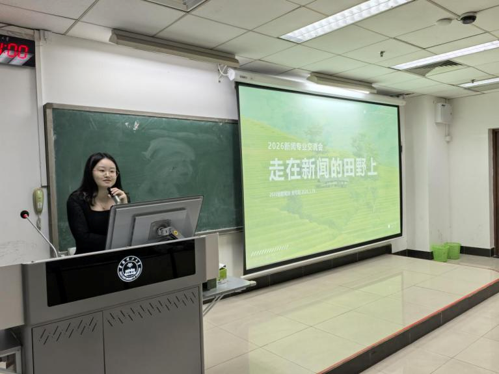
On the evening of March 19, the 2026 UndergraduateJournalism Program Sharing Session was held at the University Town Campus.Under the theme “Moving with the Times: Big Journalism and New Scenarios forSeeing the World,” the session brought together faculty members and outstandingsenior students. Through program introduction, experience sharing andinteractive discussion, it helped students gain a clearer understanding of theJournalism program, its learning pathways and future development opportunities.
Part 1:Program Introduction
At the beginning of the session, Huang Hanlin, DeputyHead of the Department of Journalism and Communication, gave a systematicintroduction to the Journalism program from five aspects: program overview,training objectives, curriculum system, training model and graduate pathways.He noted that the program is rooted in the Guangdong-Hong Kong-Macao GreaterBay Area and follows an interdisciplinary path that integrates humanities andengineering. It focuses on frontier areas such as data mining and analysis,intelligent content generation and information visualization, while furtherdeveloping its strengths in integrated journalism.
Through systematic training in news gathering, writing,editing and evaluation, data journalism production, and AIGC-assisted newsproduction, students will develop practical competencies in intelligentjournalism, including data collection and analysis, visualization productionand multi-platform content operation. The curriculum highlights theinterdisciplinary integration of humanities, social sciences and engineering.Based on a practice-driven training model, the program strengthens students’comprehensive abilities through university-enterprise collaboration, theintegration of competitions and teaching, and hands-on practice platforms.
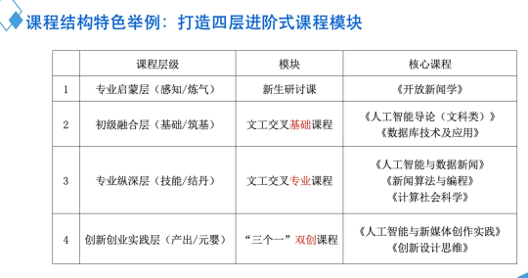
An overview of the curriculum structure
Huang also presented the diverse academic and careerprospects of Journalism graduates based on graduate outcomes over the past fouryears. In terms of further study, some graduates have pursued master’s degreesat leading universities at home and abroad, including Tsinghua University,Zhejiang University, Nanjing University, the London School of Economics andPolitical Science, the National University of Singapore and The ChineseUniversity of Hong Kong. In terms of employment, graduates have joined governmentagencies such as organization departments, tax bureaus and subdistrict offices,as well as state-owned enterprises including China Construction Science andIndustry Corporation Ltd., CCCC Guangzhou Dredging Co., Ltd., China TobaccoGuangdong Industrial Co., Ltd. and Industrial and Commercial Bank of China.Others have joined leading companies such as Tencent, Huawei and Xiaomi,demonstrating strong adaptability and professional competitiveness.
Several faculty members then shared their views oncompetency development and future pathways in Journalism. Drawing on hisbackground in computer science, associate Professor Quanyi Zou pointed out thatin an era of rapid technological change, Journalism students should activelyengage in technology, while placing greater emphasis on the core ability totell stories. Taking animated web drama creation as an example, he explainedthe irreplaceable narrative strengths of Journalism. He also introduced interdisciplinarycourses such as artificial intelligence and computational social science, whichaimed to help students improve their technological literacy.
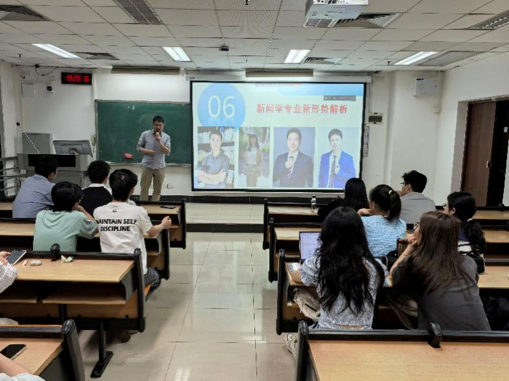
Faculty members share their views on Journalism education and careerdevelopment
Assistant Professor DifanGuo, who also has abackground in computer science, discussed both the anxieties and expectationsbrought by the innovation of AI. He noted that students should not simply relyon AI, but should pursue deeper integration between technology and professionalexpertise to build irreplaceable core competitiveness. He emphasized that theJournalism program is supported by the college’s platform, mature technologicalconditions, and the humanistic values and professional ethics behind technology.These strengths can help students further develop their expertise and expandtheir career opportunities in the wave of intelligent communication.
Associate Professor Keqing Yang observed that mainstreammedia are accelerating digital transformation and systemic reform, and that thelogic of content production and operation in the news industry has undergoneprofound changes. She emphasized that liberal arts students in the new era needto develop structured thinking that integrates humanities and engineering, aswell as an understanding of technological logic. The college’s curriculumsystem and training objectives respond closely to industry transformation, withan emphasis on humanistic literacy, journalistic sensitivity and socialconcern, helping students build core abilities that cannot be easily replacedby technology.
Associate Professor JizhouWang, Head of theDepartment of Journalism and Communication, proposed that the Journalismprogram should be understood through the concept of “big journalism.” He notedthat Journalism not only serves various media organizations, but also respondsto the communication needs of government departments, enterprises and publicinstitutions. In the digital and intelligent era, the ability to producequality content and identify valuable issues has become increasingly scarce andcannot be replaced by AI. The Journalism program plays an irreplaceable role incultivating these abilities.
The program also attaches importance to the integrationof competitions and teaching. In recent years, students have achieved strongresults in major competitions such as the China Data Journalism Competition,China Daily Campus News Awards and the National College Student Advertising ArtCompetition.
Part 2:Experience Sharing
During the experience-sharing session, several seniorstudents shared their experiences in Journalism studies, internships, furthereducation and career planning, offering useful references for students.
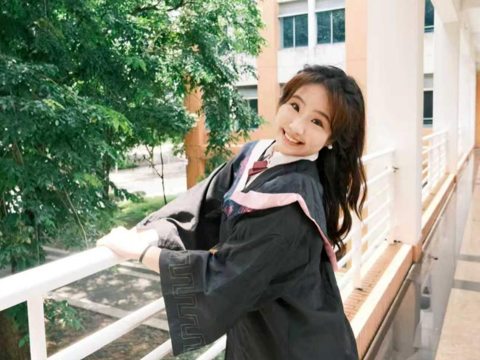
YitongWangshares herlearning experience
Yitong Wang from the Class of 2020, who has beenrecommended for postgraduate study at Zhejiang University, shared herexperiences in professional coursework, practical training and personal growth.She said that systematic training in news gathering, writing, editing and reviewinghelped her acquire solid professional skills and transferable core abilities,including observing the world from an objective and rigorous perspective,conveying ideas through clear and fluent writing, and building connectionsthrough sincere communication. She encouraged students to develop themselvesthrough professional learning and clarify their direction through practice.
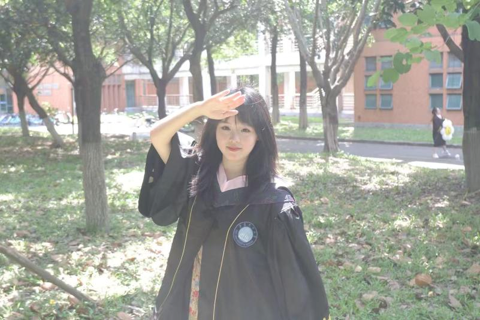
SiyanLiu shares her learning and practicalexperience
SiyanLiu from the Class of 2021, who has beenadmitted to Nanjing University for postgraduate study, shared her learning andpractical experiences. She said that the value of journalism lies in makingproblems visible and presenting them to the public, thereby making solutionspossible. During her undergraduate years, she worked on several in-depthtopics, met different groups of people through interviews and listened todiverse stories. During her internship at the in-depth reporting department ofSouthern Metropolis Daily, she took part in rescue-related reporting and cameto understand how journalism can help others and convey strength. Sheencouraged students not to be overly anxious, but to gain confidence throughlearning, practice and internships.
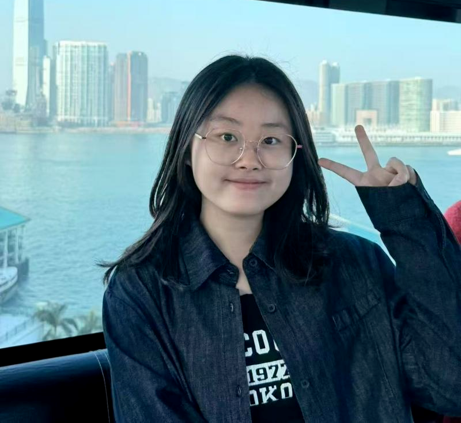
KeyangYu shares her study and internship experience
KeyangYu from the Class of 2022, who will continueher studies at The Chinese University of Hong Kong, suggested that lower-yearstudents develop their communication skills and ability to engage withreal-world contexts through social practices such as surveys, interviews andvolunteer service. She added thatseniorstudentscan explore internships in different specialized fields. Sheinterned at Guangdong Radio and Television and Southern Media Group (South),focusing on education and agriculture. She produced a viral short-video newsstory with over two million views, completed in-depth frontline reports, andtransformed field experience into her graduation thesis topic. She noted thatthe abilities cultivated by Journalism, including communication, problemidentification and logical organization, were applicable tomany industries, while the digital and intelligent transformation of mainstreammedia still provided valuable platforms for professional training.
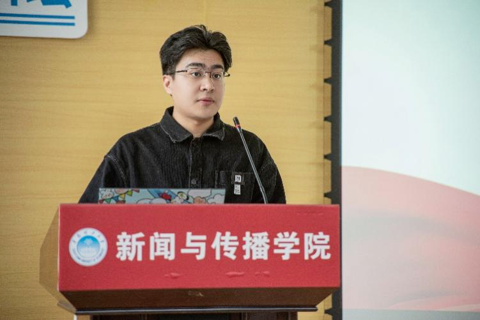
Yumitijan Alimu shares his experience
Yumitijan Alimu from the Class of 2022, who ranked firstin his major and has been recommended for postgraduate study at South ChinaUniversity of Technology, shared his thoughts under the theme “Journalism as aMethod.” Drawing on his own undergraduate experience, he encouraged students toanchor themselves amid uncertainty and rethink why they chose Journalism. Heargued that journalism, as a method, is essentially a pathway and perspectivefor observing the world and understanding society. What matters most is todevelop fundamental core abilities through journalistic training and usejournalistic thinking to empower diverse forms of development. Journalism, hesaid, has not only given him strong writing skills, but also helped him developstructured thinking, observation and communication skills. He encouragedstudents to make good use of the resources offered by the university, seek helpfrom teachers, and responded to anxiety through action.
Part 3:Q&A Session
During the Q&A session, students raised practicalquestions about professional learning and practice, covering topics such asimproving technological skills, obtaining internship opportunities andenriching practical experience. Faculty members and senior students respondedwith targeted suggestions based on their professional knowledge and personalexperience, helping students further clarify their learning directions anddevelopment pathways.
The Journalism Program Sharing Session promoted theexchange of knowledge and experience and helped students strengthen theirunderstanding of the program and its future possibilities. Moving forward, thecollege will continue to draw on the Undergraduate Program Introduction Seriesto help students deepen their understanding of professional learning, practicalcompetencies and future development, guiding them to continue exploring andgrowing in the field of journalism and communication.