On October 22, the Fourth Lecture of “Frontiers in Humanities and Engineering: Toward an Intelligent Future International Lecture Series” was held in Room 102A, Building 5, South China University of Technology. Professor Alfred Nordmann of the Technical University of Darmstadt, Germany, delivered a talk entitled “Scientific and Technical Objectivity: A Contrast of Values and Attitudes”, and Associate Professor Daria Bylieva of St. Petersburg State University, Russia, delivered a talk entitled “TechnoSigns: Signs in the Digital Environment”. The session was chaired by Professor Wu Guolin of the School of Marxism, and faculty and student representatives from the school attended.
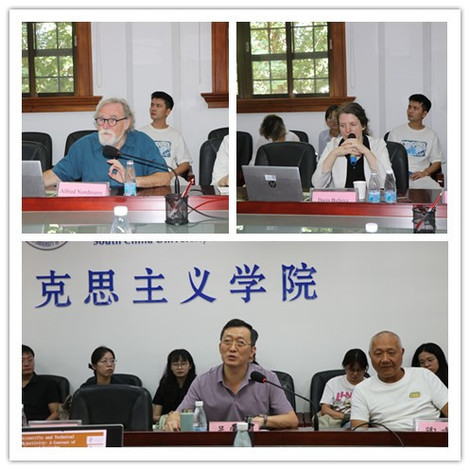
In Professor Nordmann’s talk, he pointed out that German distinguishes two concepts of objectivity: Objektivität and Sachlichkeit. The former is mainly associated with science and is commonly translated as “objectivity”; the latter is mainly associated with technology and has no straightforward equivalent in English. Traditional science seeks knowledge of reality, and its knowledge production aims to reveal the essence of things, even though it must begin with appearances. Anxiety about the distortion of reality by appearances leads “scientific objectivity” to emphasize that researchers should maintain distance from their objects, adopting a neutral, self-effacing stance to facilitate intersubjective consensus. By contrast, the technosciences emphasize engagement with things, stressing the integration of theory and practice and the coordinated control of things. The corresponding concept of objectivity is Sachlichkeit.
In her talk, Associate Professor Bylieva outlined a fundamental shift in semiotic paradigms in the digital age. The Saussurean and Peircean traditions of semiotics are rooted in human culture, with technical media shaped by human intentionality. In digital environments, however, technical media have become constitutive, and generative AI assumes the dual role of interpretant and sign producer. By tracing Leibniz’s project of a universal language, she argued that mathematical-logical computation, which seeks to separate syntax from semantics, laid the groundwork for the prehistory of techno-signs. In the transition from traditional semiotics to semiotics in the age of artificial intelligence, signs no longer possess meaning in isolation; rather, they acquire meaning dynamically within a dynamic field of signs.
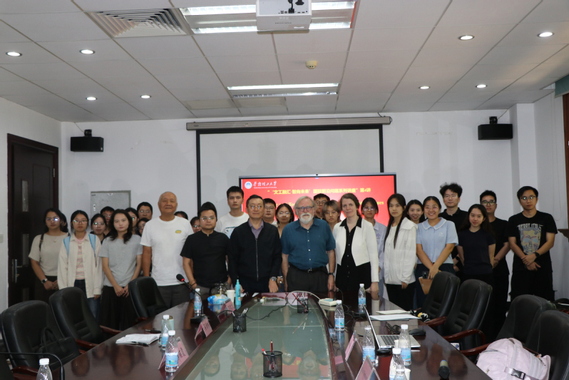
On behalf of the faculty and students, Professor Wu Guolin expressed thanks to the two speakers for their cutting-edge presentations. He encouraged faculty and students to engage deeply with the classics while also mastering new paradigms such as mathematical logic and neural networks, so as to respond to the questions of our time through interdisciplinary theoretical innovation.
Text: Xu Junjie
Photos: Wang Yan
First Review: Luo Dong
Second Review: Zhang Guoqi
Third Review: Xie Lixia