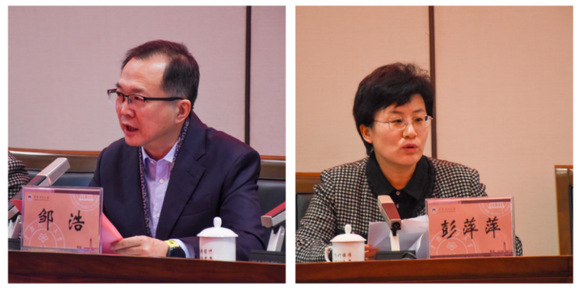
On December 27, the academic seminar on Advancing the Systematic and Theoretical Study of the Party’s Innovative Theories and the journal Marxism & Reality’s topic-planning meeting for 2026 were successfully held in South China University of Technology (SCUT). The seminar and meeting were jointly hosted by the Fourth Research Department of the Institute of Party History and Literature of the Central Committee of the Communist Party of China (CPC) and SCUT, and co-organized by the editorial office of Marxism & Reality and School of Marxism, SCUT. The opening ceremony was chaired by Liu Shaoping, CPC Committee Secretary of School of Marxism, SCUT. Zou Hao (the Standing Members of SCUT’s CPC Committee), Peng Pingping (Deputy Director of the Fourth Research Department of the Institute of Party History and Literature of the CPC Central Committee, EIC of Marxism & Reality) attended and delivered their opening speeches. Over 90 scholars, experts, and graduate students from more than 20 universities and research institutions, including the Central Party School of the CPC, Tsinghua University, Beijing Normal University, Jilin University, Dalian University of Technology, Zhejiang University, Nanjing University, Shanghai Jiao Tong University, Xiangtan University, Southwest University, Central China Normal University, Hunan Normal University, and South China University of Technology, gathered at SCUT’s Huayuan Campus to offer insights and recommendations on advancing the systematic and theoretical study of the Party’s innovative theories and on shaping the editorial agenda of Marxism & Reality for 2026.
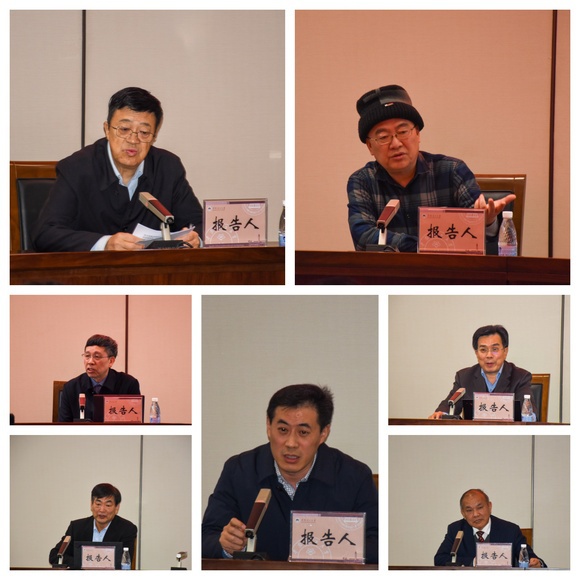
The seminar focused on discussing the systematization and academic rationalism of Party’s innovative theories. Han Qingxiang, former member of Academic Affairs Board, and Deputy Dean of Education of the Party School of the CPC Central Committee, illustrated his speech from the aspects of “Why we need to emphasize the elucidation of Party’s innovative theories with systematization and academic rationalism,” “Why ‘systematization’ here is present before ‘academic rationalism’,” and “How to understand ‘the elucidation of Party’s new theories with systematization and academic rationalism’.” Professor Han Zhen, Chair of the Academic Committee at Beijing Normal University, emphasized that in cultural interpretation, one should avoid overemphasizing cultural differences to the point of generating theoretical paradoxes. He called for promoting mutual learning and dialogue among civilizations rather than confrontation, so as to contribute to the building of a community with a shared future for humanity. Professor Li Youxin from the School of Marxism at Xiangtan University elaborated on the internal logic of the localization and contemporary development of Marxism in China. Professor Wu Zhicheng, Dean of the Institute of International Strategy at the Central Party School of the CPC, focused on advancing the building of a community with a shared future for humanity. Professor Bai Xianliang, Member of the Standing Committee of the Party Committee and Vice President of Southwest University, addressed several key relational dimensions that must be properly grasped in promoting the systematic and theoretical development of the Party’s innovative theories. Professor Liu Jingbei, former Vice President of China Executive Leadership Academy Pudong, shared his reflections on the systematic construction of the Party’s innovative theories in the new era. Professor Wan Meirong from the School of Marxism at Central China Normal University provided a systematic exposition on several issues concerning the theoretical articulation of General Secretary Xi Jinping’s important discourses on education.
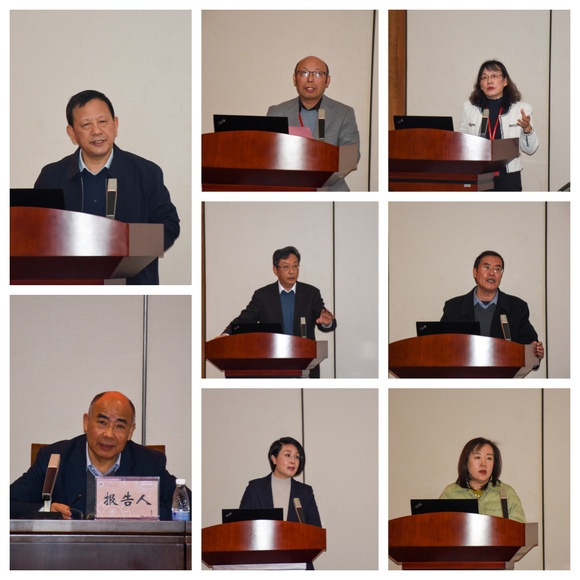
In the following speeches, Chen Jinlong, South China Normal University (SCNU)’s Chair of the Academic Committee, and Dean of the Institute of CPC History and Party Building at SCNU, profoundly interpreted the internal structure and construction method of the Marxist theory disciplinary knowledge system, from the dimensions encompassing knowledge system of discipline, academy, history, discourse and style; Professors from the School of Marxism at different universities conducted in-depth discussions: Professor Hong Xiaonan from the School of Marxism at Dalian University of Technology delivered a presentation focusing on the principled contributions of upholding the “Party’s cultural leadership;” Professor Lin Bohai from the School of Marxism at Southwest Jiaotong University elaborated on the “Dao” (principles) and “Shu” (methods) for enhancing the international influence of Chinese civilization; Professor Wu Xueqin from the School of Marxism at Anhui University analyzed the necessity of guiding the construction of an autonomous knowledge system with the Party’s innovative theories; Professor Wang Yan from the School of Marxism at Nanjing University of Aeronautics and Astronautics interpreted the “changing” and “unchanging” aspects of the basic tenets of Marxism in light of China’s concrete realities in the new era; Professor Mo Yueyun from the School of Marxism at SCUT provided a focused exposition on the theoretical and systematic development of the Party’s innovative theories regarding the united front; Professor Duan Yan from the Faculty of Marxism at Northeast Normal University and Professor Zhang Bo from the School of Marxism at Jilin University respectively explored advancing the systematic and theoretical study of the Party’s innovative theories in the new era, and the theoretical origins and core tenets of the Communist Party of China’s outlook on civilizational engagement in the new era.
During the afternoon thematic session, experts and scholars from within and outside Guangdong Province engaged in lively and in-depth discussions through a series of phased, topic-focused panels, all closely centered on “Advancing the Systematic and Theoretical Study of the Party’s Innovative Theories.” Drawing from multiple dimensions, including the development of Marxism in the new era, Xi Jinping Thought on Culture, Xi Jinping Economic Thought, Chinese modernization, and Party building, the scholars shared profound insights into how to further advance the systematic and theoretical articulation of the Party’s innovative theories. These exchanges significantly deepened the understanding of attending faculty and students regarding the theoretical coherence and systematic structure of the Party’s innovative theories. Participants unanimously expressed their commitment to studying these theories comprehensively, internalizing their essence, and putting them into practice, striving to make greater contributions in academic research and education, in supporting high-quality development during the upcoming “15th Five-Year Plan” period, and in advancing national rejuvenation and the building of a strong China through Chinese modernization.

Text: He Xiao-tong, Liu Jin
Photos: Yang Rui-jing
First review: Luo Dong
Second review: Zhang Dong-li
Final review: Xie Li-xia