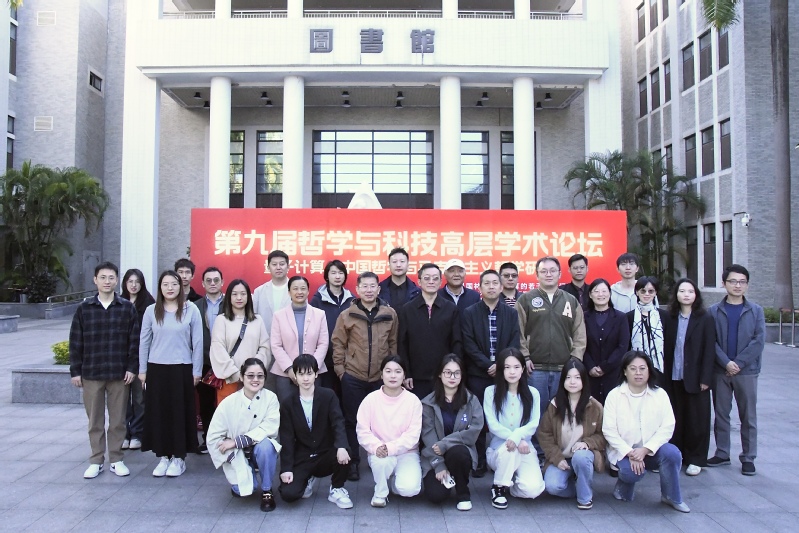
On November 29, the Ninth High-Level Forum on Philosophy and Technology was held at the Wushan campus of South China University of Technology(SCUT) in Guangzhou, Guangdong. The forum was co-organized by the Institute for Advanced Study in Philosophy, Science and Technology at SCUT, the Social Science Office of SCUT, and the Research Section for Philosophy of Science and Technology at the Institute of Philosophy, Chinese Academy of Social Sciences (CASS). It received support from the Academy of Scientific Research Institutes of SCUT, the SCUT Library, and the SCUT Interdisciplinary Research Centre. The opening ceremony was chaired by Prof. Zhang Guo-qi, Vice-Dean of the SCUT School of Marxism. Prof. Liu Shao-ping, Party Secretary of the SCUT School of Marxism, Dr. Meng Qiang, Research Fellow at the Institute of Philosophy of CASS, and Prof. Wu Guo-lin, Director of the SCUT Institute for Advanced Study in Philosophy, Science and Technology, delivered opening speeches. With the theme “Quantum Computing, Chinese Philosophy and Marxist Philosophy”, the forum discussed the philosophy of quantum computing, the concept of computation, AI and technological ethics, and the contemporary transformation of Chinese philosophy.
In the morning, Session 1 of the forum was chaired by Prof. Qi Lei-lei. Professor Wu Guolin delivered a talk titled “Several Philosophical Problems of Quantum Computing,” in which he elucidated the mechanism of quantum speedup through three key features—superposition, parallelism, and entanglement. He further highlighted the profound challenges quantum computation poses to the objectivity of mathematics and to our understanding of the relationship between “quantum information” and “quantum reality.”. Dr. Meng Qiang presented a report entitled “A Phenomenological Inquiry into Coming-into-the-World,” offering a post-Heideggerian interpretation of the spatial turn in “coming-into-the-world phenomenology.” He re-examined the essence of technology, reconceptualizing it not as Heidegger’s deconstructive Gestell (“enframing”), but as a constructive mode of “dwelling-together.”
Session 2 was chaired by Prof. Wu Guo-lin. Prof. Liu Shen gave the report “When Explainability Disappears?—Causal Crisis and Technical Transparency in Quantum AI”, analysing the causal and explanatory difficulties brought by quantum AI and their impact on transparency and accountability paradigms. Dr. Sun Sheng gave the report “Quantum Computing as Operational Space-Time—Epistemic Reconfiguration of Causal Structure by the Quantum Switch”, using the “indefinite causal order” produced by the quantum switch to argue that causal structure can be understood as programmable computational resources and discussing its reconfiguration of epistemic structure.
Session 3 was chaired by Dr. Sun Sheng. Dr. Wang Wei-chang gave the report “The MKC Model and Ontological Issues in Quantum Computing”, offering a systematic defence of the MKC model against the problem of definite values and criticizing the Pythagorean prejudice that equates the mathematical formalism of quantum mechanics with physical reality. Dr. Lin Yu-ling gave the report “Computational Knowledge as a New Form of Knowledge and a Distributed Justification Model”, proposing a five-dimensional distributed-justification model to address the validation and reliability of computational knowledge under AIGC.
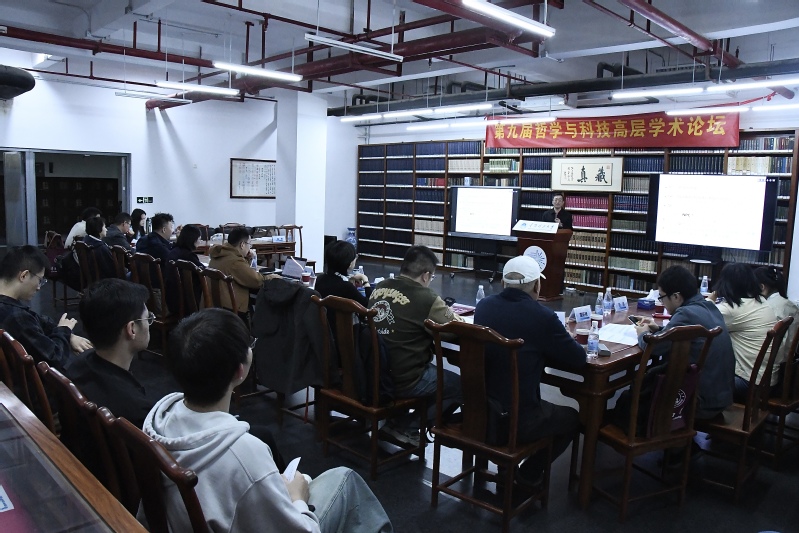
Session 4 was chaired by Dr. Meng Qiang. Prof. Qi Lei-lei gave the report “The Idea of Computation”, tracing the philosophical genealogy of “computation” from ancient Greece to the present and discussing how generative AI re-draws the boundary between computation and creation. Dr. Liu Wei-mo then gave the report “What Is a Model?—Reflections on Ancient History of Science and Contemporary AI”, drawing a cross-temporal analogy between the ancient Chinese “shi pan”(式盘) divination board and contemporary large language models to highlight models as common “operative proxy-instruments” of discovery and inference, and to clarify the continuity of human cognitive activity from the perspective of “operable proxy models”.
Session 5 was chaired by Dr. Liu Wei-mo. Prof. Wang Xiao-li gave the report “Moral Problems in the Application of Intelligent Algorithms”, focusing on algorithmic bias, human–machine interaction and the impact of virtual space on moral practice, and proposing to rebuild a moral economy that unites “virtue” (de) and “gain” (de) through data optimization, platform regulation and behavioural constraint. Dr. Lei Huan-jie gave the report “The Origins of Chinese Scientific Humanism as Seen from Early-Twentieth-Century Introductions to Science”, sorting out the historical significance of Introduction to Science writings and educational practice in the first half of the twentieth century for a “scientification humanities.” Dr. Zhang Qian gave the report on “The Ethical Spirit of Zhuangzi’s Philosophy of Implements”, stressing the practical wisdom of “stop when fit for use” and its implications for subjectivity and spiritual freedom in a technological age.
Session 6 was chaired by Prof. Liu Shen. Dr. Liu Zhan-xiong gave the report “Philosophical Reflections on Computation”, advocating “responsible computation” from the perspectives of philosophical categories, social power structures and ethical responsibility. Doctoral student Meng Zhen gave the report “The Reality of Software”, arguing for software as “constructive informational-structural reality.”
Session 7 was chaired by Prof. Wang Xiao-li. Dr. Ye Luyang presented a report titled “A Conceptual Analysis of Artificial Moral Organisms,” introducing the notion of the “moral organism” to guard against misplaced moral accountability that arises when artificial intelligence is erroneously ascribed the status of a moral agent.Drawing on the Chinese philosophical concept of ji (机)—often translated as “mechanism”or “device”—she proposed a relational-ethical paradigm that reorients moral discourse away from anthropomorphizing AI and toward contextually embedded human–technology interactions.
Following the conclusion of all sessions, the closing ceremony was held and chaired by Professor Wu Guolin. In his summary remarks, he reflected on the rich interdisciplinary dialogue that had unfolded across themes such as quantum technology, phenomenology, the philosophy of information, and software studies. He emphasized that the pursuit of truth is an ongoing journey—one with on end-point. Amid lively and thoughtful exchanges, the forum drew to a successful and inspiring close.
Text: Zhang Bing-bing
Photos: Zhu Jia-wen
First review: Wu Guo-lin
Second review: Zhang Guo-qi
Final review: Xie Li-xia