Time: 15:00, July 23, 2026
Venue:B1-e610
Speaker: Abdulrahman Alhamed
Inviter: Li Gao
Abstract
The rapid growth in mobile users andhigh-bandwidth applications is creating unprecedented challenges andopportunities in telecommunications. As we address the need for higher datarates, the mm-Wave 5G bands have been expanded to accommodate this demand. With6G on the horizon, targets are aiming for a 1 Tbps peak data rate,necessitating the allocation of even wider bands in the mm-Wave and sub-THzfrequencies. Directive communications using affordable phased arrays have beenadopted as a key technology for building mm-Wave communication systems toovercome the large free space path loss.
This talk will address the challengesassociated with designing mm-Wave ultra-wideband integrated circuits andphased-array systems capable of operating over a widespread spectrum usingadvanced SiGe technology. Additionally, a recently introduced 64-elementwideband scalable phased array design will be showcased, with a demonstrationof the 20-50 GHz multi-band operation. The talk will conclude with the keyopportunities and future directions in phased-array systems design.
Biography
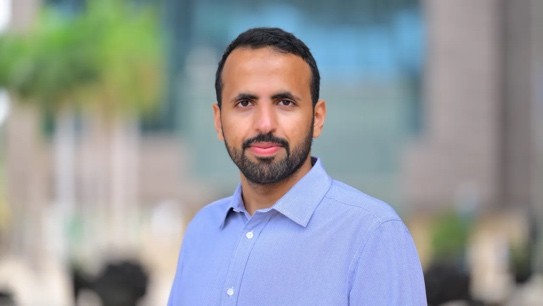
AbdulrahmanAlhamed is an Assistant Professor of Electrical and Computer Engineering (ECE)in the Computer, Electrical, and Mathematical Sciences and Engineering (CEMSE)Division at King Abdullah University of Science and Technology (KAUST). Heearned his Ph.D. in Electrical and Computer Engineering from the University ofCalifornia, San Diego (UCSD), USA.
Duringhis doctoral studies, Dr. Alhamed was a member of the Application-SpecificIntegrated Circuit (ASIC) Group at Nokia Bell Labs, contributing to thedevelopment of cutting-edge millimeter-wave (mmWave) communication circuits.Prior to joining KAUST, he worked as a Senior Technical Staff member in theSilicon Engineering Group at Apple Inc., focusing on 5G mmWave cellularchipsets.
AtKAUST, Dr. Alhamed leads the Integrated Telecommunication and Sensing Systems Labdedicated to advancing millimeter-wave and sub-terahertz (>90 GHz)technologies for telecommunications and sensing applications. His researchinterests include transceivers, phased arrays, radars, and hybrid beamformingsystems, with applications in 5G/6G telecommunications, satellitecommunications, and advanced sensing systems.
Dr.Alhamed has received several recognitions for his contributions to the field,including the Outstanding Designer Award from Analog Devices in 2021 for hiswork on 5G multiband phased-array systems.