

Researchers at SCUT Report a Significant Advancement in NanoTAC Technology for Precise Targeted Cancer Therapy
Date:
2024-03-16
View:
10
Recently, NatureNanotechnology published an article titled Nanoreceptors promotemutant p53 protein degradation by mimicking selective autophagyreceptors. The paper introduces the NanoTAC technology based on multifunctionalbiomimetic nanoreceptors and highlights significant progress in precisioncancer therapy achieved through targeted degradation of mutant p53 by NanoTACtechnology.
This work was collaboratively conducted byProfessor Zhang Yunjiao from the School of Medicine, SCUT, Professor YangXianzhu from the School of Biomedical Science and Engineering, SCUT, andProfessor Wen Longping from Guangdong Provincial People’s Hospital. Postdoctoralresearchers Huang Xiaowan and Qian Jieying, along with Associate Researcher CaoZiyang from Guangzhou First People’s Hospital, served as co-first authors.South China University of Technology is listed as the primary affiliation forthis work. The main contents of this research are as follows:
p53 is a central tumor-suppressor protein thatgoverns cell-cycle control and protects against malignant transformation.Mutations in TP53 occur in more than half of human cancers, and the resultingmutant p53 not only loses canonical tumor-suppressive functions but alsoaccumulates aberrantly, driving tumor initiation, invasion, metastasis, andresistance to therapy. Targeted degradation of mutant p53 therefore representsa compelling strategy to address fundamental therapeutic limitations. Althoughseveral approaches, such as Proteolysis‑Targeting Chimeras (PROTAC) andLysosome‑Targeting Chimeras (LYTAC), leverage endogenous degradation pathwaysto eliminate pathogenic proteins, their clinical translation remainsconstrained by suboptimal drug-like properties, limited in vivo efficacy, andpoor metabolic stability. Furthermore, the absence of a dedicated autophagyreceptor for mutant p53 has impeded the development of a safe and effectivemodality for its selective degradation.”
To overcome this barrier, the research team atSouth China University of Technology developed a biomimetic strategy inspiredby endogenous protein-degradation pathways. Using the NanoTAC platform, the Theyengineered the FDA-approved PEG–PLA nanocarrier by incorporating anoncoprotein-binding peptide together with cationic lipids that potentiateautophagy and direct cargo toward the autophagic degradation machinery. Thisdesign yields a synthetic construct that functionally mimics key features ofselective autophagy receptors. The resulting biomimetic nanoreceptoreffectively induced autophagic degradation of mutant p53 in tumor cells andproduced marked antitumor activity across multiple cancer cell lines and inpatient-derived ovarian cancer models. As an emerging biomimetic nanoplatform,NanoTAC not only enables drug delivery but also drives autophagy-mediatedclearance of pathogenic proteins, offering a promising avenue for precisiontherapy in cancer and other proteinopathy-associated diseases.”(Text and imagescontributed by Correspondents Zhang Yunjiao, Sun Zhonglin)
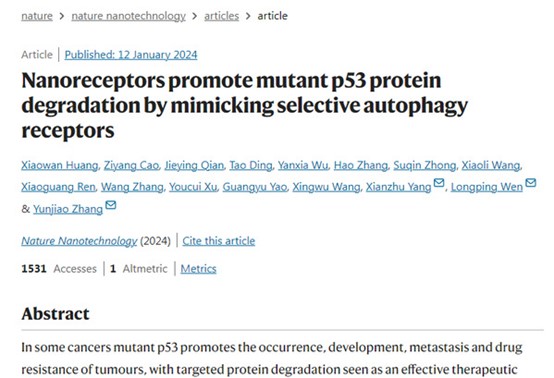
Screenshot of the Paper'sWebsite
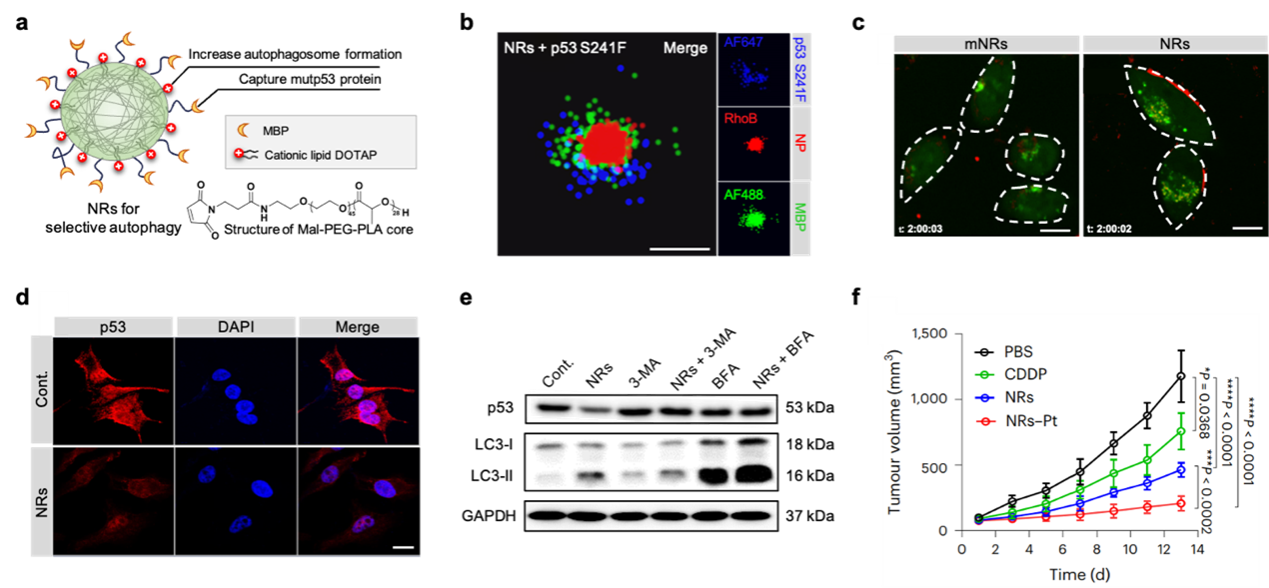
Biomimetic NanoreceptorsMimicking Selective Autophagy Receptors Enable Targeted Degradation of Mutantp53 Protein for Precision Cancer Therapy
Linker:”Nanoreceptors promote mutant p53 proteindegradation by mimicking selective autophagyreceptors”https://www.nature.com/articles/s41565-023-01562-5<p>
Click Here
QUICK ENTRY
Address:B2 Building, South China University of Technology, Guangzhou University Town, Panyu District, Guangzhou City, China
postcode:510006
Phone(TEL):+86 (0) 20 81182623(Office) 81182620(Enrollment)SCUTYXY@EDU.EN
2009-2014Copyright 2015 South China University of Technology. All Rights Reserved. 粤ICP备05084312号
