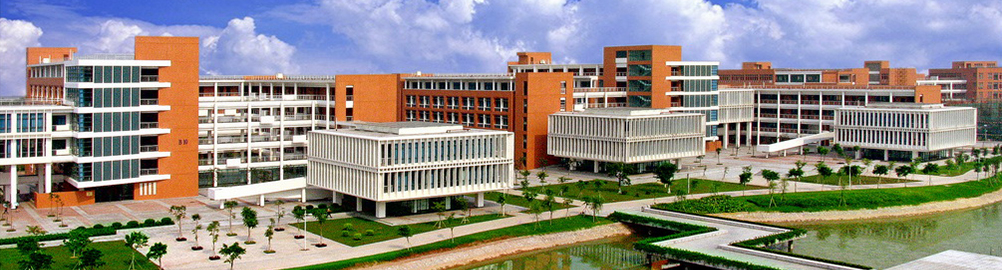
On the morningof December 28, 2024, the 9th Deans’ Forum of Law Schools in the Guangzhou Region wasgrandly held at the Guangzhou Legal Services Building (Members’ Hall of the Guangzhou LawSociety) in Baiyun District, Guangzhou.
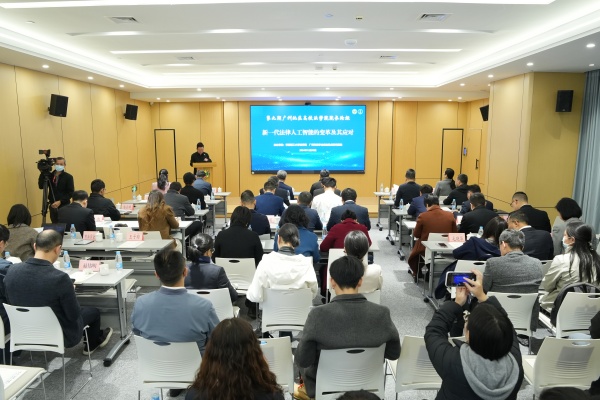
The forum wasco-hosted by the School of Law at South China University of Technology (SCUT)and the Guangzhou Key Research Base for Rule of Law Studies, under the theme ofTransformation of Next-Generation Legal Artificial Intelligence andStrategic Responses.
The eventbrought together deans from twelve leading law schools in the Guangzhou area,including SCUT, Sun Yat-sen University, and others. It also welcomedrepresentatives from technology enterprises such as Alibaba, as well as anumber of legal practitioners from the judiciary, arbitration institutions, andlaw firms, creating a dynamic platform for dialogue between academia andpractice.
In-depth Analysis of theDevelopment and Challenges of Legal Artificial Intelligence
During the keynote speechsession of the forum, Professor Jiang Wuzhen, Dean of the Law School of SouthChina University of Technology, served as the moderator. Professor Huang Hanfrom the School of Software Engineering, Mr. Sun Changlong, Technical Directorof Alibaba, and Associate Professor Liu Kai, Director of the Legal IntelligenceLaboratory of our school, conducted in-depth analyses respectively on theessence of legal artificial intelligence, the advantages and disadvantages oflarge models, case applications, construction ideas of vertical domain models,evaluation criteria, and data and technical challenges. They alsosystematically sorted out the technological iteration of artificialintelligence, clarifying the key issues and evaluation standards for thedevelopment of new-generation legal large models.
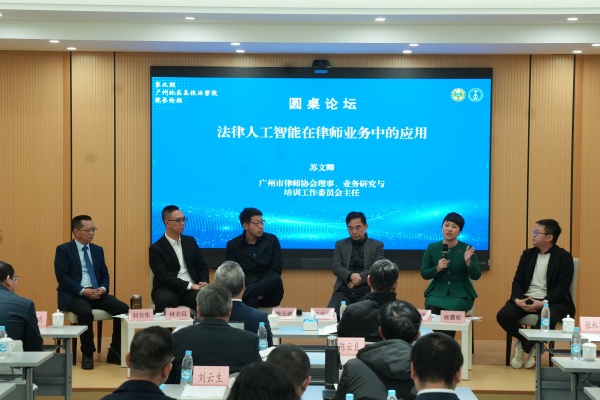
Roundtable Dialogue:Exploring the Application Prospects of Legal Artificial Intelligence
In the roundtable forumsession, hosted by Professor Liu Yunsheng, Dean of the Law School of GuangzhouUniversity, five guests held heated discussions on the applications of legalartificial intelligence in talent cultivation, judicial practice, arbitrationprocedures, legal services and commercial development. Professor Zhang Liang,Dean of the Law School of Sun Yat-sen University, then delivered comments, emphasizingthat current legal artificial intelligence serves as an auxiliary tool, andpointing out that universities should strengthen cooperation with enterprisesto promote the market popularization and application of legal artificialintelligence.
Jointly Mapping the FutureBlueprint of Legal Artificial Intelligence
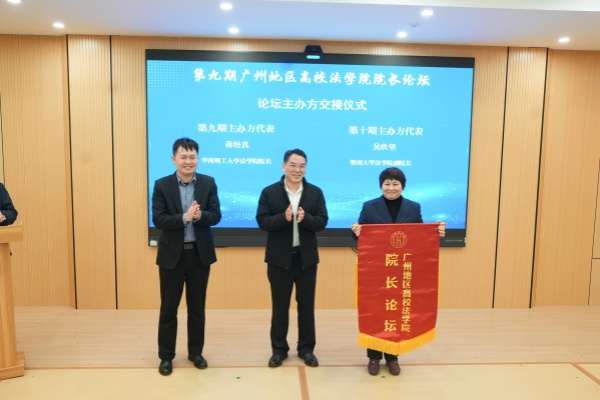
At the closing ceremony,Professor Zhang Yongzhong, Dean of the Law School of South China NormalUniversity, delivered a concluding speech, calling on all legal practitionersto actively embrace the transformation brought by legal artificialintelligence, deepen cross-industry cooperation, and jointly advance thedevelopment of legal artificial intelligence. The forum also specially arrangeda handover ceremony. Witnessed by Professor Lu Xiaoming, Vice President ofGuangdong University of Finance & Economics, the Law School of South ChinaUniversity of Technology, the host of this forum, passed the silk banner to theLaw School of Jinan University, the host of the next forum.
In addition, a specialexhibition area was set up at the forum to display the latest achievements ofour school’s Legal IntelligenceLaboratory in the field of legal artificial intelligence research, providingparticipants with an opportunity to intuitively understand the cutting-edgeprogress of legal technology.
This forum notonly provided a valuable platform for exchange between the legal and technologycommunities, but also created an opportunity for both sides to jointly addressthe challenges brought about by technological transformation.It aimed to fostercollaborative exploration of new opportunities and models for the legalprofession in the era of artificial intelligence, promoting the integration oflegal services with technological innovation. Ultimately, the forum seeks toempower the legal system through technology, enabling the law to better servesocial progress and sustainable development.