
Program Code: 080102 Duration: 4 years (Bachelor)
EducationalObjectives:
To cultivate advancedprofessionals who possess comprehensive development in morality, intelligence,physicality, aesthetics, and labor, and demonstrate profound potential andbroad development prospects in the field of mechanics and related sciences or engineering.Graduates should have a patriotic spirit, a strong sense of social mission andresponsibility, excellent scientific and humanistic literacy, a spirit ofseeking truth, innovation, and daring to strive, a solid foundation inmathematics, physics, and mechanics theory, and professional skills,outstanding innovative and practical abilities, an international perspective,and cross-cultural communication skills. They should be capable of engaging inbasic scientific research and advanced technology development in the fields ofmechanics, aerospace, advanced materials, intelligent manufacturing, civilengineering, and other related areas.
(1) Objective1: An ability to flexibly apply professional knowledge and skills such asmathematics, physics, and mechanics to solve key fundamental or core technicalproblems in engineering science.
(2) Objective2: An ability to play a leading role in the field of mechanics and relatedfields, adhere to lifelong learning, constantly update knowledge, and grasp thecutting-edge direction of basic research and engineering applications.
(3) Objective3: An ability to contribute to the socialist modernization endeavor, adhere toprofessional ethical standards, and gradually develop and improve theirabilities in cooperation, communication, and organizational managementthroughout their career development.
StudentOutcomes:
№1. Engineering Knowledge: Anability to use basic knowledge of mathematics, natural science, calculation andengineering as well as engineering expertise to develop solutions to complexengineering problems in mechanics and related fields.
№2. Problem Analysis: Anability to use the first principle of mathematics, natural science and engineeringscience to identify, formulate, study and analyze complex engineering problemsin mechanics and related fields.
№3. Design/Development ofSolutions: An ability to design creative solutions for complex engineeringproblems, and design systems, components or processes to meet identified needs,taking due account of social, cultural, resource, environmental, and otherfactors.
№4. Research: Based on scientificprinciples and using reasonable methods an ability to study complex mechanicalproblems, design experiments, analyze and interpret data, synthesizeinformation, and ultimately obtain effective conclusions that guide engineeringpractice.
№5. Use of Tools: An ability tocreate, select, and apply appropriate technologies, resources, and modernengineering and information technology tools to analyze, model, simulate, andpredict complex mechanical problems, while recognizing their limitations.
№6. Engineers and The World: Anability to analyze and evaluate the problems and achievements in the field ofmechanics, and recognize their mutual influence with social, economic,cultural, legal, and environmental factors.
№7. Morality and Ethics: Complywith national and international laws, have a sense of patriotism and socialresponsibility, adhere to professional ethics and behavioral norms, andpractice core socialist values.
№8. Individual and CollaborativeTeamwork: An ability to effectively play a role as an individual, member, orleader in solving scientific and engineering problems related to mechanics, andpromote good collaboration among teams with multidisciplinary backgrounds.
№9. Communication: An ability toeffectively communicate with colleagues in various fields in complex scientificresearch and engineering activities, including writing and understandingreports and design documents, presenting and accepting viewpoints, expressingor responding to instructions, and engaging in cross-regional and culturalexchanges.
№10. Project Management andFinance: An ability to correctly understand the amount of money in work, masterthe knowledge and skills of engineering management and economicdecision-making, and as a team member and leader, have a certain ability toorganize, coordinate, and manage projects.
№11. Continuous Lifelong Learning:In view of personal development, adhere to independent learning and Lifelonglearning, and adapt to new technologies that are constantly developing andemerging in mechanics and related fields.
RelationshipMatrix between Educational Objectives and Student Outcomes:
Educational Objectives Student Outcomes | Educational Objective 1 | Educational Objective 2 | Educational Objective 3 |
Student Outcome 1 | ● |
|
|
Student Outcome 2 | ● |
|
|
Student Outcome 3 | ● | ● |
|
Student Outcome 4 | ● | ● |
|
Student Outcome 5 | ● | ● |
|
Student Outcome 6 |
| ● | ● |
Student Outcome 7 |
| ● | ● |
Student Outcome 8 |
| ● | ● |
Student Outcome 9 |
|
| ● |
Student Outcome 10 |
|
| ● |
Student Outcome 11 |
| ● |
|
ProgramProfile:
The Engineering Mechanics programat South China University of Technology (SCUT) was established in the 1960s andflourished under the leadership of Professor Zhou Lü, a pioneer of compositemechanics in China. The program was authorized to confer Master’s degrees inthe first-level discipline of Mechanics in 2006, designated as a Key PriorityDiscipline of Guangdong Province in 2012, and granted Doctoraldegree-conferring authority in 2018. In 2020, it was selected for the NationalFirst-Class Undergraduate Major Construction Program. Currently, the programboasts a faculty of approximately 30 full-time teachers, including onerecipient of the National Science Fund for Distinguished Young Scholars, onerecipient of the National Excellent Young Scientists Fund (Overseas), and fourwinners of the Xu Zhilun Award for Outstanding Mechanics Teachers. Closelyfollowing the international frontiers of mechanics and aligning with thestrategic needs of the nation and the Guangdong-Hong Kong-Macao Greater BayArea, the program focuses on solving key mechanical issues in aerospace,advanced materials, smart manufacturing, healthcare, and civil transportation.It has become a vital base for talent cultivation, scientific research, andtechnical services in South China. Over the past five years, the program hasundertaken more than 30 national-level research projects and received one FirstPrize for Outstanding Scientific Research Outcomes from the Ministry ofEducation, alongside three provincial and ministerial-level Science andTechnology Awards. Furthermore, the Fundamental Mechanics Teaching Team wasrecognized as a Guangdong Provincial Teaching Team in 2014, and theMechanics of Materials course was named a National First-Class UndergraduateCourse in 2020. In the same period, students have earned one Excellent DoctoralDissertation Award from the Chinese Society of Theoretical and AppliedMechanics (CSTAM), three Xu Zhilun National Outstanding Mechanics StudentAwards, and over 40 honors in various academic contests, such as the NationalZhou Peiyuan Mechanics Competition.
ProgramFeatures:
(1) Toprovide students with systematic and solid professional education in mechanics,serving the strategic goals of national major engineering projects and modernindustrial intelligence, while implementing broad-based cultivation to supportdiversified student development.
(2) Toimplement an undergraduate mentorship system that leverages the diverseresearch interests of faculty to guide students in cutting-edge exploration,thereby cultivating their ability to solve complex scientific and engineeringproblems.
(3) To broaden students' international perspectives through the ambitiousinnovation of curriculum teaching and the organization of various domestic andinternational internships and exchange programs.
DegreeConferred: Bachelor of Engineering
CoreCourses:
TheoreticalMechanics, Mechanics of Materials, Structural Mechanics, Fluid Mechanics, Theoryof Elasticity, Plasticity Theory, Computational Mechanics, ExperimentalMechanics, Mechanics of Vibration, Equations of Mathematical Physics.
FeaturedCourses:
Freshman Seminars:Introduction to Mechanics; New Materials, New Structures, and New Projects:Applications of Mechanical Thinking
Introductory Courses onInnovation and Practice: Multi-disciplinary Engineering Practice in Mechanics
English-Taught Courses:Plasticity; Introduction to Aerospace and Flight Vehicles
Frontier Courses in theDiscipline: Computational Mechanics II
InterdisciplinaryCourses: Artificial Intelligence and Structural Optimization; Theory and Designof Unmanned Aerial Vehicles (UAVs)
Undergraduate-PostgraduateIntegrated Courses: Advanced Computational Mechanics; Impact Behavior ofMaterials and Structures; Damage Mechanics; Continuum Mechanics; ConstitutiveEquations of Engineering Materials; Advanced Experimental Mechanics
“Research-TeachingIntegration” Deep Learning Classrooms: Computational Mechanics II
Smart Courses(AI-Assisted Courses): Theoretical Mechanics I
University-EnterpriseCollaborative Courses: Introduction to Aerospace and Flight Vehicles
Innovative PracticeCourses: Training in Innovative Mechanical Thinking; Computational Mechanics II(Part of the “Three-Ones” Curriculum)
Specialized DesignCourses: Various Course Designs
Competition-EducationIntegrated Courses: Comprehensive Practice of Fundamental Mechanics;Comprehensive Intensive Training in Basic Mechanical Knowledge
Labor Education Courses:Engineering Training I; Professional Internship
Practical Studies &Research: Graduation Project (Thesis)
1. Registration Form of Curriculum Credits
1.1 Credits Registration Form
Course Category | Requirement | Credits | Academic Hours | Remarks | |||||||
General Basic Courses | Compulsory | 56 | 1072 |
| |||||||
General Education | 10 | 160 |
| ||||||||
Specialty Basic Courses | Compulsory | 34 | 552 |
| |||||||
Elective Courses | Elective | 20 | 320 |
| |||||||
Total | 120 | 2104 |
| ||||||||
Practice Training | Compulsory | 20 | 26 weeks |
| |||||||
Elective | 20 | 20 weeks |
| ||||||||
Credits Required for Graduation | 120 + 40 = 160 | ||||||||||
Suggested Credits for Each Semester | 1 | 2 | 3 | 4 | 5 | 6 | 7 | 8 | |||
25 | 26 | 24 | 23 | 20 | 18 | 12 | 12 | ||||
1.2 Category Registration Form
Academic Hours | Credits | ||||||||||
Total | Include | Include | Total | Include | Include | Include | |||||
Compulsory | Elective | Theory Course | Lab | Compulsory | Elective | Practice-concentrated Training | Theory Course Credits | Lab | Innovation and Entrepreneurship Education | ||
2104 | 1624 | 480 | 1561 | 543 | 160 | 120 | 40 | 40 | 96 | 24 | 12 |
2. CoursesSchedule
Course Category | Course No. | Course Title | C/E | Total Curriculum Hours | Credits | Semester | ||||
Class Hours | Theoretical class hours | Lab Hours | Practice Hours | Other Hours | ||||||
General Basic Courses | 031101661 | Ethics and Rule of Law | C | 40 | 36 |
|
| 4 | 2.5 | 1 |
031101371 | Skeleton of Chinese Modern History | 40 | 36 |
|
| 4 | 2.5 | 2 | ||
031101424 | Thought of Mao ZeDong and Theory of Socialism with Chinese Characteristics | 40 | 36 |
|
| 4 | 2.5 | 3 | ||
031101522 | Fundamentals of Marxism Principle | 40 | 36 |
|
| 4 | 2.5 | 4 | ||
031101761 | The Xi Jinping Thought on Socialism with Chinese Characteristics for a New Era | 48 | 36 |
|
| 12 | 3.0 | 6 | ||
031101331 | Analysis of the Situation & Policy | 64 | 64 |
|
|
| 2.0 | 1-8 | ||
044101383 | English for Academic Purposes (1) | 32 | 32 |
|
|
| 2.0 | 1 | ||
044102452 | English for Academic Purposes (2) | 32 | 32 |
|
|
| 2.0 | 2 | ||
084101181 | Introduction to Artificial Intelligence | 36 | 24 |
|
| 12 | 2.0 | 1 | ||
045102811 | Python Language Programming | 40 | 32 |
|
| 8 | 2.0 | 1 | ||
074106601 | Fundamentals of Design Expression | 64 | 54 | 10 |
|
| 3.0 | 1 | ||
040100051 | Calculus II (1) | 80 | 80 |
|
|
| 5.0 | 1 | ||
040100411 | Calculus II (2) | 80 | 80 |
|
|
| 5.0 | 2 | ||
040100401 | Linear Algebra & Analytic Geometry | 48 | 48 |
|
|
| 3.0 | 1 | ||
040100023 | Probability & Mathematical Statistics | 48 | 48 |
|
|
| 3.0 | 2 | ||
041100582 | General Physics I (1) | 64 | 64 |
|
|
| 4.0 | 2 | ||
041101391 | General Physics I (2) | 64 | 64 |
|
|
| 4.0 | 3 | ||
041100671 | Physics Experiment (1) | 32 |
| 32 |
|
| 1.0 | 3 | ||
041101051 | Physics Experiment (2) | 32 |
| 32 |
|
| 1.0 | 4 | ||
052100332 | Physical Education (1) | 36 |
|
|
| 36 | 1.0 | 1 | ||
052100012 | Physical Education (2) | 36 |
|
|
| 36 | 1.0 | 2 | ||
052100842 | Physical Education (3) | 36 |
|
|
| 36 | 1.0 | 3 | ||
052100062 | Physical Education (4) | 36 |
|
|
| 36 | 1.0 | 4 | ||
006100112 | Military Principle | 36 | 18 |
|
| 18 | 2.0 | 2 | ||
| General Education Courses:1.Select at least 3 courses from the following five: Critical Thinking, Logic and Thinking, Science and Technology & Humanities, Academic Writing, Communication and Interaction;2. Compulsorily choose 1 course from the Four Histories; 3. Complete 2 credits of Public Art General Education Courses. | E | 160 | 160 |
|
|
| 10.0 |
| |
Total | 1232 | 948 | 74 |
| 210 | 66.0 |
| |||
2.CoursesSchedule
Course Category | Course No. | Course Title | C/E | Total Curriculum Hours | Credits | Semester | ||||
Class Hours | Theoretical class hours | Lab Hours | Practice Hours | Other Hours | ||||||
Specialty Basic Courses | 033109241 | Frontiers in Intelligent Civil Engineering Systems | C | 32 | 32 |
|
|
| 2.0 | 1 |
033100983 | Theoretical Mechanics I | C | 64 | 64 |
|
|
| 4.0 | 3 | |
033106891 | Equations of Mathematical Physics | C | 32 | 32 |
|
|
| 2.0 | 3 | |
033108781 | Mechanics of Materials V | C | 64 | 64 |
|
|
| 4.0 | 4 | |
033101825 | Fluid Mechanics | C | 48 | 48 |
|
|
| 3.0 | 4 | |
033101781 | Theory of Elasticity | C | 64 | 64 |
|
|
| 4.0 | 5 | |
032101653 | Structural Mechanics | C | 64 | 64 |
|
|
| 4.0 | 5 | |
033102843 | Experimental Mechanics | C | 56 | 32 | 24 |
|
| 3.0 | 5 | |
033107871 | Computational Mechanics (1) | C | 48 | 36 | 12 |
|
| 3.0 | 6 | |
033102654 | Plasticity Theory | C | 40 | 40 |
|
|
| 2.5 | 6 | |
033101752 | Mechanics of Vibration | C | 40 | 40 |
|
|
| 2.5 | 6 | |
Total | C | 552 | 528 | 24 |
|
| 34.0 |
| ||
Elective Courses | Module 1: Freshman Seminar Courses (Choose 1 of 6, obtain 1.0 credits) | |||||||||
033108751 | Innovative material, structure and engineering: Applying mechanics thinking | E | 16 | 16 |
|
|
| 1.0 | 1 | |
033109881 | Smart transportation and sustainable development | E | 16 | 16 |
|
|
| 1.0 | 1 | |
033109941 | Digital design and intelligent construction frontiers | E | 16 | 16 |
|
|
| 1.0 | 1 | |
033109171 | Engineering management in the era of artificial intelligence | E | 16 | 16 |
|
|
| 1.0 | 1 | |
033109541 | Digital twin watersheds and future water conservancy | E | 16 | 16 |
|
|
| 1.0 | 1 | |
033109991 | Future urban science: intelligent design and sustainable systems | E | 16 | 16 |
|
|
| 1.0 | 1 | |
Module 2: Featured Elective Courses (Obtain 10.0 credits at least) | ||||||||||
033101762 | Numerical Analysis | E | 48 | 32 | 16 |
|
| 2.5 | 3 | |
033108771 | Introduction to Aerospace and Aircrafts | E | 32 | 24 |
| 8 |
| 1.5 | 3 | |
033106601 | Theory and Design of Unmanned Aerial Vehicle | E | 32 | 32 |
|
|
| 2.0 | 5 | |
033109291 | Mechanical Design of Materials and Structures under Extreme Conditions | E | 32 | 32 |
|
|
| 2.0 | 6 | |
033107912 | Artificial Intelligence and Structural Optimization | E | 32 | 32 |
|
|
| 2.0 | 6 | |
033100112 | Theory of Plates and Shells | E | 28 | 16 | 12 |
|
| 1.5 | 6 | |
033107872 | Computational Mechanics (2) | E | 32 | 32 |
|
|
| 2.0 | 7 | |
033108801 | Impact Behavior of Material and Structure | E | 32 | 26 | 6 |
|
| 1.5 | 7 | |
033108841 | Damage Mechanics | E | 32 | 32 |
|
|
| 2.0 | 7 | |
033108791 | Advanced Computational Mechanics | E | 32 | 32 |
|
|
| 2.0 | 7 | |
033108821 | Advanced Experimental Mechanics | E | 32 | 32 |
|
|
| 2.0 | 8 | |
033108861 | Continuum Mechanics | E | 32 | 32 |
|
|
| 2.0 | 8 | |
033108591 | Constitutive Relations of Engineering Materials | E | 32 | 32 |
|
|
| 2.0 | 8 | |
Module 3: General Elective Courses (Obtain 9.0 credits at least) | ||||||||||
040102651 | Complex Variable and Integral Transformation | E | 48 | 48 |
|
|
| 3.0 | 3 | |
033107751 | Digital Image Processing and Applications | E | 32 | 32 |
|
|
| 2.0 | 3 | |
033109031 | Civil & transportation laboratory safety | E | 32 |
| 32 |
|
| 1.0 | 3 | |
033107221 | Ocean-based renewable energy | E | 32 | 32 |
|
|
| 2.0 | 3 | |
033109711 | Operations Research Basics | E | 32 | 32 |
|
|
| 2.0 | 3 | |
033107891 | Introduction on Scientific Writing and Literature Retrieval | E | 16 | 16 |
|
|
| 1.0 | 4 | |
045100772 | C++ Programming Foundations | E | 40 | 32 |
|
| 8 | 2.0 | 4 | |
033107792 | Materials constructed design and construction | E | 32 | 32 |
|
|
| 2.0 | 4 | |
034101784 | Electrical Engineering and Electrontechnics I | E | 48 | 48 |
|
|
| 3.0 | 4 | |
024100141 | Experiment of Electrical Engineering and Electrontechnics | E | 24 |
| 24 |
|
| 1.0 | 5 | |
033108521 | Frontiers of academic and engineering innovation | E | 16 | 16 |
|
|
| 1.0 | 5 | |
033106711 | Remote Sensing and Geographic Information System | E | 36 | 32 | 4 |
|
| 2.0 | 5 | |
033108532 | Structural analysis principles and program fundamentals | E | 32 | 32 |
|
|
| 2.0 | 5 | |
033107581 | System Design and Development of Engineering Software | E | 32 | 32 |
|
|
| 2.0 | 5 | |
033109441 | Non-destructive testing and intelligent data analysis | E | 32 | 32 |
|
|
| 2.0 | 5 | |
033101571 | Structural model concepts and experiments | E | 20 | 8 | 12 |
|
| 1.0 | 6 | |
033108321 | Development and utilization of marine space | E | 32 | 32 |
|
|
| 2.0 | 6 | |
033108941 | Modern Engineering Surveying | E | 32 | 32 |
|
|
| 2.0 | 6 | |
033103104 | Engineering project management I | E | 32 | 32 |
|
|
| 2.0 | 6 | |
033109461 | Engineering economics I | E | 32 | 32 |
|
|
| 2.0 | 6 | |
033109471 | Engineering regulations & contracts I | E | 32 | 32 |
|
|
| 2.0 | 6 | |
037102783 | General chemistry | E | 32 | 32 |
|
|
| 2.0 | 7 | |
037101943 | General Chemistry Experiment | E | 16 |
| 16 |
|
| 0.5 | 8 | |
020100051 | Innovation Research Training | E | 32 |
|
|
| 32 | 2.0 | 7 | |
020100041 | Innovation Research Practice I | E | 32 |
|
|
| 32 | 2.0 | 7 | |
020100031 | Innovation Research Practice II | E | 32 |
|
|
| 32 | 2.0 | 7 | |
020100061 | Entrepreneurial Practice | E | 32 |
|
|
| 32 | 2.0 | 7 | |
Total |
| E | Minimum elective course credits required: 20 | |||||||
3.Practice-concentrated Training
Course No | Course Title | C/E | Total Curriculum Hours | Credits | Semester | |
Practice weeks | Lecture Hours | |||||
006100151 | Military Training | C | 2 weeks |
| 2.0 | 1 |
031101551 | Marxism Theory and Practice | C | 2 weeks |
| 2.0 | 3 |
030100702 | Engineering TrainingⅠ | C | 2 weeks |
| 2.0 | 4 |
033108851 | Comprehensive Practice of Fundamental Mechanics | C | 2 weeks |
| 2.0 | 4 |
033101884 | Internship | C | 2 weeks |
| 2.0 | 5 |
033100364 | Bachelor Thesis | C | 16 weeks |
| 10.0 | 8 |
033108741 | Mechanics Innovative Thinking Training | E | 2 weeks | 2 | 2.0 | 2 |
033108871 | Seminar and Practice on Equations of Mathematical Physics | E | 2 weeks | 4 | 2.0 | 3 |
033107952 | Course Design of Numerical Analysis | E | 2 weeks | 2 | 2.0 | 3 |
033107862 | Course Design of Introduction to Aerospace and Aircrafts | E | 2 weeks | 2 | 2.0 | 3 |
033107832 | Course Design of Fluid Mechanics | E | 2 weeks | 2 | 2.0 | 4 |
033103272 | General Intensive Training of The Fundamental Knowledge of Mechanics | E | 2 weeks | 8 | 2.0 | 5 |
033101702 | Course Design of Structural Mechanics | E | 2 weeks | 4 | 2.0 | 5 |
033108811 | Experiments and Simulation of Elasticity | E | 2 weeks | 14 | 2.0 | 5 |
033106592 | Course Design of the Theory and Design of Unmanned Aerial Vehicle | E | 2 weeks | 2 | 2.0 | 5 |
033107882 | Course Design of Computational Mechanics | E | 2 weeks | 4 | 2.0 | 6 |
033108891 | Experiments and Simulation of Plasticity | E | 2 weeks | 9 | 2.0 | 6 |
033108921 | Course Design of Vibration Mechanics | E | 2 weeks | 10 | 2.0 | 6 |
033107922 | Course Design of Artificial Intelligence and Structural Optimization | E | 2 weeks | 8 | 2.0 | 6 |
033108931 | Engineering Surveying Practice | E | 2 weeks |
| 2.0 | 6 |
033108901 | Programming Practice of Advanced Methods in Computational Mechanics | E | 2 weeks | 12 | 2.0 | 7 |
033108911 | Comprehensive Training in Mechanics Simulation | E | 2 weeks | 4 | 2.0 | 7 |
033108831 | Comprehensive Practice of Photomechanics | E | 2 weeks | 2 | 2.0 | 8 |
Total | C | 26 weeks | 89 | 20.0 |
| |
E | Minimum elective course credits required: 20 | |||||
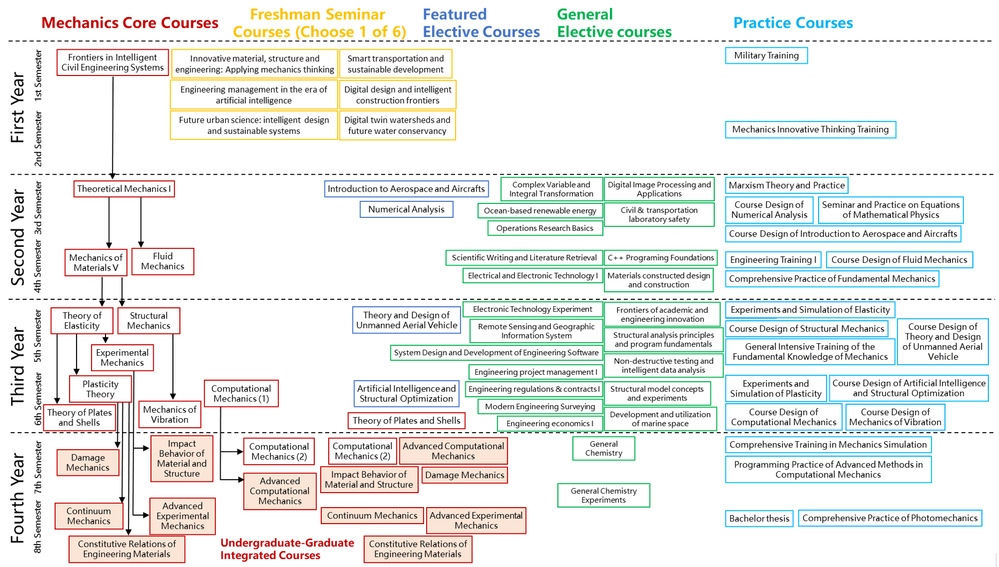
Course Topology Map
4.Relation Matrix between Curriculum System andStudent Outcomes
No. | Course | 1 | 2 | 3 | 4 | 5 | 6 | 7 | 8 | 9 | 10 | 11 |
1 | Ethics and Rule of Law |
|
|
|
|
|
| ● |
|
|
|
|
2 | The Xi Jinping Thought on Socialism with Chinese |
|
|
|
|
|
| ● |
|
|
|
|
3 | Thought of Mao ZeDong and Theory of Socialism with Chinese Characteristics |
|
|
|
|
|
| ● |
|
|
|
|
4 | Fundamentals of Marxism Principle |
|
|
|
|
|
| ● |
|
|
|
|
5 | Skeleton of Chinese Modern History |
|
|
|
|
|
| ● |
|
|
|
|
6 | Analysis of the Situation & Policy |
|
|
|
|
|
| ● |
|
|
|
|
7 | English for Academic Purposes (1) |
|
|
|
|
|
|
|
| ● |
|
|
8 | English for Academic Purposes (2) |
|
|
|
|
|
|
|
| ● |
|
|
9 | Introduction to Artificial Intelligence |
| ● | ● |
| ● |
|
|
|
|
|
|
10 | Python Language Programming |
| ● | ● |
| ● |
|
|
|
|
|
|
11 | Fundamentals of Design Expression |
|
|
|
| ● |
|
|
|
|
|
|
12 | General Physics I (1) | ● | ● |
|
|
|
|
|
|
|
|
|
13 | General Physics I (2) | ● | ● |
|
|
|
|
|
|
|
|
|
14 | Physics Experiment (1) |
| ● |
| ● |
|
|
|
|
|
|
|
15 | Physics Experiment (2) |
| ● |
| ● |
|
|
|
|
|
|
|
16 | Calculus II (1) | ● | ● |
|
|
|
|
|
|
|
|
|
17 | Calculus II (2) | ● | ● |
|
|
|
|
|
|
|
|
|
18 | Linear Algebra & Analytic Geometry | ● | ● |
|
|
|
|
|
|
|
|
|
19 | Probability & Mathematical Statistics | ● | ● |
|
|
|
|
|
|
|
|
|
20 | Physical Education (1) |
|
|
|
|
|
|
|
|
|
| ● |
21 | Physical Education (2) |
|
|
|
|
|
|
|
|
|
| ● |
22 | Physical Education (3) |
|
|
|
|
|
|
|
|
|
| ● |
23 | Physical Education (4) |
|
|
|
|
|
|
|
|
|
| ● |
24 | Military Principle |
|
|
|
|
|
| ● |
|
|
|
|
25 | Frontiers in Intelligent Civil Engineering Systems | ● | ● |
| ● |
|
|
|
|
|
|
|
26 | Theoretical Mechanics I | ● | ● |
|
|
|
|
|
|
|
|
|
27 | Equations of Mathematical Physics | ● | ● |
| ● |
|
|
|
|
|
|
|
28 | Mechanics of Materials V | ● | ● |
|
|
|
|
|
|
|
|
|
29 | Fluid Mechanics | ● | ● |
| ● |
|
|
|
|
|
|
|
30 | Theory of Elasticity | ● | ● |
| ● | ● |
|
|
|
|
|
|
31 | Structural Mechanics | ● | ● |
|
|
|
|
|
|
|
|
|
32 | Experimental Mechanics | ● | ● |
| ● | ● |
|
|
|
|
|
|
33 | Computational Mechanics (1) | ● | ● |
| ● | ● |
|
|
|
|
|
|
34 | Plasticity Theory | ● | ● |
| ● | ● |
|
|
|
|
|
|
35 | Mechanics of Vibration | ● | ● |
|
|
|
|
|
|
|
|
|
36 | Innovative material, structure and engineering: Applying mechanics thinking | ● | ● |
|
| ● |
|
|
|
|
|
|
37 | Smart transportation and sustainable development | ● |
| ● |
|
| ● |
|
|
|
| ● |
38 | Digital design and intelligent construction frontiers | ● | ● | ● |
|
| ● |
|
|
|
| ● |
39 | Engineering management in the era of artificial intelligence |
|
|
|
|
|
| ● | ● | ● | ● | ● |
40 | Digital twin watersheds and future water conservancy | ● |
| ● |
|
| ● |
|
|
|
| ● |
41 | Future urban science: intelligent design and sustainable systems | ● | ● | ● |
|
| ● |
|
|
|
| ● |
42 | Numerical Analysis | ● |
|
| ● | ● |
|
|
|
|
|
|
43 | Introduction to Aerospace and Aircrafts | ● | ● |
|
|
|
|
|
| ● |
|
|
44 | Theory and Design of Unmanned Aerial Vehicle | ● | ● | ● |
|
|
|
|
|
|
|
|
45 | Artificial Intelligence and Structural Optimization |
| ● |
| ● | ● |
|
|
|
|
|
|
46 | Mechanical Design of Materials and Structures under Extreme Conditions | ● | ● |
|
|
|
|
|
|
|
|
|
47 | Theory of Plates and Shells | ● | ● |
| ● |
|
|
|
|
|
|
|
48 | Computational Mechanics (2) | ● | ● |
| ● | ● |
|
|
|
|
|
|
49 | Impact Behavior of Material and Structure | ● | ● |
|
|
|
|
|
|
|
|
|
50 | Damage Mechanics | ● |
|
| ● |
|
|
|
|
|
|
|
51 | Advanced Computational Mechanics | ● | ● | ● | ● | ● |
|
|
|
|
|
|
52 | Advanced Experimental Mechanics | ● | ● |
| ● |
|
|
|
|
|
|
|
53 | Continuum Mechanics | ● | ● |
| ● |
|
|
|
|
|
|
|
54 | Constitutive Relations of Engineering Materials | ● | ● | ● | ● | ● |
|
|
|
|
|
|
55 | Complex Variable and Integral Transformation | ● | ● |
|
|
|
|
|
|
|
|
|
56 | Digital Image Processing and Applications | ● | ● |
|
| ● |
|
|
|
|
|
|
57 | Civil & transportation laboratory safety |
|
|
|
|
|
| ● |
| ● | ● |
|
58 | Ocean-based renewable energy | ● |
|
| ● | ● | ● |
|
|
|
|
|
59 | Operations Research Basics |
| ● | ● |
| ● |
|
|
|
|
|
|
60 | Introduction on Scientific Writing and Literature Retrieval |
|
|
|
| ● |
|
|
|
|
| ● |
61 | C++ Programming Foundations |
| ● | ● |
| ● |
|
|
|
|
|
|
62 | Materials constructed design and construction | ● | ● | ● |
| ● |
|
|
|
|
|
|
63 | Electrical Engineering and Electrontechnics I |
| ● |
|
| ● |
|
|
|
|
|
|
64 | Experiment of Electrical Engineering and Electrontechnics |
| ● |
|
|
|
|
|
|
|
|
|
65 | Frontiers of academic and engineering innovation | ● | ● |
|
|
| ● |
|
|
|
|
|
66 | Remote Sensing and Geographic Information System |
|
| ● |
| ● |
|
|
|
|
|
|
67 | Structural analysis principles and program fundamentals |
| ● | ● |
| ● |
|
|
|
|
|
|
68 | System Design and Development of Engineering Software |
|
| ● |
| ● |
|
|
|
|
|
|
69 | Non-destructive testing and intelligent data analysis |
| ● | ● |
| ● |
|
|
|
|
|
|
70 | Frontiers of academic and engineering innovation | ● | ● | ● |
| ● | ● | ● |
|
|
|
|
71 | Structural model concepts and experiments | ● | ● | ● |
| ● |
|
|
|
|
|
|
72 | Development and utilization of marine space |
| ● | ● |
| ● |
|
|
|
|
|
|
73 | Modern Engineering Surveying |
| ● | ● |
| ● |
|
|
|
|
|
|
74 | Engineering project management I |
|
|
|
|
| ● | ● | ● |
| ● |
|
75 | Engineering economics I |
|
|
|
|
| ● | ● | ● |
| ● |
|
76 | Engineering regulations & contracts I |
|
|
|
|
| ● | ● | ● |
| ● |
|
77 | General chemistry | ● | ● |
| ● |
|
|
|
|
|
|
|
78 | General Chemistry Experiment | ● |
| ● |
|
|
|
|
|
|
|
|
79 | Innovation Research Training |
|
|
| ● |
|
|
| ● | ● | ● |
|
80 | Innovation Research Practice I |
|
|
| ● |
|
|
| ● | ● | ● |
|
81 | Innovation Research Practice II |
|
|
| ● |
|
|
| ● | ● | ● |
|
82 | Entrepreneurial Practice |
|
|
|
|
|
|
| ● | ● | ● |
|
83 | Military Training |
|
|
|
|
|
| ● |
|
|
|
|
84 | Marxism Theory and Practice |
|
|
|
|
|
| ● |
|
|
|
|
85 | Engineering TrainingⅠ |
|
| ● |
| ● | ● |
|
|
|
|
|
86 | Comprehensive Practice of Fundamental Mechanics | ● | ● |
|
| ● |
|
|
|
|
|
|
87 | Internship |
|
|
|
| ● | ● |
| ● | ● |
|
|
88 | Bachelor Thesis |
|
| ● | ● | ● |
|
| ● | ● |
| ● |
89 | Mechanics Innovative Thinking Training | ● | ● |
| ● | ● |
|
|
|
|
|
|
90 | Seminar and Practice on Equations of Mathematical Physics | ● | ● |
| ● |
|
|
|
| ● |
|
|
91 | Course Design of Numerical Analysis |
|
| ● | ● | ● |
|
|
|
|
|
|
92 | Course Design of Introduction to Aerospace and Aircrafts |
|
| ● | ● | ● |
|
|
|
|
|
|
92 | Course Design of Fluid Mechanics |
|
| ● | ● | ● |
|
|
|
|
|
|
94 | General Intensive Training of The Fundamental Knowledge of Mechanics | ● | ● | ● | ● |
|
|
|
|
|
|
|
95 | Course Design of Structural Mechanics | ● | ● | ● | ● |
|
|
|
|
|
|
|
96 | Experiments and Simulation of Elasticity |
|
| ● | ● | ● |
|
|
|
|
|
|
97 | Course Design of the Theory and Design of Unmanned Aerial Vehicle |
|
| ● | ● | ● |
|
|
|
|
|
|
98 | Course Design of Computational Mechanics |
|
| ● | ● | ● |
|
|
|
|
|
|
99 | Experiments and Simulation of Plasticity |
|
| ● | ● | ● |
|
|
|
|
|
|
100 | Course Design of Vibration Mechanics | ● | ● |
| ● | ● |
|
|
| ● |
|
|
101 | Course Design of Artificial Intelligence and Structural Optimization |
|
| ● | ● | ● |
|
|
|
|
|
|
102 | Engineering Surveying Practice | ● | ● | ● |
|
|
|
|
|
|
|
|
103 | Programming Practice of Advanced Methods in Computational Mechanics | ● | ● | ● | ● | ● |
|
|
|
|
|
|
104 | Comprehensive Training in Mechanics Simulation | ● | ● |
| ● | ● |
|
|
|
|
|
|
105 | Comprehensive Practice of Photomechanics | ● | ● |
| ● | ● |
|
|
|
|
|
|
5.“Second Classroom” Activities
“Second Classroom” Activities are comprised of two parts, HumanitiesQuality Education and Innovative Ability Cultivation.
(1) Basic Requirements of Humanities Quality Education
Besides gaining course credits listed in one’s subject teachingcurriculum, a student is required to participate in extracurricular activitiesof Humanities Quality Education based on one’s interest, acquiring no less thanfive credits.The advanced undergraduates must complete one ofcourses of Humanities Quality Education which has seventy two class hours (it'sequivalent to one credit which belongs to Humanities Quality Education Creditof Extracurricular Class) offered by the College Physical Education TeachingGroup. Mental Health Education for College Students (2 credits) is opened invirtual third semester which belongs to Humanities Quality Education Credit ofExtracurricular Class.
(2) Basic Requirements of Innovative Ability Cultivation
Besides gaining course credits listed in one’s subject teachingcurriculum, a student is required to participate in any one of the followingactivities: National Undergraduate Training Programs for Innovation andEntrepreneurship, Guangdong Undergraduate Training Programs for Innovation andEntrepreneurship, Student Research Program (SRP), One-hundred-steps InnovativeProgram, or any other extracurricular activities of Innovative AbilityCultivation that last a certain period of time (e.g. subject contests, academic lectures), acquiring no less than four credits.