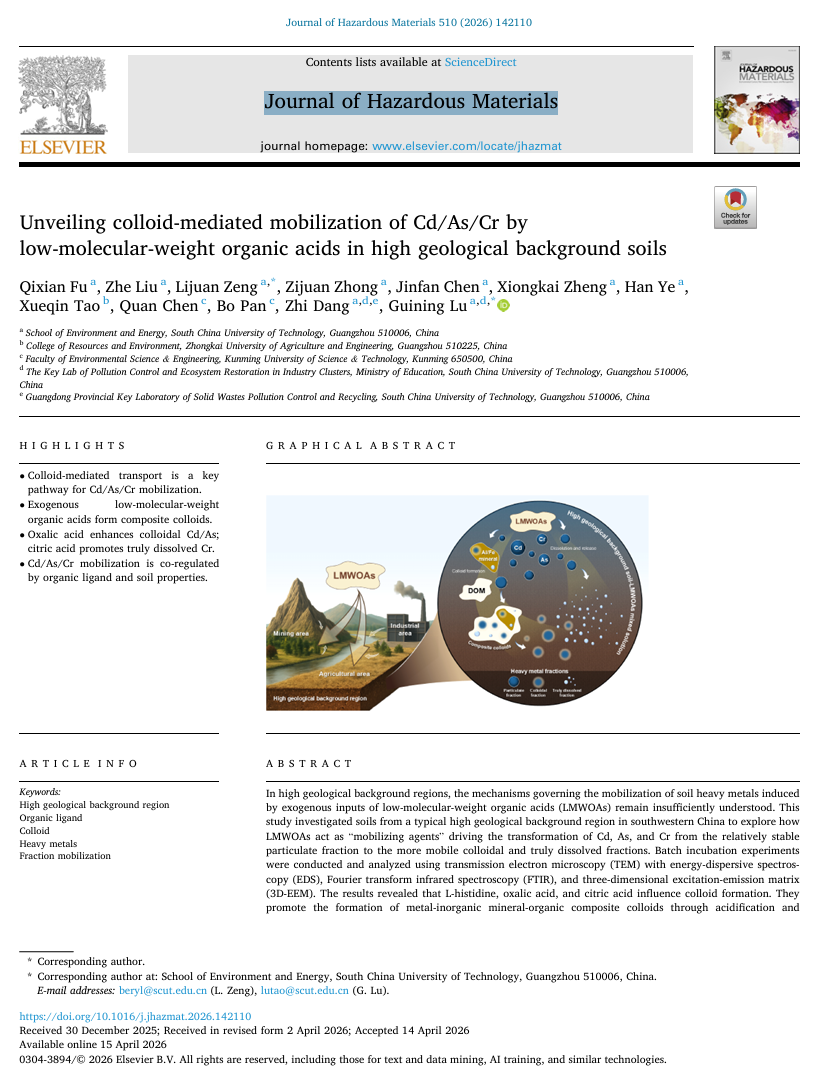
【题目】Unveiling colloid-mediated mobilization of Cd/As/Cr by low-molecular-weight organic acids in high geological background soils
【期刊】Journal of Hazardous Materials
【第一作者】符其娴
【摘要】In high geological background regions, the mechanisms governing the mobilization of soil heavy metals induced by exogenous inputs of low-molecular-weight organic acids (LMWOAs) remain insufficiently understood. This study investigated soils from a typical high geological background region in southwestern China to explore how LMWOAs act as “mobilizing agents” driving the transformation of Cd, As, and Cr from the relatively stable particulate fraction to the more mobile colloidal and truly dissolved fractions. Batch incubation experiments were conducted and analyzed using transmission electron microscopy (TEM) with energy-dispersive spectroscopy (EDS), Fourier transform infrared spectroscopy (FTIR), and three-dimensional excitation-emission matrix (3D-EEM). The results revealed that L-histidine, oxalic acid, and citric acid influence colloid formation. They promote the formation of metal-inorganic mineral-organic composite colloids through acidification and complexation processes. Colloid-mediated transport was identified as a key pathway for heavy metal mobilization in high geological background soils. Mobilization is co-regulated by soil physicochemical properties (e.g., pH and organic matter content) and LMWOA characteristics (e.g., functional groups and concentration), which jointly control metal redistribution among particulate, colloidal, and truly dissolved fractions. Among the tested acids, oxalic acid exhibited the most pronounced effect by promoting the release of low-molecular-weight dissolved organic matter and facilitating the formation of composite colloids, resulting in maximum colloidal proportions of Cd, As, and Cr reaching 28.75%, 11.53%, and 55.65%, respectively. These findings highlight the complex interactions between LMWOAs and soil properties and emphasize the importance of controlling exogenous inputs of mobilizing agents in high geological background regions affected by industrial and agricultural activities.
【文章链接】https://doi.org/10.1016/j.jhazmat.2026.142110