【标题】Transformation behaviors of polybrominated diphenyl ethers (PBDEs) in electronic waste during thermal dismantling processes: Effect mechanisms of coexisting metals
【期刊】Journal of Hazardous Materials
【第一作者】梁佳豪
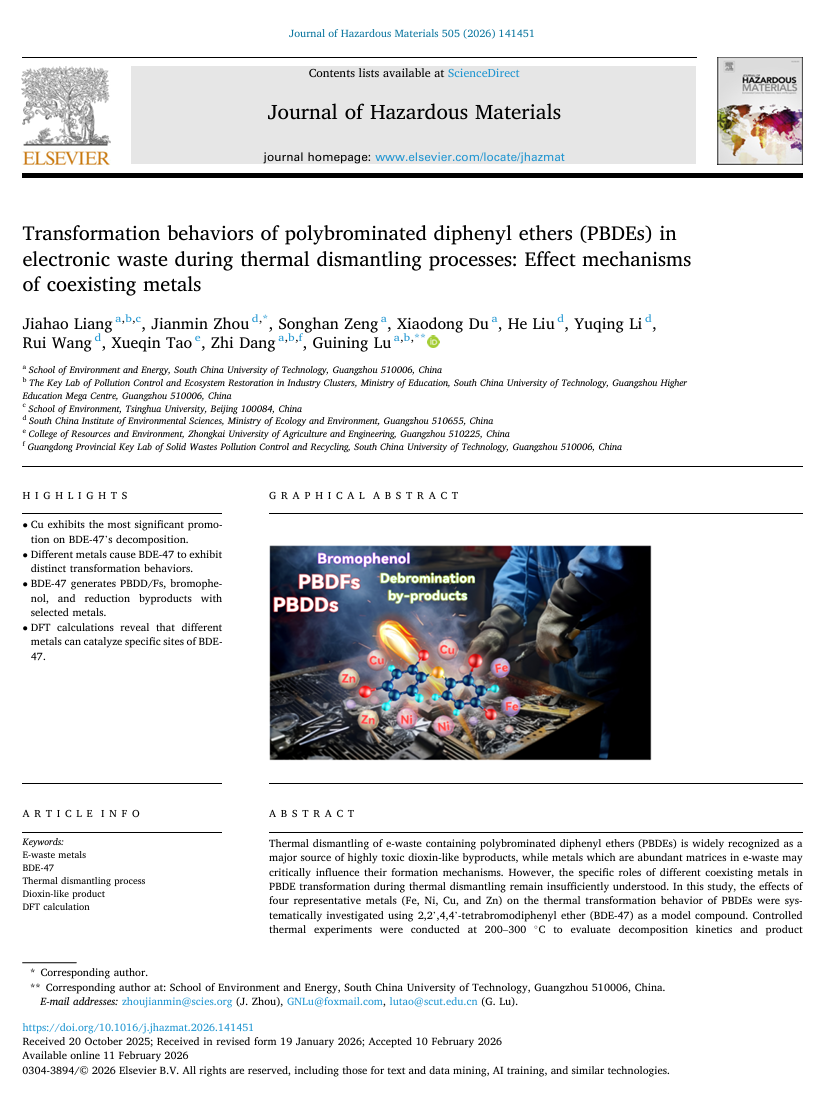
【摘要】Thermal dismantling of e-waste containing polybrominated diphenyl ethers (PBDEs) is widely recognized as a major source of highly toxic dioxin-like byproducts, while metals which are abundant matrices in e-waste may critically influence their formation mechanisms. However, the specific roles of different coexisting metals in PBDE transformation during thermal dismantling remain insufficiently understood. In this study, the effects of four representative metals (Fe, Ni, Cu, and Zn) on the thermal transformation behavior of PBDEs were systematically investigated using 2,2’,4,4’-tetrabromodiphenyl ether (BDE-47) as a model compound. Controlled thermal experiments were conducted at 200–300 °C to evaluate decomposition kinetics and product distributions. All investigated metals significantly accelerated the decomposition of BDE-47 to varying extents, with Cu exhibiting the strongest promotional effect, yielding rate constants of 20.832 h−1, 35.184 h−1, and 57.504 h−1 at 200, 250, and 300 °C, respectively. Three major categories of transformation products were identified across all metal systems: (1) tri-/tetra-brominated dibenzofurans (PBDFs) and di-/tri-brominated dibenzo-p-dioxins (PBDDs), (2) dibromophenols, and (3) debromination byproducts. Product distribution patterns indicate that Fe, Ni, Cu, and Zn preferentially interact with or catalytically activate ether bonds, ortho C–H/C–Br bonds, ortho C–Br bonds, and ortho C–H bonds of BDE-47, respectively. These observations are further supported by weak intermolecular interaction analyses based on density functional theory (DFT) calculations. Based on experimental results and theoretical analysis, the transformation pathways of BDE-47 in the presence of different metals were systematically proposed, demonstrating that metal-specific catalytic activation of distinct reactive sites governs the formation of diverse dioxin-like products during thermal dismantling. Overall, this study highlights the substantial risk of dioxin-like compound formation during thermal e-waste dismantling and provides mechanistic insights that are critical for environmental risk assessment and the development of safer e-waste treatment strategies.
【文章链接】https://doi.org/10.1016/j.jhazmat.2026.141451