【标题】Partition-Transformation Coupling Effect on Photolytic Detoxification of Polybrominated Diphenyl Ethers (PBDEs) Bonding with Polystyrene Microplastics: The Critical Role of Hydrogen Donor and Aryl on Mitigation of Polybrominated Dibenzofurans (PBDFs) Formation
【期刊】
【第一作者】张晨昱
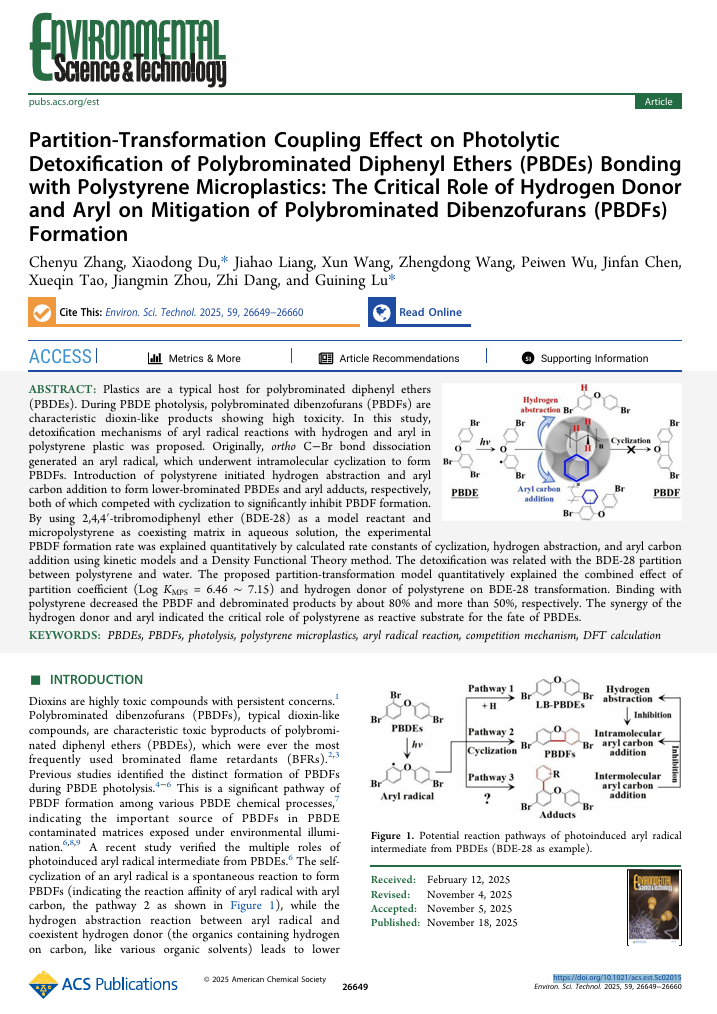
【摘要】 Plastics are a typical host for polybrominated diphenyl ethers (PBDEs). During PBDE photolysis, polybrominated dibenzofurans (PBDFs) are characteristic dioxin-like products showing high toxicity. In this study, detoxification mechanisms of aryl radical reactions with hydrogen and aryl in polystyrene plastic was proposed. Originally, ortho C-Br bond dissociation generated an aryl radical, which underwent intramolecular cyclization to form PBDFs. Introduction of polystyrene initiated hydrogen abstraction and aryl carbon addition to form lower-brominated PBDEs and aryl adducts, respectively, both of which competed with cyclization to significantly inhibit PBDF formation. By using 2,4,4 '-tribromodiphenyl ether (BDE-28) as a model reactant and micropolystyrene as coexisting matrix in aqueous solution, the experimental PBDF formation rate was explained quantitatively by calculated rate constants of cyclization, hydrogen abstraction, and aryl carbon addition using kinetic models and a Density Functional Theory method. The detoxification was related with the BDE-28 partition between polystyrene and water. The proposed partition-transformation model quantitatively explained the combined effect of partition coefficient (Log K MPS = 6.46 similar to 7.15) and hydrogen donor of polystyrene on BDE-28 transformation. Binding with polystyrene decreased the PBDF and debrominated products by about 80% and more than 50%, respectively. The synergy of the hydrogen donor and aryl indicated the critical role of polystyrene as reactive substrate for the fate of PBDEs.
【文章链接】https://doi.org/10.1021/acs.est.5c02015