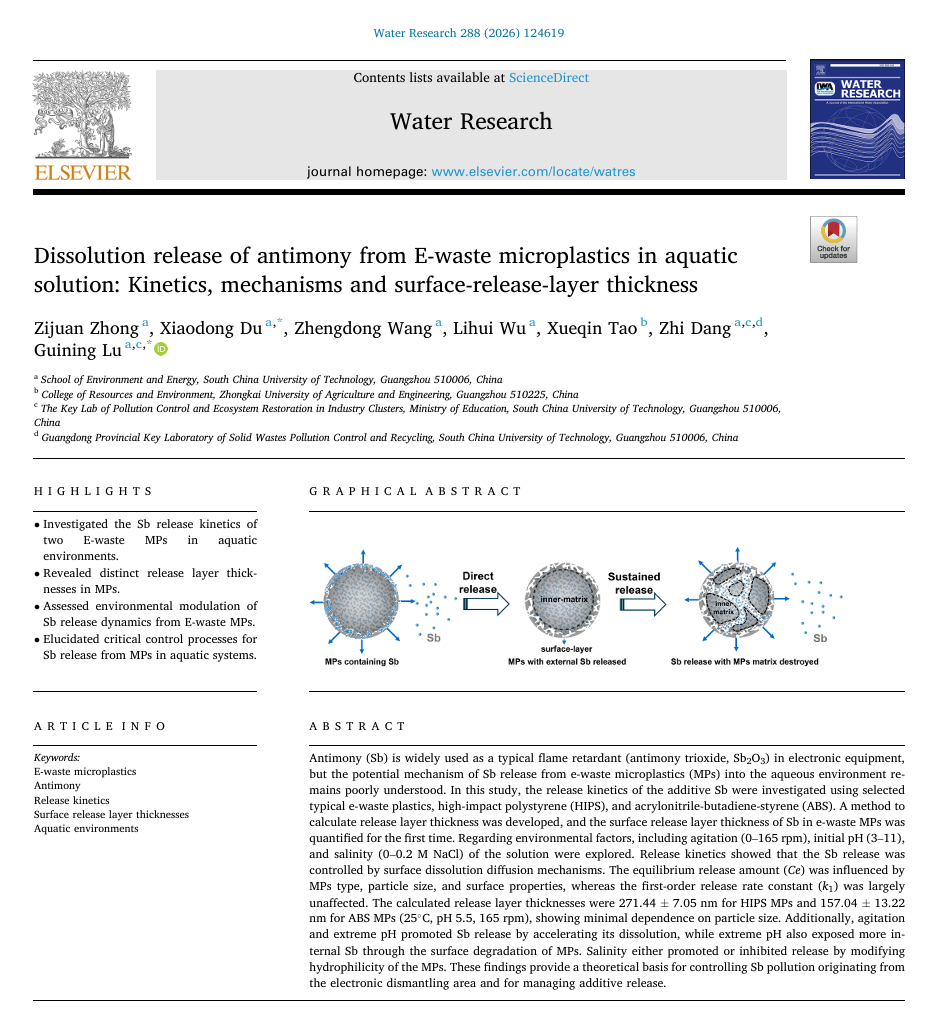
【标题】Dissolution release of antimony from E-waste microplastics in aquatic solution: Kinetics, mechanisms and surface-release-layer thickness
【期刊】Water Research
【第一作者】钟紫娟
【摘要】Antimony (Sb) is widely used as a typical flame retardant (antimony trioxide, Sb2O3) in electronic equipment, but the potential mechanism of Sb release from e-waste microplastics (MPs) into the aqueous environment remains poorly understood. In this study, the release kinetics of the additive Sb were investigated using selected typical e-waste plastics, high-impact polystyrene (HIPS), and acrylonitrile-butadiene-styrene (ABS). A method to calculate release layer thickness was developed, and the surface release layer thickness of Sb in e-waste MPs was quantified for the first time. Regarding environmental factors, including agitation (0–165 rpm), initial pH (3–11), and salinity (0–0.2 M NaCl) of the solution were explored. Release kinetics showed that the Sb release was controlled by surface dissolution diffusion mechanisms. The equilibrium release amount (Ce) was influenced by MPs type, particle size, and surface properties, whereas the first-order release rate constant (k1) was largely unaffected. The calculated release layer thicknesses were 271.44 ± 7.05 nm for HIPS MPs and 157.04 ± 13.22 nm for ABS MPs (25°C, pH 5.5, 165 rpm), showing minimal dependence on particle size. Additionally, agitation and extreme pH promoted Sb release by accelerating its dissolution, while extreme pH also exposed more internal Sb through the surface degradation of MPs. Salinity either promoted or inhibited release by modifying hydrophilicity of the MPs. These findings provide a theoretical basis for controlling Sb pollution originating from the electronic dismantling area and for managing additive release.
【文章链接】https://doi.org/10.1016/j.watres.2025.124619