【标题】Release mechanisms of decabromodiphenyl ether from typical e-waste microplastics into water: Insights from molecular dynamics simulations
【期刊】Journal of Hazardous Materials
【第一作者】汪正东
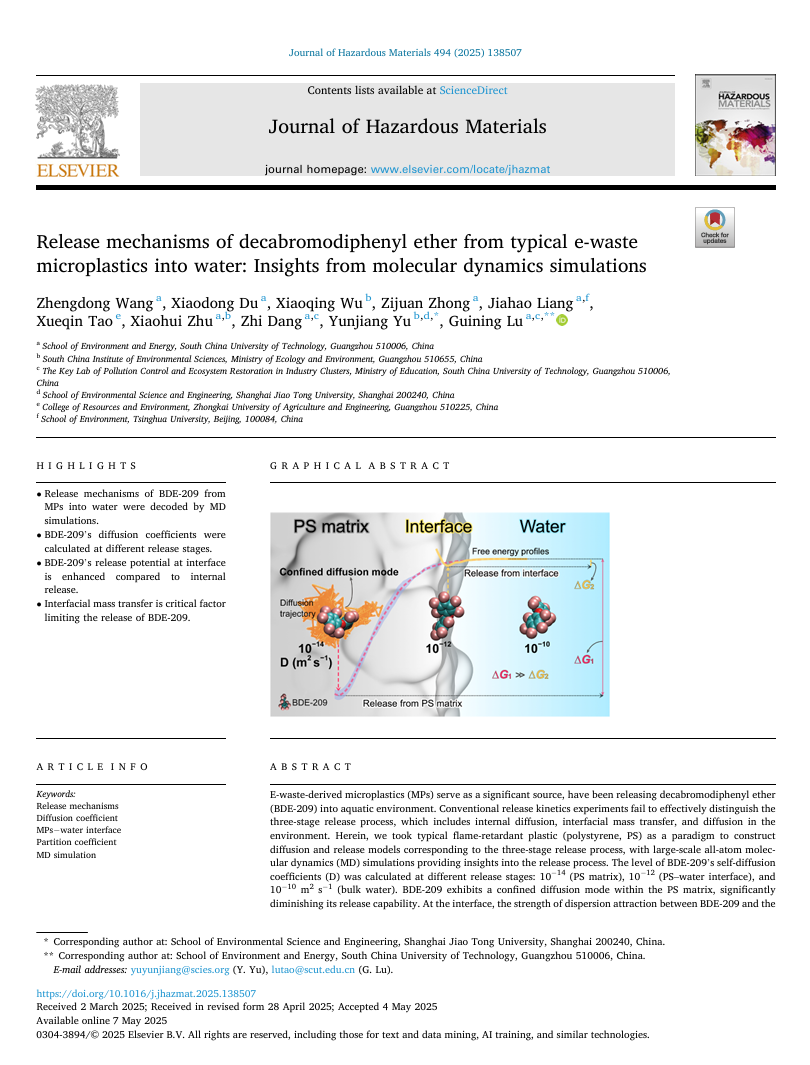
【摘要】E-waste-derived microplastics (MPs) serve as a significant source, have been releasing decabromodiphenyl ether (BDE-209) into aquatic environment. Conventional release kinetics experiments fail to effectively distinguish the three-stage release process, which includes internal diffusion, interfacial mass transfer, and diffusion in the environment. Herein, we took typical flame-retardant plastic (polystyrene, PS) as a paradigm to construct diffusion and release models corresponding to the three-stage release process, with large-scale all-atom molecular dynamics (MD) simulations providing insights into the release process. The level of BDE-209’s self-diffusion coefficients (D) was calculated at different release stages: 10−14 (PS matrix), 10−12 (PS–water interface), and 10−10 m2 s−1 (bulk water). BDE-209 exhibits a confined diffusion mode within the PS matrix, significantly diminishing its release capability. At the interface, the strength of dispersion attraction between BDE-209 and the PS surface determines the ease of its release and the partition equilibrium between the two phases. Our findings elucidated the molecular-scale dynamic and thermodynamic mechanisms governing BDE-209 release from MPs into water, expanding the understanding of polybrominated diphenyl ether release from e-waste-derived MPs. Moreover, our established MD simulation methods can be adapted to explore the release or adsorption mechanisms of various additives in different kinds of MPs.
【文章链接】https://doi.org/10.1016/j.jhazmat.2025.138507